

Fire truck financing is the set of methods departments use to pay for apparatus over time rather than in one payment. Most often that means a tax-exempt municipal lease-purchase, which spreads the cost across budget years at a lower rate than a commercial loan and usually ends with the department owning the truck outright.
Key Takeaways
- Roughly 90% of new and used fire trucks bought in the United States are financed in some form, according to Fire Apparatus Magazine. Cash purchases are the exception, not the rule.
- A tax-exempt municipal lease carries a lower rate because the lender pays no federal income tax on the interest, the same principle that makes municipal bonds cheap.
- A non-appropriation clause is what keeps a municipal lease from counting as debt, which is why it generally avoids a bond election in most states. Confirm your own state’s rules with your finance officer.
- On a used truck, set the term against the rig’s remaining service life, not against the longest term the lender will approve.
- Below roughly $40,000, financing costs can outweigh the cash-flow benefit. Sometimes the right answer is to pay for the truck.
How do fire departments pay for a fire truck?
Most of them borrow. Fire Apparatus Magazine reported in 2018 that around 90% of new and used fire trucks purchased in this country are financed in some manner, whether through a lease, a lease-purchase or a grant. A department paying cash from a capital reserve is unusual.
There are five routes, and they are not mutually exclusive:
| Route | What it is | Typical term | Best for |
|---|---|---|---|
| Cash / capital reserve | Paying outright from reserves | — | Departments with a funded reserve, or low-cost older units |
| Municipal lease-purchase | Tax-exempt lease ending in ownership | 2–15 years, 10 most common | Most departments buying apparatus |
| General obligation bond | Voter-approved public debt | 10–20 years | Large purchases, stations, multi-rig programs |
| Commercial loan | Conventional taxable financing | Varies | Departments not eligible for tax-exempt treatment |
| Grant funding | AFG or state programs | — | Partial funding, combined with one of the above |
Before any of it matters you need a truck and a number. It is worth working out what a used fire truck costs and looking at what is in stock before you approach a lender — you can browse the used fire trucks we have in stock and price a real unit rather than an estimate.
What is a municipal lease-purchase, and why is the rate lower?
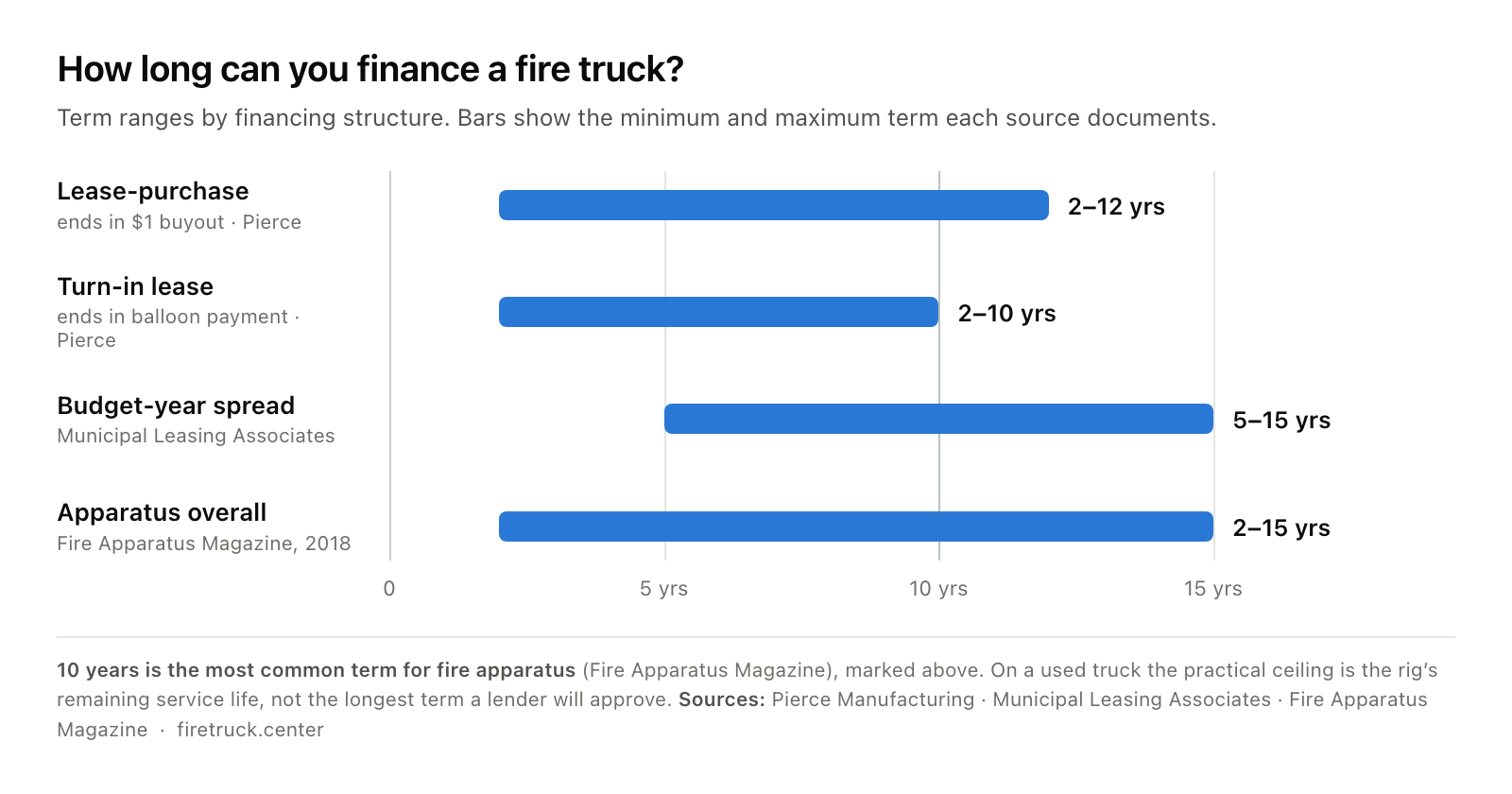
A municipal lease-purchase lets a public entity pay for apparatus across several budget years and take ownership at the end, usually for a nominal buyout. Pierce documents its lease-purchase at 2 to 12 years ending in “a one-dollar purchase option.”
The rate is lower for a specific reason, and it is worth understanding because it is the whole financial advantage. Interest a lender earns on a properly structured municipal lease is exempt from federal income tax, under the same tax treatment that lets municipal bonds carry tax-exempt rates. The lender is not taxed on that income, so it can write a lower rate. Municipal Leasing Associates puts it plainly: “The tax exemption, in this case, benefits the lender — and allows us to offer lower rates.”
That is the mechanism. It is not a discount anyone is granting the department out of goodwill, and it only holds if the lease is structured and documented properly, which is why this is a conversation for your finance officer rather than a form you fill in.
Terms vary by structure. Municipal Leasing Associates describes spreading apparatus payments across 5, 10 or 15 budget years. Fire Apparatus Magazine reports 10 years as the most common term for apparatus, within a 2 to 15 year range. A turn-in lease works differently: Pierce offers 2 to 10 years ending in a balloon payment set at the truck’s estimated resale value, which the department either pays to keep the rig or walks away from.
Does a fire truck lease need voter approval?
Generally no, in most states, and the reason is a single clause. A municipal lease contains a non-appropriation clause, which lets the governing body decline to appropriate funds for the lease in any future fiscal year. NCL Government Capital describes the practical effect: “In the event the agency does not include the lease payments in the budget, the agency can elect to return the equipment and cancel the lease without penalty.”
That clause is not a courtesy. It is what keeps the lease from being classified as debt. The Equipment Leasing and Finance Association, the industry’s trade body, explains that the clause ensures the lease “is not deemed to be ‘an instrument of debt’” and warns that a lease reclassified as debt could be “deemed void or voidable.” ELFA also notes that courts examine any attempt to restrict that right closely: “there can be no compulsion to appropriate, such as economic or moral influences.”
Because the obligation is annual rather than multi-year debt, it typically sits outside the bond-election process that a general obligation bond requires. Two cautions. This varies by state, and “most states” is not “your state” — confirm it with your finance officer or counsel before you plan around it. And the clause cuts both ways: the same provision that spares you a referendum also means the lender can take the truck back if a future council declines to fund the payment.
Know the number before you talk to a lender
Browse Fire Truck Center’s current inventory — pumpers, aerials, tankers and brush trucks. Every unit inspected, certified and individually priced.
What changes when you finance a used fire truck?
Two things, and neither is covered by the manufacturers and lenders who dominate this topic.
A 10 or 15 year lease makes sense on a new pumper with 20 to 25 years of service ahead of it. Put that same term on a 20-year-old unit and you are still making payments on a truck you have already retired. Set the term against remaining service life. If a rig has 10 good years in it, a 10-year lease is the ceiling rather than the starting point, and a shorter term on a lower balance is usually affordable anyway.
The lender’s security is the truck itself, which means the paperwork that protects you also protects them. A unit with a current third-party NFPA pump test, a current aerial certification where applicable, and a documented inspection history is a materially stronger collateral position than an as-is auction purchase with no records. Every truck we sell goes through a 150-point inspection with third-party pump testing and aerial certification, and that file is as useful in a financing conversation as it is on the apparatus floor.
A used truck also changes the numbers underneath the decision. The same Fire Apparatus Magazine piece quoted a dealer contrasting “a new aerial apparatus will run $1 million” with “a used aerial will cost $300,000.” Financing a third of the amount over a term that matches the asset is a different proposition from financing the whole thing over fifteen years. If you are still weighing a new build against a used truck, the financing difference belongs in that comparison.
How do financing and an AFG grant work together?
They are complements, not alternatives. FEMA’s Assistance to Firefighters Grant program funds what it calls critically needed resources for fire departments, and a grant award rarely covers an entire apparatus purchase. The common structure is a grant covering part of the cost with the balance financed.
The sequencing matters more than most departments expect. Grant cycles run on their own calendar and awards are not guaranteed, while apparatus availability moves independently. A used truck that suits you today may be gone by the time an award lands, and lead times on new versus used apparatus differ by years rather than weeks. That argues for knowing your financing position before the grant decision rather than after, so an award accelerates a plan already in place instead of starting one.
When is financing the wrong call?
When the financing costs more than the flexibility is worth. This is the part nobody selling a loan will tell you.
We carry sound older units in the $20,000 to $40,000 range, and sub-$100,000 apparatus is a normal part of the inventory. On a $900,000 new pumper, spreading cost across budget years is obviously right — very few departments have that in reserve. On a $30,000 truck, origination costs and interest on a small balance can add up to more than the benefit of not paying it at once, particularly for a department that could cover it from a reserve or across two budget years.
Two things worth doing before you finance anything. Get a trade-in valued. Retiring apparatus has real value and reduces the balance you need to finance at all, which is often the cheapest money in the transaction.
And compare the total cost of the lease against paying outright, not just the monthly payment against your budget line. A payment that fits is not the same as a purchase that makes sense.
Financing is a tool for matching a large cost to a budget that arrives annually. Where that is the problem, it works well. Where it is not, it is an expense.
Frequently asked questions about fire truck financing
Can a volunteer fire department get fire truck financing?
Yes. Volunteer and combination departments finance apparatus regularly, and many qualify for tax-exempt municipal lease treatment either directly or through their municipality or fire district. Eligibility turns on the entity’s public status rather than on whether the firefighters are paid. Your finance officer or the lender can confirm how your department is classified.
What credit does a fire department need to finance a truck?
Lenders look at the entity’s financial position and payment history rather than a personal credit score. A department with clean financials, current audits and no outstanding legal issues generally has a straightforward time of it. The truck itself is the collateral, so documented condition and certification strengthen the application.
How long can you finance a fire truck?
Terms generally run from 2 to 15 years, with 10 years the most common for apparatus. On a used truck the practical limit is the rig’s remaining service life rather than the lender’s maximum term, and financing a truck past its retirement is the most common structuring mistake.
Is a fire truck lease considered debt?
Usually not. A municipal lease includes a non-appropriation clause that lets the governing body decline to fund the payment in a future budget year, and that provision is what keeps the lease from being classified as an instrument of debt. Because it is not debt, it generally avoids the bond election a general obligation bond would require, though this varies by state.
Can you finance a used fire truck, or only a new one?
Used apparatus is financed routinely. The Fire Apparatus Magazine figure of roughly 90% financed covers new and used alike. What changes on a used truck is the term, which should match remaining service life, and the weight the lender puts on inspection and certification records, since the truck is the security.
Talk to us about financing a truck you have seen
Fire Truck Center has been selling quality-tested used fire apparatus since 2015 from 1991 Hartel Ave, Levittown, PA 19057, with hundreds of trucks delivered across 49 states. Every truck gets a 150-point inspection and a 30-day satisfaction guarantee, and we work with lenders that specialize in emergency vehicles.
Find the truck first, then structure the payment. Tell us the apparatus type and the budget you are working with and we will tell you honestly what is in stock, what it would take in trade, and whether financing it is worth doing. Call (215) 559-9119 or email help@firetruck.center.
Sources
- Equipment Leasing and Finance Association — Municipal Leasing 201: Non-Appropriation and Mitigation (July/August/September 2022)
- FEMA — Assistance to Firefighters Grants
- Pierce Manufacturing — Fire Truck Leasing Purchase Programs
- Municipal Leasing Associates — Fire Truck Leasing
- Fire Apparatus Magazine — Leasing Fire Trucks Gaining Greater Popularity (2018)
- NCL Government Capital — What is a non-appropriation clause?

 CALL US NOW