


A dry hydrant is a non-pressurized pipe permanently installed in a pond, lake or stream, with a fire department connection at the roadside. An engine hooks up its hard suction hose and drafts water by suction, the same way it would from an open pond, without anyone wading in. It gives a rural district a hydrant where there are no water mains.
Key Takeaways
- A dry hydrant has no pressure. Your pump does all the work, so the hydrant is only as good as the truck drafting from it.
- The federal design standard, NRCS Code 432, allows up to 15 feet of static lift in drought. Fire pumps are rated at 10 feet.
- ISO treats a qualifying dry hydrant like a standard hydrant, if it delivers 250 gpm for two hours, year-round.
- It only improves the rating for properties within 1,000 feet of it, inside five road miles of a station.
- Before you buy a used pumper or tender for a dry-hydrant district, ask for a pump test run at draft.
What is a dry hydrant?
A dry hydrant is a permanent suction pipe that runs from below the waterline of a pond, lake or stream to a capped connection beside a road or pull-off. The USDA Natural Resources Conservation Service defines it as “a nonpressurized permanent pipe assembly installed to permit withdrawal of water by suction from a water source.” It holds no water under pressure, which is why it’s called dry.
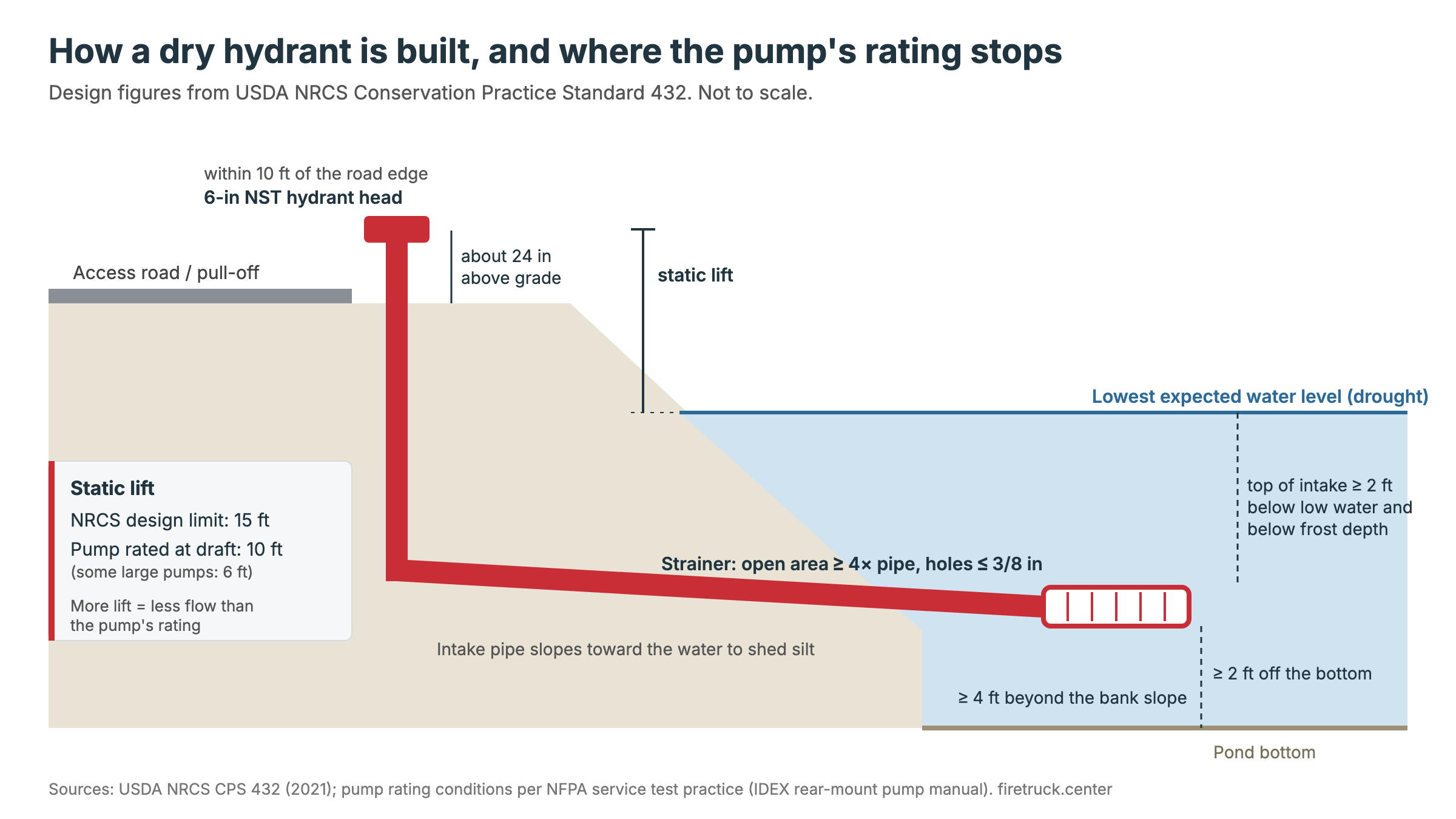
A typical installation has four parts. A strainer sits underwater at the far end. A buried intake pipe, usually PVC, slopes back toward the bank.
A riser comes up about 24 inches above grade. A hydrant head on top takes a 6-inch National Standard Thread connection, so an engine’s suction hose couples straight on.
It is not a dry-barrel hydrant. The hydrants on town water mains in cold climates are called dry-barrel because the barrel drains between uses so it won’t freeze. Those are pressurized. NRCS Code 432 tells installers in plain terms not to use conventional dry-barrel hydrants for this job.
Why do rural departments depend on dry hydrants?
Rural departments depend on dry hydrants because they turn a fill site into a hose connection. Without one, filling a tanker from a pond means finding firm ground, laying out hard suction, getting a strainer into enough water, and priming, often in the dark. With one, the crew pulls up, uncaps the head and couples on.
That time shows up in every trip. A tanker shuttle is a loop: dump at the fire, drive to water, fill, drive back. Fill time is one leg of that loop, and the arithmetic in our guide to sizing a water tender by its round trip shows how much one slow leg costs in sustained gallons per minute.
Union County, North Carolina reported that its dry hydrant at Cane Creek Lake lets a typical 3,000-gallon tanker fill in less than six minutes. That only helps if the tanker has a pump or a connection that can use it. A self-filling tender, one with its own pump plumbed to draft, can fill at the hydrant without an engine standing by. If your district is planning dry hydrants, look at used tankers and tenders that can draft and fill themselves at the same time.
How does a dry hydrant affect your ISO rating?
A dry hydrant can count as a creditable water supply in the ISO Public Protection Classification, the rating insurers use to price property coverage. Verisk, which runs ISO, says the Fire Suppression Rating Schedule recognizes dry hydrants and suction points and treats them the same way it treats standard fire hydrants. Water supply carries 40% of a community’s classification.
The bar is specific. The supply must be available 365 days a year. It must deliver 250 gpm for two hours, starting within five minutes of the first apparatus arriving. That is the minimum for a Class 8 or better.
Three conditions catch departments out:
- Drought. ISO may ask for certification of the water available during a 50-year drought cycle, signed by a state-certified professional. A pond that’s full in April doesn’t count if it’s a mud flat in a dry August.
- Distance. In a split classification, the better class applies to properties within five road miles of a recognized station and within 1,000 feet of a hydrant or alternate supply. A dry hydrant on the far side of the district does nothing for the homes near the station.
- Proof. The hydrant has to be tested and maintained, and the records kept. An untested pipe is a pipe, not a water supply.
What does the standard say a dry hydrant must deliver?
NRCS Conservation Practice Standard 432 sets the federal design numbers. For fire suppression it requires at least 30,000 gallons of pumpable water, or a flow of at least 250 gpm without interruption for two hours. Design is based on no more than 15 feet of total static lift at low water during drought.
| Item | NRCS Code 432 requirement |
|---|---|
| Water available | 30,000 gal pumpable, or 250 gpm for 2 hours without interruption |
| Design lift | Not over 15 ft total static lift at drought low water |
| Intake depth | Top of intake at least 2 ft below lowest water and 2 ft below frost-free depth, whichever is deeper |
| Strainer position | At least 2 ft above the pool bottom, at least 4 ft beyond the earth slope |
| Strainer open area | At least 4 times the pipe’s cross-section, holes no larger than 3/8 in |
| Hydrant head | Accepts a 6-inch National Standard Thread connection |
| Connection height | About 24 in above ground, never higher than the truck’s intake |
| Distance from road | Pump connection within 10 ft of the access road or pull-off |
| Testing | Fire department pump test at design capacity after installation, then annually at maximum design flow |
NRCS also calls for an all-weather access road, reflective marking, and inspection every spring and fall with a back-flush to clear silt from the screen. Where the riser could freeze, it points to the insulated collar method in NFPA 1142, the standard on water supplies for suburban and rural firefighting.
Why can a good dry hydrant still fail on the fireground?
A dry hydrant built exactly to standard can still underdeliver, because the pump is rated at less lift than the pipe was designed for. NRCS designs to as much as 15 feet of static lift in drought. Fire pumps are rated at draft at 10 feet of lift through 20 feet of suction hose, and IDEX’s rear-mount pump manual notes that larger pumps are rated at 6 feet.
Output drops as lift climbs. A drafting handout from the Russellville, Arkansas fire department puts the flow at 20 feet of lift at about 60% of rated capacity. Fire Apparatus Magazine gives a rule of thumb that a pump rated at 10 feet can reach roughly 26 to 27 feet of lift at about 50% of its rating. Somewhere between those, on a dry summer evening, your 1,250 gpm pump is a smaller pump.
Altitude takes more. The NFPA rating already assumes 2,000 feet of elevation, which Fire Apparatus Magazine equates to about 2.38 feet of extra lift. Above that, performance falls below the rating. A suction lay longer than 20 feet costs flow too.
Then there’s the water side:
- Silt and growth. A clogged screen starves the pump. That’s why the standard calls for back-flushing and clearing aquatic growth.
- Ice. Intakes go below frost depth, but the riser and head still need protection in hard winters.
- Low water. Pump manuals ask for two feet or more of water over the strainer. Drought takes that away first.
None of that is an argument against dry hydrants. It’s an argument for knowing your worst-case lift at each one, and buying trucks that can pull from it.
What should you check on a used truck that will draft from dry hydrants?
Ask for a pump test performed at draft, not from a hydrant, and read the sheet. The annual pump service test is allowed to run from a pressurized hydrant, and a truck that tests well on hydrant pressure has never proven it can lift water. Our breakdown of what a fire truck pump test does and does not prove covers the full test sequence.
For a dry-hydrant district, check these on any used pumper or self-filling tender:
- Test location. The performance test sheet should say draft, with the lift recorded. A hydrant test tells you less.
- Priming time. A sound pump primes in about 30 seconds at 1,250 gpm or below, and about 45 seconds for larger pumps. Time it yourself.
- Suction hose and intake size. Fire Apparatus Magazine recommends 6-inch suction hose on any pump of 500 gpm or more. A 1,500 to 2,000 gpm pump may need two 6-inch suction lines to reach capacity at draft.
- Strainer and hard suction on the truck. Check that both are there, that gaskets are present and soft, and that the coupling threads match your hydrant heads.
- Intake height. NRCS says the hydrant connection must never sit higher than the truck’s intake. Measure your trucks’ intakes against your installed heads.
- Rated lift. Find the pump’s data plate or manufacturer rating. If your worst hydrant sits near 15 feet, ask the pump maker for performance at that lift.

At Fire Truck Center, every pump test is run by an independent tester, not by us. In our founder’s words, “All tests are performed by a third party — one of the two major testing companies in the area.” Ask us for the sheet on any unit, and ask whether it was run at draft. Browse used pumpers with documented pump tests with that question in hand.
Who pays for a dry hydrant?
Most dry hydrants are funded through state forestry or fire programs, often with federal money behind them, and installed on private land with the owner’s written approval. The truck that uses it comes out of your apparatus budget, so plan both together.
A few examples of how states handle it:
- Virginia. The Department of Forestry and the Department of Fire Programs fund 100% of new installations and repairs. Departments apply on Form 4.30, and the deadline is March 31 each year.
- Maryland. The Maryland Forest Service used federal grant money to install 114 new dry hydrants across the state.
- Missouri. State law, RSMo 320.273, directs the state fire marshal and the Department of Conservation to run a dry hydrant technical assistance program for rural fire departments and fire protection districts.
The USDA’s NRCS also treats the dry hydrant as a conservation practice, Code 432, so your county’s NRCS or soil and water conservation district office is a good first call. They can help with site design, water yield and permits.
Frequently asked questions
Is a dry hydrant the same as a dry-barrel hydrant?
No. A dry hydrant is a non-pressurized suction pipe in a pond, lake or stream that an engine drafts from. A dry-barrel hydrant is a pressurized hydrant on a water main whose barrel drains between uses to prevent freezing.
How deep does a dry hydrant pipe go?
Under NRCS Code 432, the top of the intake sits at least 2 feet below the lowest expected water level and at least 2 feet below the local frost-free depth, whichever is deeper. The strainer is held at least 2 feet off the bottom to keep it out of silt.
How much water does a dry hydrant need to count for ISO?
ISO requires the supply to deliver 250 gpm for two hours, every day of the year, starting within five minutes of the first apparatus arriving. NRCS designs to the same flow, or at least 30,000 gallons of pumpable water.
What size connection does a dry hydrant use?
The NRCS standard calls for a hydrant head that accepts a 6-inch National Standard Thread connection, with a cap that comes off without tools. Confirm your suction hose couplings match before you need them.
How often should a dry hydrant be tested?
NRCS calls for a fire department pump test at the maximum design flow at least once a year, after back-flushing the system. The hydrant should also be inspected each spring and fall to clear silt and growth from the screen.
Can a dry hydrant freeze?
The intake is set below frost depth so the pipe below ground stays open. The riser above ground can freeze in hard winters, which is why the standard calls for mounded soil or an insulated collar on the standpipe.
Talk to us about trucks that draft from your water points
Fire Truck Center has been selling quality-tested used fire apparatus since 2015, to departments across the United States. Every unit goes through a 150-point inspection, pump tests are run by an independent tester, and every sale carries a 30-day satisfaction guarantee.
If your district drafts from ponds or dry hydrants and you need a pumper or tender that can do it, call us at (215) 559-9119 or email help@firetruck.center. Tell us your worst-case lift and we’ll tell you which trucks on our lot fit.
Sources
- USDA Natural Resources Conservation Service — Conservation Practice Standard: Dry Hydrant, Code 432 (July 2021)
- Verisk ISO Mitigation — Alternative Water Supplies
- Verisk ISO Mitigation — Water Supply Evaluations
- City of Nolanville, Texas — ISO Public Protection Classification Summary Report (July 2021)
- Fire Apparatus Magazine — Water Delivery System Design (May 2009)
- IDEX / Hale Products — Rear Mount Pumps Operating and Maintenance Manual
- UL Solutions — NFPA 1911 Pump Testing (June 2023)
- Russellville Fire Department, Arkansas — Drafting
- Virginia Department of Forestry — Dry Hydrant Program
- Maryland Department of Natural Resources — Dry Hydrants (August 2022)
- Missouri Revisor of Statutes — Section 320.273, Dry hydrant technical assistance program
- Union County, North Carolina — New Dry Hydrant Is Operational at Cane Creek Lake (July 2022)

 CALL US NOW