


The right water tender size is the one that sustains your required fire flow over your real round trip to water. A water tender, or tanker, is a fire apparatus built to haul water to scenes without hydrants. Its useful output isn’t gallons but gallons per minute delivered over a complete cycle: dump, drive, fill, drive back.
Key Takeaways
- Buy sustained flow, not gallons. Tank volume divided by full cycle time is the number that matters.
- ISO credits the weakest link in your water chain, not your biggest tank.
- Under about three miles to water, a smaller truck with a fast dump beats a bigger truck with a slow one.
- NFPA 1142’s own formula writes off 10% of a gravity tender’s tank before the arithmetic starts.
- The dump rate printed on a listing has been tested by nobody — there is no required test method.
What size water tender do you need?
Size a tender by the flow it holds up over a full shuttle cycle, then buy enough trucks to reach the flow your rating and your fires demand. The arithmetic is tank volume divided by the time one truck takes to dump, drive to water, fill, and drive back. Multiply by 0.9 if it’s a conventional gravity truck, because some of the load never comes out fast enough to count.
That formula isn’t ours. NFPA 1142 publishes it in its annex material as continuous flow capability, equation C.10a:
Q = ( V ÷ ( A + T1 + T2 + B ) ) × k
V is tank volume in gallons. A is the time to pull into the dump site, offload into a portable tank, and pull clear. T1 and T2 are the two travel legs, and B is the same maneuver at the fill site.
That leaves k, a coefficient for the part of the tank you can’t use: 1.0 for vacuum apparatus, 0.9 for every other water tender.
Travel time has its own published formula, and it’s the same one the insurance rating uses: T = 0.65 + 1.7D, where D is one-way miles. That assumes a 35 mph planning speed, with the 0.65 covering acceleration and braking. Before you shop, drive the route to your draft site and time it. Then look at the used tankers and water tenders we have in stock with a flow target in hand rather than a gallon figure.
Why is tank size the wrong number to shop on?
Because the rating that your residents pay for credits the smallest capacity in the chain, and your tank is only one link. The Fire Suppression Rating Schedule says it plainly: fire department supply is the capacity of the source, the capacity of the source pumping equipment, the capacity of the delivery apparatus, or the capacity of the final delivery pump, whichever is least.
Buy a 4,000-gallon tender and draft from a pond that yields 200 gpm, and you’re credited for 200 gpm. The tank did nothing. ISO lists ten things it weighs for shuttle credit — fire-site pump capacity, drop-tank capacities, four separate distances, discharge rate, fill rate, source yield and set-up times. Amount of water carried is one item out of ten.
Here’s what that looks like with two real-world trucks. Tender A carries 3,000 gallons, dumps out the back through an elbow adapter the crew has to fit, and fills through one port. Tender B carries 2,000 gallons, dumps through a straight chute the driver opens from the cab, and fills through two ports. Tender A takes 12.7 minutes a cycle in handling alone; Tender B takes 5.0.
| One-way haul to water | Tender A — 3,000 gal, slow dump and fill | Tender B — 2,000 gal, fast dump and fill | Delivers more |
|---|---|---|---|
| 1 mile | 155 gpm | 186 gpm | the 2,000-gallon truck |
| 2 miles | 130 gpm | 137 gpm | the 2,000-gallon truck |
| 3 miles | 112 gpm | 109 gpm | the 3,000-gallon truck |
| 5 miles | 87 gpm | 77 gpm | the 3,000-gallon truck |
| 8 miles | 66 gpm | 54 gpm | the 3,000-gallon truck |
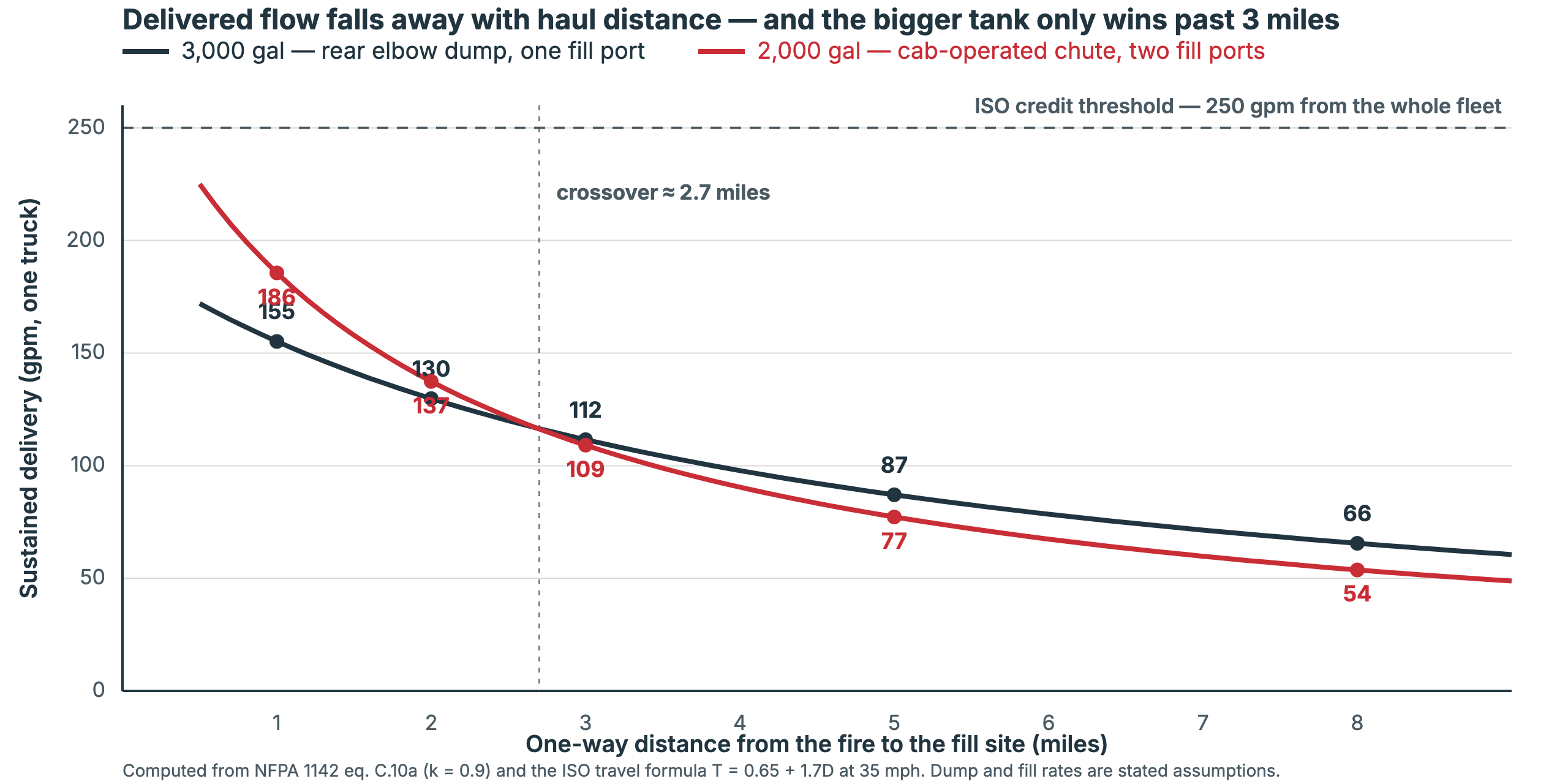
The crossover sits near 2.7 miles. Close to water, hardware wins and the thousand extra gallons are dead weight. Past three miles, travel swamps everything and the only lever left is how much each trip carries. Those dump and fill rates are our stated assumptions for the example, not measurements of a specific truck — run the same arithmetic with your own timings.
Two honest notes on that table. Neither truck reaches 250 gpm by itself at any distance shown, so sizing a tender means sizing a fleet. And if Tender B were a vacuum unit, its k rises to 1.0 and the one-mile figure goes from 186 to 206 gpm.
How much water does your department have to move?
If you want a Public Protection Classification of Class 8 or better without hydrants, you need 250 gpm for two hours, flowing within five minutes of the first-due apparatus arriving, held without interruption, available 365 days a year. Water supply carries 40 of the points in the whole classification.
There’s a lower rung. A department with strong service but no qualifying supply can reach Class 8B by delivering 200 gpm for 20 minutes — 4,000 gallons — on the initial alarm to every reported structure fire, again starting inside five minutes. Class 9 asks only for an apparatus with a pump rated at 250 gpm at 150 psi and a 200-gallon tank.
Five minutes is the number that hurts. A 2021 National Fire Academy study modeled shuttle throughput across a rural Ohio township with 34 surveyed tenders and found 250 gpm arriving at 23.1 minutes on average, and 500 gpm at 24.1. That’s a real district with real trucks, roughly 18 minutes behind the standard its insurance rating is scored against.
Needed fire flow for a single building runs from 500 gpm to 12,000 gpm depending on its size, construction, occupancy and exposure. Work out the flow your worst realistic building needs before you shop. If you’re still choosing between apparatus classes, start with deciding between a pumper and a tanker, and for a plain breakdown of how much water each class of apparatus carries, we’ve covered that separately.
What do the water tender classes commit to?
The federal typing standard describes a tender with four specs, and one of them is a clock. NWCG’s PMS 200 types support tenders by tank, pump flow, rated pressure and a maximum refill time — strong evidence that gallons alone were never enough to define the truck.
| Requirement | Support Type 1 | Support Type 2 | Support Type 3 | Tactical Type 1 | Tactical Type 2 |
|---|---|---|---|---|---|
| Tank capacity (gal) | 4,000 | 2,500 | 1,000 | 2,000 | 1,000 |
| Pump minimum flow (gpm) | 300 | 200 | 200 | 250 | 250 |
| At rated pressure (psi) | 50 | 50 | 50 | 150 | 150 |
| Maximum refill time (minutes) | 30 | 20 | 15 | N/A | N/A |
| Pump and roll | No | No | No | Yes | Yes |
| Personnel (minimum) | 1 | 1 | 1 | 2 | 2 |
Support tenders haul. Tactical tenders haul and fight fire, which is why they carry pump-and-roll, a higher rated pressure and a second crew member. A Type 2 water tender in the support column is a 2,500-gallon truck that has to refill inside 20 minutes; in the tactical column it’s a 2,000-gallon truck that can flow while moving.
Divide each capacity by its refill limit and you get the slowest average fill the class tolerates: roughly 133 gpm for Support Type 1, 125 for Type 2, 67 for Type 3. That arithmetic is ours, not NWCG’s. It sits far below the 1,000 gpm fill connection NFPA specifies for structural apparatus, because the two documents answer different questions — one types a wildland resource, the other builds a fire truck.
Which hardware on the truck sets your flow ceiling?
The dump arrangement first, the fill connection second. Those two pieces of steel decide most of your cycle time, and both are visible in a walkaround.
The 2021 study surveyed 34 tenders and sorted their dump valves by how much time each configuration added to every trip:
| Dump arrangement | Share of the fleet | Time added per trip |
|---|---|---|
| Straight chute, operated remotely from the cab | 8.8% | 0.0 min |
| Straight chute, manual operation by ground crew | 11.8% | 0.3 min |
| Angled chute that stays attached while driving | 23.5% | 0.6 min |
| Rear-dump only, needs an elbow that can’t stay on | 55.9% | 1.2 min |
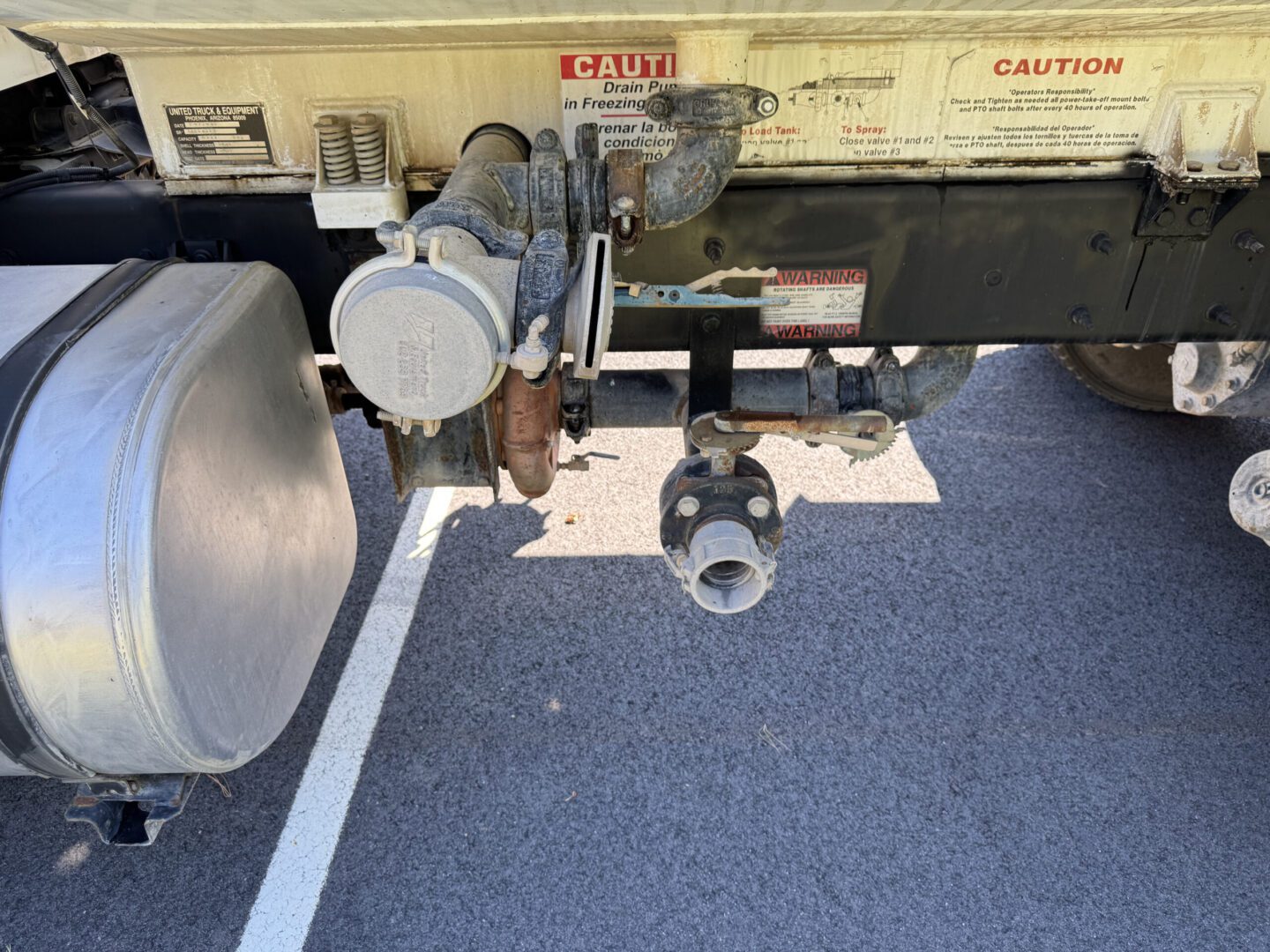
Most of the fleet had the slowest option. Over a two-hour ISO run at a ten-minute cycle, 1.2 minutes a trip costs you more than a full extra round trip. A cab-operated straight chute costs nothing and was fitted to fewer than one truck in ten.
Fill ports matter nearly as much, and about half the surveyed trucks had only one usable connection. Tank material sets a hard limit too. The two main poly tank manufacturers both cap fill at 1,000 gpm and 100 psi at the inlet on tanks of 1,000 gallons or more, and going past either can damage the tank and void its warranty.
The 2016 edition of NFPA 1901 required a direct tank fill capable of a minimum 1,000 gpm. So on a poly-tank tender the standard’s floor and the tank’s ceiling are the same number, and NFPA 1901 says nothing about fill pressure. Those standards now sit inside NFPA 1900, which consolidated the automotive fire apparatus documents.
One more thing worth knowing about gravity trucks: the discharge rate falls as the tank drains and head pressure drops. That’s why NFPA 1142 discounts a tenth of the load. A vacuum tender pushes its water out under pressure, so the rate stays flat and the standard counts the whole tank.
What should you check on a used tender before you buy?
Check the four numbers no listing prints: real dump time, real fill time, usable capacity against rated capacity, and portable tank capacity against the tender’s own load. A listing gives you gallons and a year. None of the figures that set your delivered flow appear on it.
Start with this:
- Time an actual dump. The 2016 NFPA 1901 spec said a tender must pass 90% of its tank through any transfer outlet at no less than 1,000 gpm. The standard supplied no test method, and the voluntary volumetric procedure in NFPA 1142 is not in general use by manufacturers or departments. Nobody has certified the number — so get it timed with water in the tank.
- Time a fill, through the ports the truck has. One port or two changes the answer, and so does the adapter you own.
- Look at how the dump chute travels. If it needs an elbow fitted on scene, you’re buying 1.2 minutes per trip for the life of the truck.
- Check for a poly tank warning label. No standard requires one, and a fill crew that overpressurizes an unlabeled poly tank can damage it.
- Measure the portable tank against the truck. Drop-tank capacity should take a full load. In the surveyed fleet it was often well short.
- Do the weight arithmetic. Water runs 8.34 lb per gallon, so 3,000 gallons is 25,020 lb before chassis, body, pump, crew or equipment.
- Pull the pump records. A tender with a 500 gpm or better pump can nurse at the dump site; two-thirds of the surveyed fleet could.
Every truck we sell goes through a 150-point inspection and a pump test before it’s listed, and we’ll time a dump and a fill for you on request. If budget is the open question, we have written up what a used tanker costs and how fast you can get one and a broader used fire truck price guide.
Frequently asked questions
How many gallons of water do fire department tankers usually carry?
Most fire service water tenders carry between 1,000 and 4,000 gallons, with 2,000 to 3,000 the common range on the used market. Federal typing sets support tender classes at 4,000, 2,500 and 1,000 gallons and tactical classes at 2,000 and 1,000.
What is a Type 2 water tender?
A Type 2 water tender under NWCG typing is a 2,500-gallon support tender with a pump flowing at least 200 gpm at 50 psi and a maximum refill time of 20 minutes. A Type 2 tactical tender is different: 2,000 gallons, 250 gpm at 150 psi, with pump-and-roll capability and a two-person minimum crew.
What is the difference between a tanker and a water tender?
They are the same apparatus under two names. Structural fire departments generally say tanker, while wildland and federal agencies say water tender to avoid confusion with aircraft. NFPA calls the class mobile water supply apparatus.
How many gallons does a water tender need for an ISO rating?
ISO sets no gallon figure for a tender. It requires 250 gpm delivered for two hours, starting within five minutes of the first-due apparatus, for a Class 8 or better without hydrants. Gallons only matter through the flow they produce across your round trip.
How fast should a water tender dump its tank?
The 2016 edition of NFPA 1901 required a mobile water supply apparatus to discharge at least 90% of its tank through any transfer outlet at 1,000 gpm or more. Gravity trucks slow down as the tank empties, so time a real dump rather than trusting the rating.
Can one water tender meet the ISO 250 gpm requirement on its own?
Rarely. A 3,000-gallon tender on a two-mile haul sustains roughly 130 gpm by the published formula, so two trucks are needed to clear 250 gpm, and three at five miles. Plan the fleet, not the single purchase.
Talk to us about matching a tender to your water supply
Fire Truck Center has been selling quality-tested used fire apparatus since 2015. Every unit gets a 150-point inspection and a pump test before it goes on the lot, we deliver nationwide, and we back the sale with a 30-day satisfaction guarantee. Most departments have a truck in service in weeks, not years.
If you know your haul distance and your fill site yield, send us both and we’ll tell you which tank size in stock meets your flow and which one would be money spent on gallons you can’t move. Call (215) 559-9119 or email help@firetruck.center.
Sources
- ISO (Verisk) — Water Supply Evaluations (accessed 2026)
- ISO (Verisk) — Alternative Water Supplies (accessed 2026)
- Insurance Services Office — Fire Suppression Rating Schedule (2012)
- U.S. Fire Administration, National Fire Academy — Keller, Planning for Water Shuttle Operations (2021)
- NWCG — Equipment, PMS 200 (reviewed 2024)
- NWCG — Water Handling Equipment Guide, PMS 447-1
- NFPA — Calculating the Required Fire Flow (2022)
- Fire Engineering — Naylis, Moving Water: Shuttle Operations (2026)
- Firehouse — Water Shuttle Operations

 CALL US NOW