

Which fire truck type you need is decided by four things about your department, not by the truck: your water supply, your staffing, your building stock, and your call mix. Apply them in that order and most of the catalogue eliminates itself before you look at a single unit.
That order is the part most buying guides skip. They list the types side by side as though the choice were a matter of taste. It isn’t. Three of those four inputs have published numbers attached, and those numbers decide the answer for you.
This page is the decision, not the dictionary. If you want to know what a quint or a water tender is before you start, read our guide to what each apparatus type is and does and come back. If you already know the types and need to work out which one your district can justify, start here, then see the used fire trucks we have in stock right now.
Key Takeaways
- Work the four inputs in order: water supply, staffing, building stock, call mix. Budget comes last, because it changes which unit you buy inside a type, not which type you need.
- No hydrants means your water supply is apparatus. ISO credits a tanker shuttle only at 250 gallons per minute sustained for two hours, which is 30,000 gallons of water moved.
- The pumper/tanker line is a number, not an opinion. A tank of 1,749 gallons or less with a pump of 750 gpm or more is a pumper. At 1,750 gallons it is a tanker whatever the pump does.
- Staffing decides one rig or two. A straight aerial carries no pump, so it commits you to crewing a pumper beside it on every structural response.
- NFPA 1710 and NFPA 1720 no longer exist as separate standards. Both were folded into NFPA 1750, whose 2026 edition took effect 9 December 2025.
Which fire truck type do you need?
Start with the four inputs, in the order below, and stop as soon as one of them rules out the type you had in mind. Water supply goes first because it is the only input that can remove an entire category from your list before you compare a single specification.
| What is true of your district | Rules in | Rules out | The threshold that settles it |
|---|---|---|---|
| Hydrants throughout the response area | Pumper, rescue pumper | A dedicated tanker | Needed Fire Flow for your buildings runs 500 to 12,000 gpm at 20 psi residual |
| No hydrant system anywhere | Pumper plus a tanker or water tender | Covering it with one rig | 250 gpm held for 2 hours, available within 5 minutes of first-due arrival |
| Hydrants in the borough, none in the township | A pumper-tanker, or a pumper plus a tender | — | Cross 1,750 gallons of tank and the unit is classified a tanker |
| Typical turnout is fewer than six firefighters | Quint, rescue pumper, mini pumper | A straight aerial that needs its own pumper | Every rig you add is a rig you have to staff on every call |
| Nothing taller than two storeys | Pumper, rescue pumper | An aerial | Reach is set by what you must get over the top of |
| Three storeys or larger commercial buildings | Aerial or quint | — | Classification breaks at 94/95 ft for ladders and 85/86 ft for platforms |
| Mostly medical and rescue runs | Rescue pumper | A second plain engine | 50% or more full-height, full-depth compartments makes it a rescue pumper |
| One truck for both wildland and structural work | Mini pumper, also called initial attack | An NFPA 1906 brush truck | A brush truck pump tops out at 500 gpm |
Budget is deliberately absent from that table. A tight budget changes the year, the hours and the brand you end up with. It does not change whether your township needs to haul its own water.
What does your water supply decide?
If your district has no hydrant system, your water supply is apparatus rather than infrastructure, and the insurance arithmetic is specific about what that apparatus has to deliver. ISO’s Fire Suppression Rating Schedule puts 40 of a community’s grading points on water supply, and a Public Protection Classification of Class 8 or better requires at least 250 gallons per minute for two hours on top of the community’s maximum daily consumption.
A tanker shuttle counts toward that. The conditions are that the water is available within five minutes of the first-due apparatus arriving, and that the flow holds without interruption for the full two hours.
Run the number before you shop, because it is arithmetic a committee can do in an afternoon. Two hours at 250 gallons per minute is 30,000 gallons of water that has to arrive at the fire. A single 3,000-gallon tender on a 15-minute round trip averages 200 gallons per minute, so it misses the mark on its own. Two of them clear it with room to spare.
That calculation is usually the moment a department stops asking whether it wants a tanker. Good used tankers and water tenders are the hardest category on the market to source, so once the number says you need one, start looking early. Our founder puts it plainly: finding tanker trucks is always difficult, and there are not many on the market these days.
Departments with strong service and no water to back it up are not stuck, either. ISO has a Class 8B rating for exactly that situation.
Where is the line between a pumper and a tanker?
The line is a published number rather than a judgement call. A unit with a tank of 1,749 gallons or less and a pump rated 750 gpm or more is classified a pumper. At 1,750 gallons it becomes a tanker no matter how good the pump is. In the band between 1,000 and 1,749 gallons, the pump rating decides: 750 gpm or better and it is a pumper, below that and it is a tanker.
Those thresholds come from FAMA’s apparatus definitions, the reporting standard the manufacturers themselves write to. They are referenced to NFPA 1901, whose content now lives in NFPA 1900 following the consolidation of the apparatus standards. If you are unsure which document governs the truck you are looking at, we have written up which NFPA standard applies to your apparatus.
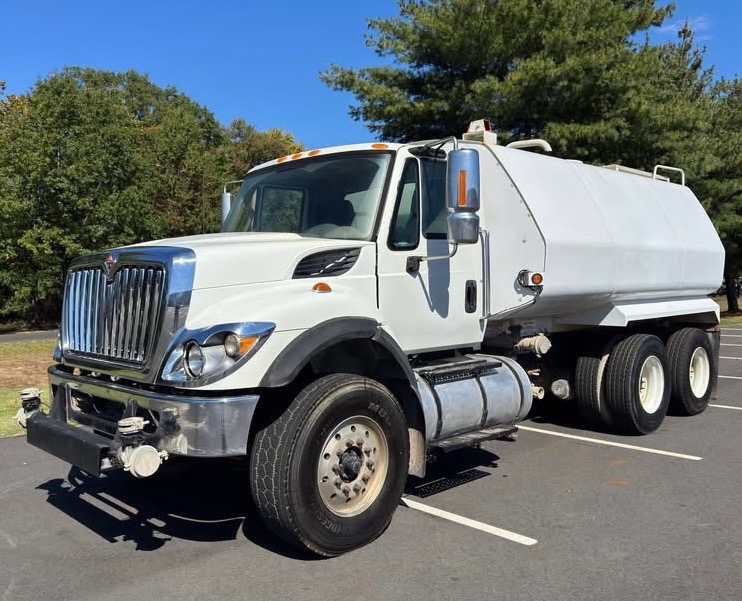
This matters at the paperwork stage more than people expect. A department that asks us for “a tanker with a decent pump” is usually describing a pumper-tanker, and the title, the spec sheet and the ISO credit will all call it a pumper. Nothing is wrong with buying one. You should know which word your district is going to have to defend in a grant application.
Two more boundaries in the same set are worth memorising, because you can check both from a listing:
Half or more in full-height, full-depth configuration makes it a rescue pumper. Below half, it is a pumper with good storage.
A pump with 300 gallons or more behind it is a rescue pumper. Under 300 gallons and it is classified special service.
Both checks apply to the used pumpers and rescue pumpers in anyone’s inventory, including ours.
Worked out your type? See what is on the lot.
Pumpers, aerials, tankers, rescues and brush trucks, every one inspected, pump-tested and priced. Tell us your water supply and your turnout and we will tell you what fits.
How many firefighters can you put on the road?
Staffing decides whether you buy one piece of apparatus or two, and it is the input departments most often leave out of the conversation. A straight aerial carries no pump, so it cannot work alone on a structural fire. It needs an engine beside it, which means crewing two rigs every time instead of one.
Our founder has been asked this often enough to have a settled answer:
“In general, we don’t try to steer customers away from a Quint. The main alternative would be a straight aerial without a pump, but then you’d need a separate pumper to support it. That creates additional staffing challenges because you now have to operate two pieces of apparatus instead of one. So, if a department is looking for a Quint, we generally try to help them find one rather than steer them toward something else.”
Vitaly Samsonov, founder, Fire Truck Center
For a volunteer department running six on a good turnout, that is the whole decision. One rig that pumps and reaches beats two rigs you cannot both staff, even though the quint gives you two major systems to inspect and certify instead of one.
If you are citing a standard to your township on staffing and deployment, cite the current one. NFPA 1710 covered career departments and NFPA 1720 covered volunteer departments, and both have been combined into NFPA 1750, along with NFPA 1730 and NFPA 1201. The 2026 edition was issued on 19 November 2025 and took effect on 9 December 2025. Nearly every apparatus article still in circulation names 1710 or 1720.
Do your buildings need an aerial at all?
Your building stock decides this, not your call volume. Departments already know what they have to reach over the top of, and that sets the reach before any other specification is worth discussing. As our founder describes it, departments know whether they need a 60-foot, a 75-foot, a 100-foot, or in rare cases more.
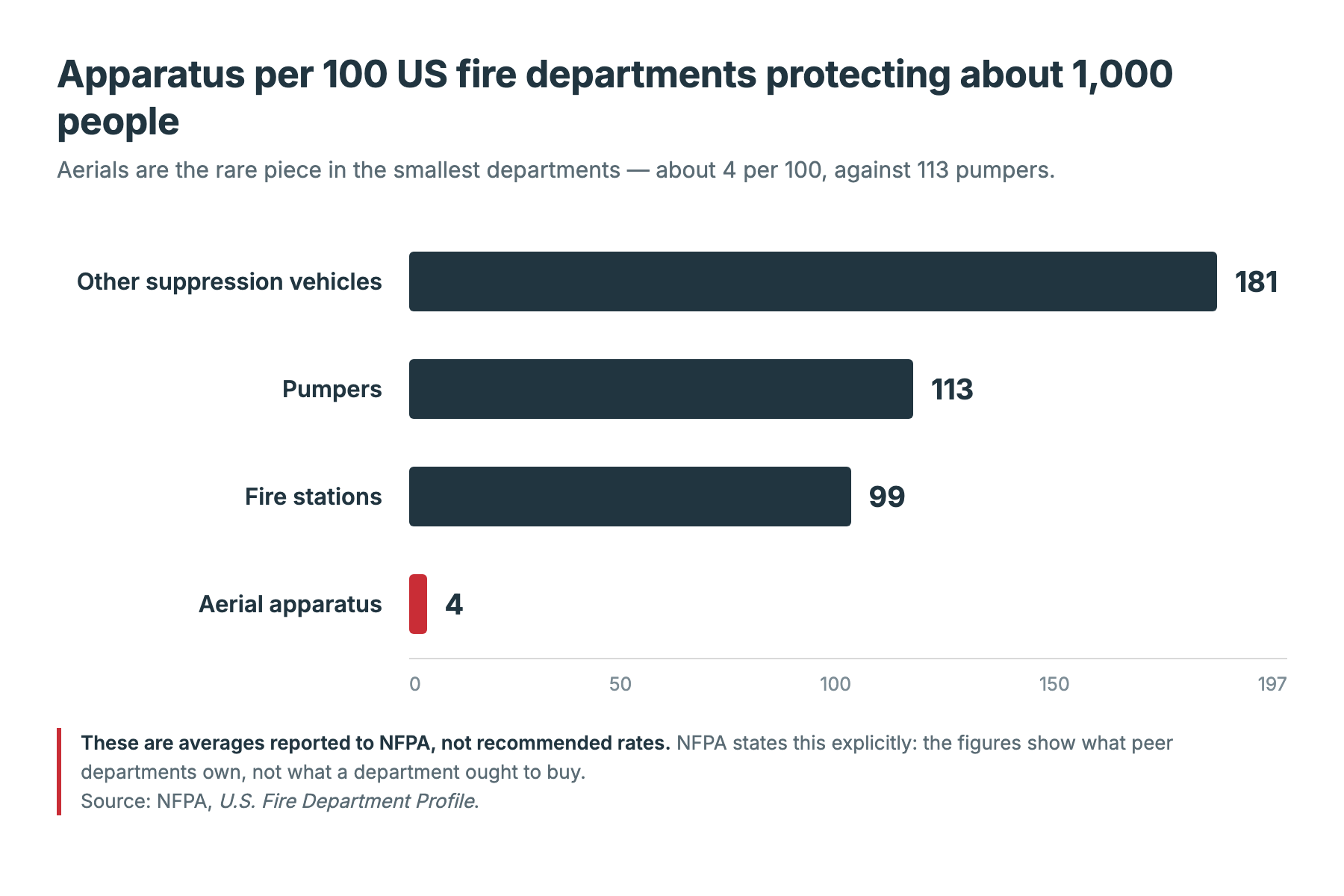
The national picture is worth a look before a small department commits. NFPA’s fire department profile reports apparatus averages by community size, and for every 100 departments protecting around 1,000 people you would expect roughly 113 pumpers, 181 other suppression vehicles, and about 4 aerial apparatus. NFPA is explicit that these are averages reported to them and not recommended rates, so read them as what peers own rather than what you ought to buy.
Budget for the certification as well as the truck. Aerial devices have to pass a nondestructive test at least every five years, which is an owning cost rather than a buying cost, and first-time aerial buyers routinely miss it. Every aerial we sell goes out with a current third-party certification, and that test is a whole day’s work on a ladder truck.
What do your calls say about body style?
Call mix decides compartment layout, not pump size. In 2024, US fire departments answered 42.7 million calls: 28.2 million of them were medical aid, which is 66 percent, while 1.4 million were fires, which is 3.3 percent.
Those proportions are why so many departments replacing an engine end up buying a rescue pumper instead of a second plain pumper. The pump and tank do the fire work that 3 percent of the calls require, and the full-depth compartments carry the extrication and medical equipment that the other two-thirds demand.
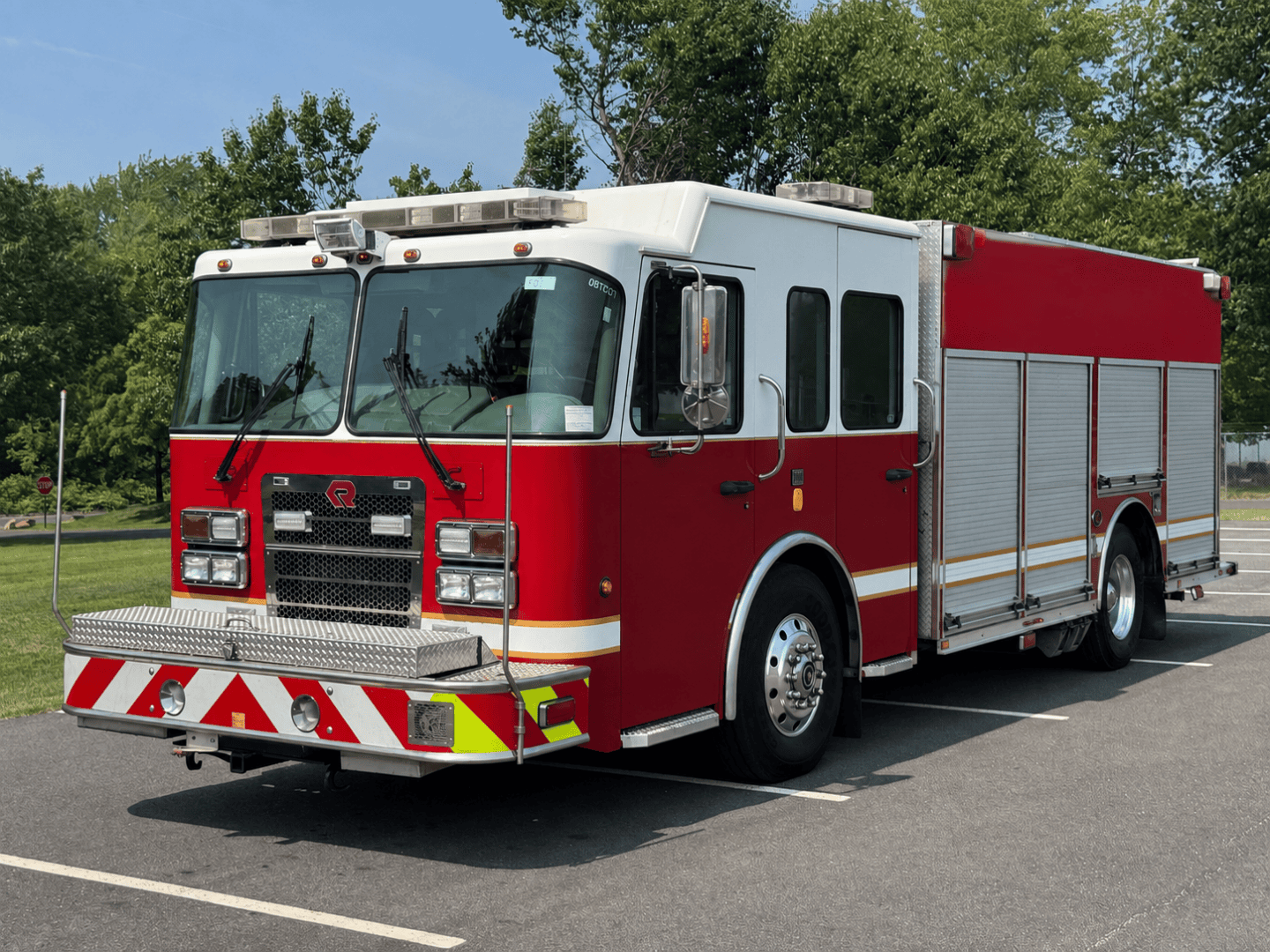
One classification trap sits in the same place. A truck built to work both wildland and structural fires, what the trade calls urban interface, is classified a mini pumper rather than a brush truck. A true NFPA 1906 brush truck is limited to a pump between 10 and 500 gpm with pump-and-roll capability. If you want one vehicle for the grass fires and the house fires, you are shopping for initial attack apparatus, and the word on the listing may not say so.
Which type fits your budget?
Work out the type from the four inputs first, then price it. Budget changes which unit you buy inside a type; it does not change which type your district needs. Service-ready used apparatus runs roughly as follows:
| Apparatus type | Typical used range |
|---|---|
| Aerials, quints and ladders | $20,000 to $500,000+ |
| Pumpers and engines | $45,000 to $350,000+ |
| Tankers and tenders | $50,000 to $300,000+ |
| CAFS, dry chem and ARFF | $50,000 to $150,000 |
| Brush and wildland 4×4 | $55,000 to $200,000 |
| Rescue trucks | $70,000 to $175,000 |
Units over 20 years old often land between $20,000 and $40,000, and they are frequently reserve trucks from small departments with very low mileage. For a fuller picture of what moves these numbers, see our used fire truck price guide.
Buying used does not cost you rating points for age. ISO’s Fire Suppression Rating Schedule sets no maximum age for fire apparatus, and it credits a pumper at its demonstrated capability in gallons per minute at 150 psi net pump pressure. What gets graded is what the truck proves on the day, not its model year.
That is the reason every truck we sell carries a 150-point inspection and a third-party NFPA pump test, with aerial certification where it applies. The paperwork is what converts a used truck into a graded capability.
Frequently asked questions about choosing a fire truck type
What fire truck type do rural departments without hydrants need?
A pumper plus mobile water supply. The pumper fights the fire and a tanker, also called a water tender, keeps it supplied. ISO will credit that shuttle only if the department can deliver 250 gallons per minute within five minutes of the first-due arrival and sustain it for two hours, which works out to 30,000 gallons.
Which fire apparatus replaces a separate engine and ladder company?
A quint. It carries a pump, a water tank, hose, ground ladders and an aerial device, so one rig does both jobs with one crew. The trade-off is that you are inspecting, certifying and maintaining two major systems on a single vehicle rather than one system on each of two.
Is a tanker the same thing as a pumper with a big tank?
No, and the boundary is a specific number. A tank of 1,749 gallons or less paired with a pump rated 750 gpm or more is classified as a pumper. At 1,750 gallons the unit is a tanker regardless of the pump rating.
How many firefighters do we need to run the apparatus we are buying?
That depends on the apparatus, which is why staffing belongs in the decision before you choose a type rather than after. A straight aerial with no pump commits you to crewing a second piece of apparatus on every structural response. NFPA 1750, the 2026 consolidated standard that replaced NFPA 1710 and NFPA 1720, is the document that governs deployment and staffing.
Does buying a used fire truck hurt our ISO rating?
Not for its age. ISO’s Fire Suppression Rating Schedule sets no maximum age for fire apparatus and credits a pumper at its demonstrated flow at 150 psi net pump pressure. What counts is proven capability, which means a current pump test, and for an aerial a nondestructive test within the last five years.
What is the difference between a rescue truck and a rescue pumper?
Compartment design and water. A rescue pumper has a pump, a tank of 300 gallons or more, and half or more of its body compartments in full-height, full-depth configuration. Below 300 gallons it is classified as special service fire apparatus instead.
Talk to us about the type your district needs
Fire Truck Center has sold reconditioned, quality-tested used fire apparatus since 2015, and we have delivered to departments in about 49 states. Every truck goes through a 150-point inspection with third-party NFPA pump tests and aerial certifications before it leaves, and every one carries a 30-day satisfaction guarantee: a full refund within 30 days for any reason, with us paying the return freight.
If you have worked through the four inputs and want to know what is available in the type you landed on, call us at (215) 559-9119 or email help@firetruck.center. Tell us your water supply situation and your typical turnout, and we will tell you honestly whether the truck you are looking at fits them.
Sources
- FAMA — Apparatus Definitions for Truck Reporters (updated 2025)
- ISO Mitigation — Water Supply Evaluations, PPC Technical Subjects (undated; accessed 8 October 2026)
- ISO Mitigation — Maximum Age for Apparatus, PPC Technical Subjects (undated; accessed 8 October 2026)
- NFPA — NFPA 1750 Standard Development, 2026 edition (effective 9 December 2025)
- NFPA — NFPA 1710 Standard Development, consolidation notice
- NFPA — NFPA 1720 Standard Development, consolidation notice
- NFPA — U.S. Fire Department Profile Report (2020 data, published 2022)
- NFPA — Fire Department Calls statistics, 2024 data (table updated March 2026)
- NFPA — Emergency Response and Responder Safety Consolidation Project (plan approved April 2019)
- Pierce Manufacturing — Pumper Fire Apparatus: Overview and Examples (undated; accessed 8 October 2026)

 CALL US NOW