

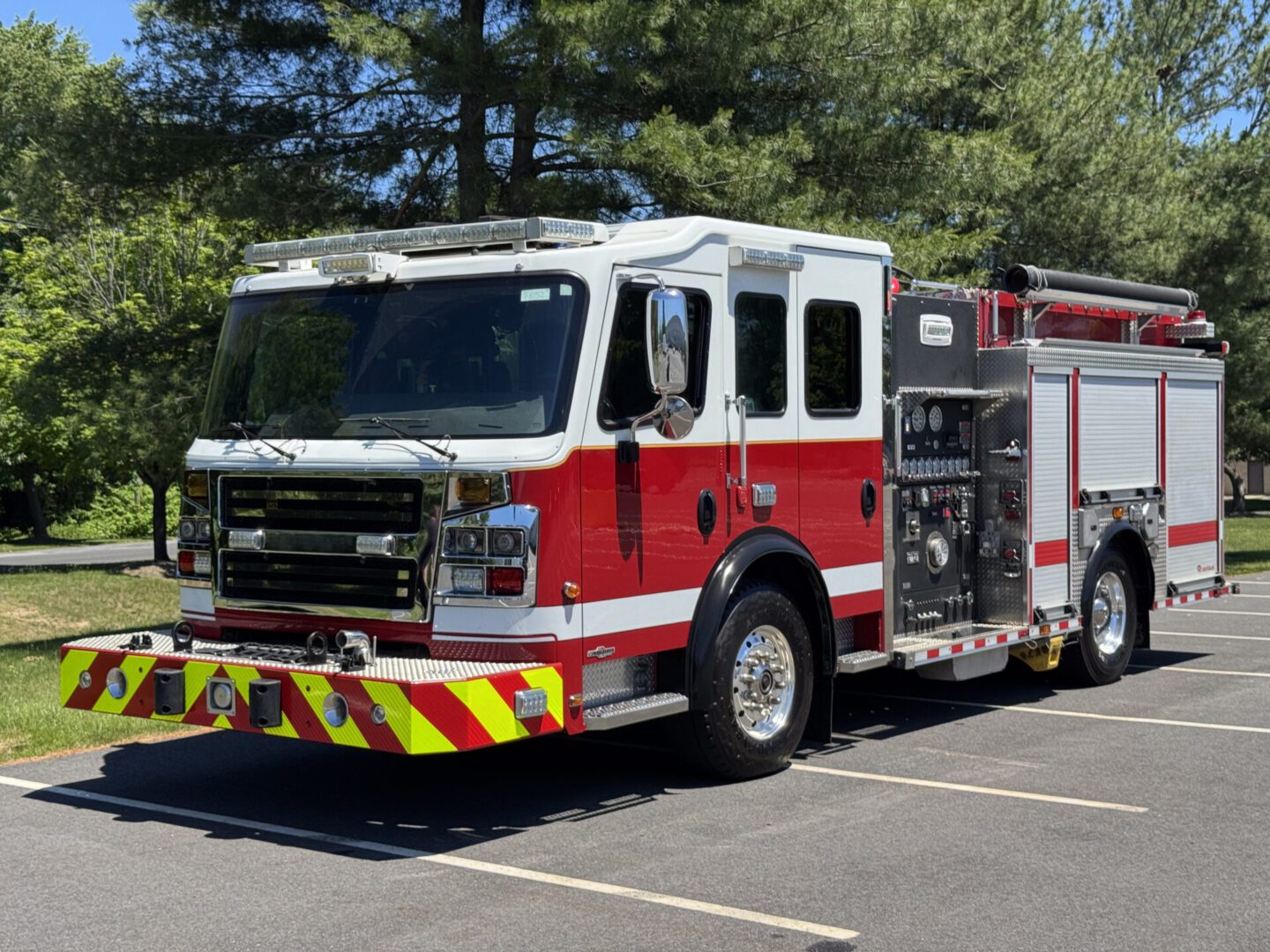
NFPA 1900 is the standard for how new fire apparatus is built. NFPA 1910 is the standard for how apparatus already in service is inspected, maintained, refurbished, tested and retired. Both carry a 2024 edition, and between them they replaced eight older standards, including the two numbers most of the fire service still says out loud: NFPA 1901 and NFPA 1911.
If you’re shopping for a used truck, the second number is the one that reaches your firehouse. Every unit in the used fire apparatus we have in stock was built under NFPA 1901 and is maintained under NFPA 1910, and that split is worth understanding before you sign for one.
Key Takeaways
- NFPA 1900 replaced NFPA 414, 1901, 1906 and 1917. NFPA 1910 replaced NFPA 1911, 1912, 1925 and 1071.
- NFPA 1900 applies to apparatus contracted on or after 1 January 2024. It does not apply retroactively, so a used truck is never “out of compliance” with it.
- NFPA 1910 applies to every in-service apparatus regardless of build year. It covers the annual pump test (Chapter 22), aerial testing and nondestructive testing (Chapter 23), and Level I and Level II refurbishment (Chapters 30 and 31).
- The “15-year rule” lives in Annex D, which states on its own first line that it is not part of the requirements of the standard.
- What matters on a used truck is which edition of NFPA 1901 governed the build. Seven editions ran from 1991 to 2016, and they differ on seat belts, stability, striping and speed limits.
What is NFPA 1900, and which standards did it replace?
NFPA 1900 is the Standard for Aircraft Rescue and Firefighting Vehicles, Automotive Fire Apparatus, Wildland Fire Apparatus, and Automotive Ambulances, and it merged four separate documents into one. It took effect for fire apparatus contracted on or after 1 January 2024.
The four standards it absorbed were NFPA 414 (aircraft rescue and firefighting vehicles), NFPA 1901 (automotive fire apparatus), NFPA 1906 (wildland fire apparatus) and NFPA 1917 (automotive ambulances).
This was not a rewrite of the rules. It came out of the NFPA Emergency Response and Responder Safety consolidation project, which the NFPA Standards Council supported in April 2019 and which began work in January 2020. The plan grouped related standards together so a department buys one document instead of four. Three technical committees each wrote their own chapters of NFPA 1900.
A second consolidation ran alongside it, and that’s the one almost nobody talks about.
| New standard | What it governs | Standards it replaced |
|---|---|---|
| NFPA 1900 (2024) | How new apparatus is designed, built and accepted | NFPA 414, NFPA 1901, NFPA 1906, NFPA 1917 |
| NFPA 1910 (2024) | Inspection, maintenance, refurbishment, testing and retirement of in-service vehicles | NFPA 1911, NFPA 1912, NFPA 1925, NFPA 1071 |
What is NFPA 1910, and why does it matter more if you’re buying used?
NFPA 1910 is the Standard for the Inspection, Maintenance, Refurbishment, Testing, and Retirement of In-Service Emergency Vehicles and Marine Firefighting Vessels. It replaced NFPA 1911, NFPA 1912, NFPA 1925 and NFPA 1071, and it applies to every apparatus in your fleet no matter what year it was built or which standard it was built to.
That’s why it matters more to a used buyer than NFPA 1900 does. NFPA 1900 governed a build you were not part of. NFPA 1910 governs what you have to do with the truck starting the day it lands in your bay.
The chapters a buyer meets in practice:
- Chapter 22 — performance testing of fire pumps. This is the annual pump service test.
- Chapter 23 — performance testing of aerial devices, including 23.7, nondestructive testing procedures.
- Chapter 20 — road tests and annual weight verification.
- Chapter 30 and Chapter 31 — Level I and Level II refurbishing, the two levels a refurb contract is written against.
- Chapter 6 — out-of-service criteria, the list that says when a truck comes off the line.
- Chapter 5 — retirement of emergency vehicles.
Every one of those produces paperwork, and that paperwork is what you should be asking a seller for. Our founder puts it plainly when asked why the tests matter:
“Extremely important — they give customers assurance the vehicle meets the very stringent NFPA requirements and is safe to operate. All tests are performed by a third party — one of the two major testing companies in the area. They can take a whole day (e.g., for a ladder truck).”
That’s the standard we hold ourselves to on every used truck we sell: a 150-point inspection, plus third-party NFPA pump tests and aerial certifications where the truck has a pump or an aerial. If you want the fuller version of what to look at yourself, we wrote up what a used fire truck inspection should cover.
Want the test paperwork before you commit?
Every truck we sell carries a 150-point inspection, and a third-party NFPA pump test or aerial certification where it applies. Tell us the unit and we will send the records.
Does NFPA 1900 apply to a used fire truck?
No. NFPA 1900 applies to fire apparatus contracted on or after 1 January 2024, and it does not reach backwards. A pumper built in 2015 was built to NFPA 1901, and it stays an NFPA 1901 truck for the rest of its service life.
Note that the trigger is the contract date, not the delivery date. A truck ordered in December 2023 and delivered two years later was built to NFPA 1901, because the order came first.
This has a practical consequence for reading listings. “NFPA 1900 compliant” on a pre-2024 used truck is either sloppy wording or wrong. The question worth asking is which edition of NFPA 1901 the truck was built to, because the editions are not interchangeable.
Which NFPA edition was your truck built to?
Find the model year, then match it to the edition of NFPA 1901 in force when the apparatus was contracted. Seven editions ran between 1991 and 2016, and each one added safety requirements the editions before it did not carry.
The edition history below comes from William C. Peters, a voting member of the NFPA apparatus committee, writing in Fire Engineering in August 2026.
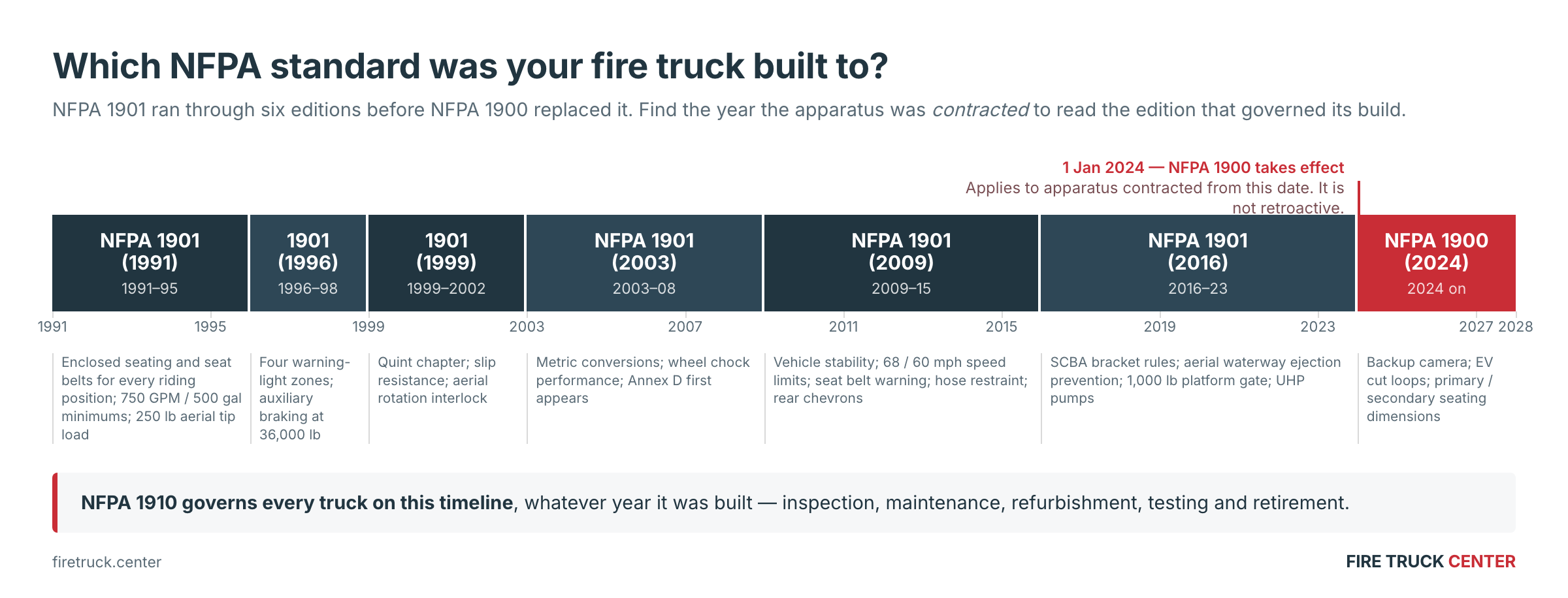
| Edition | Apparatus contracted | What that edition first required |
|---|---|---|
| NFPA 1901 (1991) | 1991–1995 | Fully enclosed seating with a seat belt for every riding position; reflective striping; 750 GPM minimum pump and 500 gallon minimum tank; 250 lb aerial tip load at 0° elevation; stabilizer interlocks |
| NFPA 1901 (1996) | 1996–1998 | Four defined warning-light zones; auxiliary braking on apparatus 36,000 lb and over; grouped pump panel controls; equipment and SCBA securement in the cab |
| NFPA 1901 (1999) | 1999–2002 | A quint chapter; slip resistance requirements for stepping and walking surfaces; aerial rotation interlock against short-jacking; enclosed SCBA fill stations |
| NFPA 1901 (2003) | 2003–2008 | Metric conversions; wheel chock performance requirements; Annex D first appears with first-line and reserve guidance |
| NFPA 1901 (2009) | 2009–2015 | Vehicle stability requirement; maximum speed of 68 mph over 26,000 lb GVWR and 60 mph over 50,000 lb or 1,250 gallons; seat belt warning system and longer belts; hose restraint; rear chevron striping; 2007 EPA engines and diesel particulate filters |
| NFPA 1901 (2016) | 2016–2023 | SCBA bracket mounting and release requirements; a secondary means of preventing aerial waterway monitor ejection; 1,000 lb platform gate force; an ultra-high-pressure pump chapter; safety striping on high walking surfaces |
| NFPA 1900 (2024) | 2024 onward | Backup camera; electric-vehicle cut loops and identification; speed threshold moved from 26,000 lb to 33,000 lb GVWR; primary and secondary seating dimensions; minimum ground ladder complement removed; equipment lists moved to Annex A as recommendations |
Two things to keep in mind when you use this table. The model year is a guide rather than proof, because the contract date governs and a truck built near an edition boundary can fall either way. And the build plate or the original purchase spec is the real evidence, so ask for it on anything where a specific safety feature is part of your decision.
The 2009 line is the one that changes the most minds. A 2007 pumper predates it, which means vehicle stability requirements, the seat belt warning system, hose restraint and rear chevron striping were not required when it was built. The truck may still have some of them. It was not obligated to.
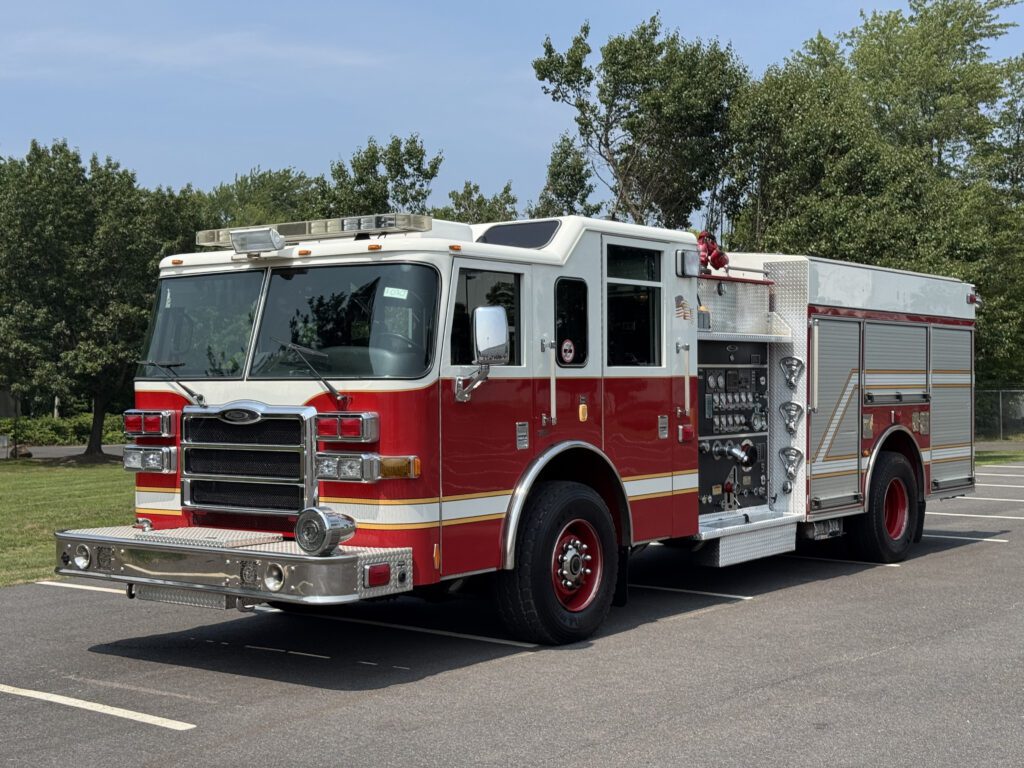
2007 Pierce Dash pumper, Stock #F070 — contracted under NFPA 1901 (2003 edition).
The 1991 line matters for aerials, since that’s the edition that set the 250 lb tip load at 0° elevation and required stabilizer interlocks. Anything older than 1991 is a different animal, which is part of why the used aerial and ladder trucks worth buying tend to be newer than the pumpers.
What does NFPA 1910 say about retiring apparatus at 15 years?
It recommends. It does not require. The 15-year and 25-year guidance sits in Annex D, Guidelines for First-Line and Reserve Fire Apparatus, and Annex D opens by stating that it is not part of the requirements of the NFPA document.
The guidance reads that apparatus more than 15 years old, properly maintained and still in serviceable condition, should be placed in reserve status and upgraded to the refurbishment standard. Apparatus more than 25 years old, or apparatus not manufactured to the applicable NFPA standards, should be replaced.
Read the conditions in that sentence. “Properly maintained” and “still in serviceable condition” are doing real work, and neither one is an age. The annex has also been around a while, since it first appeared in the 2003 edition of NFPA 1901.
Our founder’s version, from buying apparatus for a living:
“We don’t typically rule out aerials based on their age or manufacturer… we focus much more on the condition of the individual truck than on its age or brand. You can have a newer truck that’s been pretty beat up, while an older truck that’s been properly maintained might be in much better shape.”
Age is a screening tool, not a verdict. If you want a better one, engine hours against mileage tells you more about how a truck was used than the model year does.
Which number should you cite when you write a spec or a grant?
Cite NFPA 1900 with its edition year for a new apparatus purchase. Cite NFPA 1910 with the chapter for testing, maintenance, refurbishment or a replacement justification on a truck you already own. Citing NFPA 1901 or NFPA 1911 on a document written today points at a standard that is no longer being revised.
Three cases cover most of what a department writes:
NFPA 1900, current edition. You can read the scope and status on NFPA’s own NFPA 1900 standard page.
NFPA 1910, Chapter 22 for pumps, Chapter 23 for aerials.
NFPA 1910, Chapter 30 for Level I or Chapter 31 for Level II. Naming the level is what keeps a refurb quote comparable between shops.
The numbers are settled. The content is not. NFPA 1900’s next revision is under way: the first draft report posted on 3 June 2026 and the public comment period closed on 27 July 2026. Items in that first draft, proposed rather than adopted, include inflatable restraints for outboard cab seats, a required digital alert warning system, and removal of the 50 ft minimum aerial length.
Frequently asked questions
Is NFPA 1901 still valid?
Its content is still the governing build standard for every apparatus contracted before 1 January 2024, and NFPA’s page still lists the 2016 edition as current. It is no longer revised as a stand-alone standard, because that work moved to NFPA 1900.
What is the difference between NFPA 1900 and NFPA 1910?
NFPA 1900 covers how a new apparatus is built. NFPA 1910 covers what happens to it afterwards, including inspection, maintenance, refurbishment, testing and retirement. A truck is built once to NFPA 1900 and maintained for its whole life to NFPA 1910.
Does a used fire truck have to meet NFPA 1900?
No. NFPA 1900 applies to apparatus contracted on or after 1 January 2024. A used truck is held to the edition that was in force when it was ordered, and to NFPA 1910 for testing and maintenance from then on.
How often does NFPA require a fire pump test?
NFPA 1910 Chapter 22 covers performance testing of fire pumps, and the service test runs annually. Third-party testing companies perform it and issue the documentation.
Does NFPA require fire trucks to be replaced after 15 years?
No. That guidance sits in Annex D of NFPA 1910, which states that it is not part of the requirements of the standard. It recommends moving apparatus over 15 years old into reserve status and replacing apparatus over 25 years old or not built to the applicable NFPA standards.
What replaced NFPA 1911?
NFPA 1910 replaced it. NFPA 1911’s content was combined with NFPA 1912 (refurbishing), NFPA 1925 (marine firefighting vessels) and NFPA 1071 (emergency vehicle technician qualifications). The 2017 edition was NFPA 1911’s last as a stand-alone standard.
Talk to us about the paperwork on a specific truck
Fire Truck Center has been selling quality-tested used fire apparatus since 2015, out of Levittown, Pennsylvania, to departments across the country. Every used truck we sell goes through a 150-point inspection and in-house reconditioning, with third-party NFPA pump tests and aerial certifications on the units that have a pump or an aerial. Those are the same records NFPA 1910 expects a department to keep, so we’d rather hand them over before you buy than after.
If you’re weighing a specific unit and want to see what it was built to and what it has been tested to, call us at (215) 559-9119 or email help@firetruck.center. Tell us the truck and we’ll send the pump test, the aerial certification and the inspection sheet for it.
Sources
- NFPA — NFPA 1900 Standard Development (2024 edition)
- NFPA — NFPA 1910 Standard Development (2024 edition)
- NFPA — NFPA 1901 Standard Development (2016 edition, last stand-alone)
- NFPA — NFPA 1911 Standard Development (2017 edition, last stand-alone)
- NFPA — Emergency Response and Responder Safety Consolidation Project (2019)
- Intertek Inform — NFPA 1910:2024 table of contents (2022)
- FAMA — NFPA 1900: What’s New and Why (18 December 2023)
- Fire Engineering — The NFPA Apparatus Standard: Where We’ve Been, Where We Are Now, and Where We Are Going (31 August 2026)
- UL Solutions — Fire Department Pump Performance Testing Services
- UL Solutions — Fire Department Aerial Device Testing and Inspection

 CALL US NOW