


A fire pump’s capacity rating is the flow it’s built to deliver from draft, at 150 psi net pump pressure, lifting water 10 feet through 20 feet of suction hose. It’s a factory test condition. At a hydrant, the flow you get depends on the water main and your supply hose, so a 1,500 gpm pump often moves far less.
Key Takeaways
- A 1,500 gpm rating is a drafting number. It says what the pump does at 150 psi from static water, not what your hydrants can feed it.
- Hooked to a pressurized source, a pump can beat its rating. FAMA puts the gain at 10% or more over the same pump at draft.
- Hydrants are classed by the flow they give at 20 psi residual. A light-blue Class AA hydrant gives 1,500 gpm or more, and most public systems are Class A or B.
- Supply hose eats pressure fast. 1,500 gpm loses about 18 psi per 100 feet in 5-inch hose and about 45 psi in 4-inch.
- In our worked example, a 1,640 gpm hydrant feeding 500 feet of 5-inch hose gives the pump about 910 gpm. Size the pump to your water supply.
What does a 1,500 gpm pump rating actually promise?
A 1,500 gpm pump rating promises that the pump can move 1,500 gallons a minute at 150 psi net pump pressure while drafting. The test setup is fixed: 20 feet of hard suction hose and 10 feet of lift from static water, the way the Fire Apparatus Manufacturers’ Association (FAMA) describes the NFPA rating. The same pump is then held to smaller flows at higher pressures. Our guide to the fire truck pump test walks through each leg.
The rating tells you two useful things. It tells you the pump’s size class, and it gives you a fixed point to test against every year. It doesn’t tell you how much water reaches a nozzle on your street.
Three conditions change the real number:
- Lift. Pumps are rated at 10 feet of lift. The Alabama Fire College pump manual is blunt about it: if the lift is less, capacity goes up, and if the lift is more, capacity goes down.
- Elevation. Atmospheric pressure drops about 0.5 psi for every 1,000 feet of elevation. NFPA only requires rated performance up to 2,000 feet above sea level, according to FAMA. Above that, holding the rating can take more horsepower or a different pump.
- Water supply. From a hydrant, the pump only gets what the main and the supply line can send it. That’s the big one, and it’s what the rest of this post is about.
Our founder puts the normal range for a structural pumper at “between 1,250 GPM up to about 2,000 GPM,” with the size set by a department’s ISO requirements or its own application. If you’re shopping that range, our used pumpers in stock list the pump rating on every unit. The question is what that rating will turn into on your water system.

Why can a fire pump move more water from a hydrant than from draft?
A fire pump can move more water from a hydrant than from draft because the hydrant does part of the work. Almost every fire pump in service is centrifugal, and a centrifugal pump adds pressure to whatever pressure is already coming in.
The Alabama Fire College manual gives the arithmetic. If the pump has to discharge at 150 psi and 50 psi is coming in from the hydrant, the pump only adds 100 psi. That difference, discharge pressure minus intake pressure, is called net pump discharge pressure. A pump working at a lower net pressure can move more water.
FAMA’s pump capacity outline puts a number on it. From the tank or a pressurized source, in-service performance “may increase the pump’s flow 10% or more compared with the same pump at draft.” The San Diego Fire-Rescue drill manual makes the same point from the operator’s side: running below 150 psi can mean discharging more than rated capacity, and a hydrant connection can raise discharge too.
So a 1,500 gpm pump isn’t a ceiling. On a strong hydrant with a short supply line, it can beat its rating. On a weak one, the pump never gets the chance. The limit has moved from the pump to the water system.
How much water can your hydrant actually give?
Your hydrant can give the flow its main can supply while the pressure stays at 20 psi. That’s the number hydrant flow tests report and the number the paint on the hydrant is meant to show. NFPA 291, the recommended practice for hydrant flow testing and marking, classes public hydrants by flow at 20 psi residual pressure and colour-codes the bonnet and caps to match.
| Class | Bonnet and cap colour | Flow at 20 psi residual | What it means for a 1,500 gpm pump |
|---|---|---|---|
| AA | Light blue | 1,500 gpm or more | The only class that can feed a 1,500 gpm pump on its own, and only over a short supply line |
| A | Green | 1,000 to 1,499 gpm | One hydrant can’t fill the pump. Plan a second hydrant or a second supply line |
| B | Orange | 500 to 999 gpm | Roughly half the pump at best. A bigger pump buys nothing here |
| C | Red | Under 500 gpm | Treat it as a tanker fill point, not a pumper supply |
Most hydrants aren’t light blue. The National Fire Sprinkler Association says most public water systems are Class A or B, delivering on average 1,000 gpm at 20 psi as a target flow.
Why 20 psi? Because dropping a main lower than that causes problems for the whole system, not just the fire.
The U.S. Fire Administration’s water supply manual says systems are designed to hold 20 psi at every point under fire flow, and that the figure is used to avoid cavitation in the mains or in the suction hose between the hydrant and the pumper. Many state health departments don’t allow lower pressures.
Washington’s drinking water rule, for one, requires 20 psi at the operating hydrant and positive pressure everywhere else in the system under fire flow.
The 20 psi flow comes from a field test, not a guess. A test crew reads the static pressure, flows water, reads the residual pressure, then runs the NFPA 291 formula used by rating bureaus like Washington’s WSRB:
Flow at 20 psi = test flow × [(static − 20) ÷ (static − residual)]^0.54
Here’s one we’ll keep using. A hydrant reads 70 psi static and drops to 50 psi while flowing 1,000 gpm. Its flow at 20 psi is 1,000 × (50 ÷ 20)^0.54, or about 1,640 gpm. That’s a Class AA, light-blue hydrant.
Don’t trust the paint without the test sheet. The University of Tennessee’s MTAS, which advises Tennessee cities, calls this one of the biggest colour-coding mistakes: marking a hydrant at whatever it flowed during the test instead of calculating its flow at 20 psi. MTAS says the correction can change the colour on up to 50% of the hydrants in a system.
How much pressure does the supply line take before water reaches the pump?
The supply line takes a share of pressure that grows with the square of the flow. Double the flow and friction loss goes up four times. The fire service formula is:
Friction loss = C × (gpm ÷ 100)² × (length ÷ 100)
C is a coefficient for the hose size. The traditional values quoted by Fire Engineering are 0.08 for 5-inch hose and 0.2 for 4-inch. Here’s what that does at the two flows that matter for a 1,500 gpm pumper:
| Supply hose | 1,000 gpm, per 100 ft | 1,000 gpm, 500 ft lay | 1,500 gpm, per 100 ft | 1,500 gpm, 500 ft lay |
|---|---|---|---|---|
| 5-inch LDH (C = 0.08) | 8 psi | 40 psi | 18 psi | 90 psi |
| 4-inch LDH (C = 0.2) | 20 psi | 100 psi | 45 psi | 225 psi |
Look at the bottom-right cell. Pushing 1,500 gpm through 500 feet of 4-inch hose would cost 225 psi in friction. No municipal hydrant has that to give. Even 5-inch hose needs 90 psi of friction allowance at that flow and length, on top of the 20 psi you want left at the pump.
Fire Engineering’s large-diameter hose article puts the gap simply: 4-inch carries 2.5 times the friction loss of 5-inch at any flow. Its relay example shows 1,000 gpm moving 2,250 feet in 5-inch hose on 180 psi of available pressure, against 900 feet in 4-inch. The same article notes that manufacturers’ published friction figures run somewhat lower than the textbook coefficients, so treat the table as a planning number. Your own hose, tested, beats it.
What does a 1,500 gpm pump actually get from a hydrant?
In our worked example, a 1,500 gpm pump gets about 910 gpm through 500 feet of 5-inch supply line, and about 640 gpm through 4-inch. That’s from a light-blue hydrant that tests at 1,640 gpm.
Here’s how we got there. Take the hydrant above, 70 psi static and 50 psi residual at 1,000 gpm.
As flow rises, the hydrant’s pressure falls along the same NFPA 291 curve. As flow rises, the supply line’s friction loss climbs with the square of the flow. The most the pump can draw is the flow where hydrant pressure, minus friction loss, still leaves 20 psi at the pump intake.
| Supply line length | Max flow to the pump, 5-inch LDH | Max flow to the pump, 4-inch LDH |
|---|---|---|
| Pump on the hydrant | 1,640 gpm | 1,640 gpm |
| 100 ft | 1,360 gpm | 1,120 gpm |
| 300 ft | 1,070 gpm | 790 gpm |
| 500 ft | 910 gpm | 640 gpm |
| 800 ft | 770 gpm | 520 gpm |
| 1,000 ft | 700 gpm | 470 gpm |
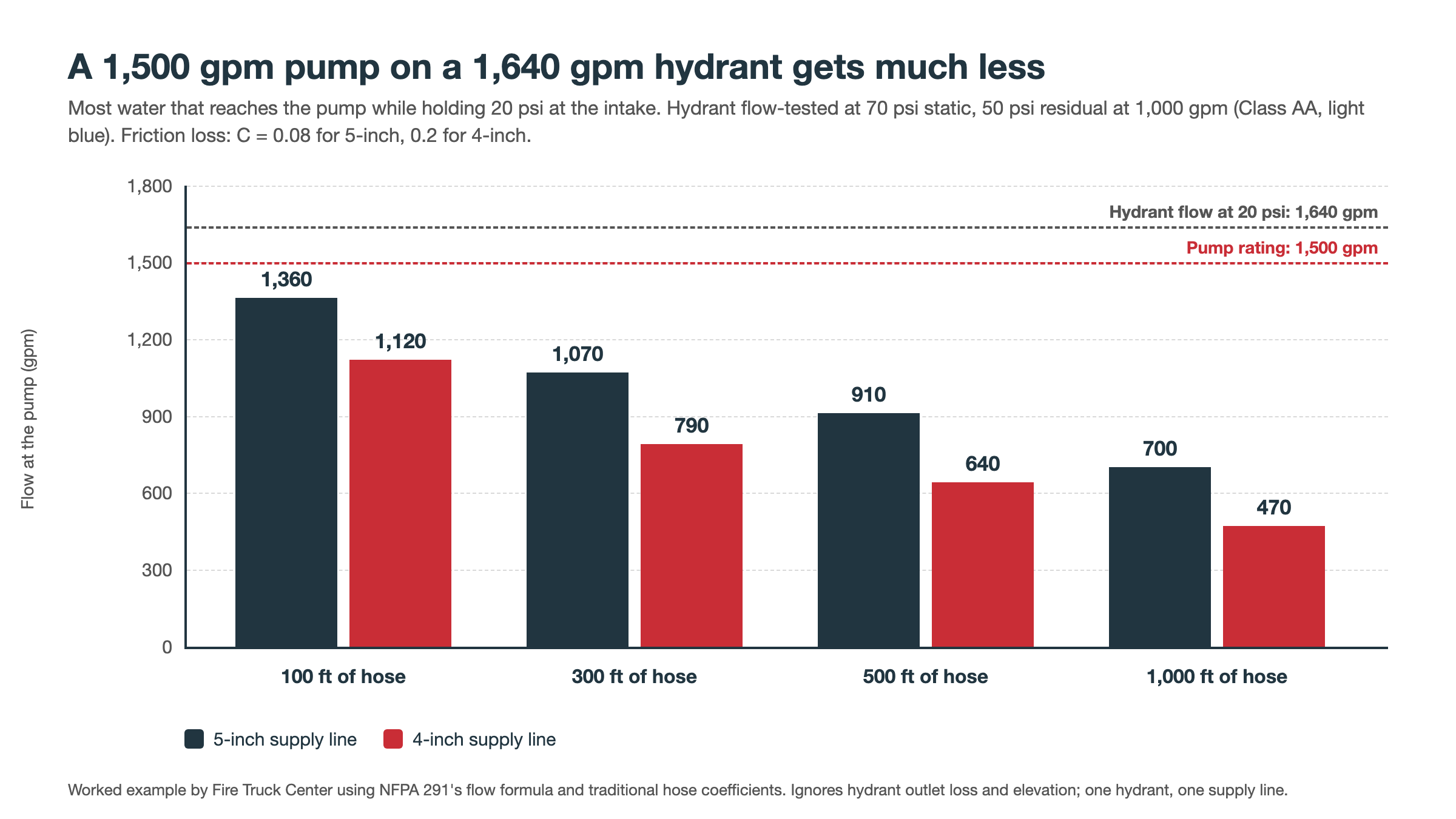
Two things stand out. Even a Class AA hydrant only fills a 1,500 gpm pump when the pumper sits on it. And by the time you’re 300 feet away on 4-inch hose, that pump is running at about half its rating, with nothing wrong with the pump.
This example leaves things out on purpose, so read it as a pattern, not a prediction. It ignores loss through the hydrant barrel and outlet, it ignores hills, and it uses one hydrant and one supply line. A second hydrant or a second line changes the answer, and so does a supply engine pumping the line, which is exactly why departments run relays. Your water utility’s flow test for the actual hydrant replaces our 70/50/1,000 with real numbers.
On the fireground, the pump’s intake gauge shows when you’ve reached that limit. The Alabama Fire College manual explains why: as the operator opens up discharge pressure or flow, intake pressure from the hydrant falls, and push too far and it drops below 0 psi. The San Diego drill manual’s rule is that hydrant residual should never go from positive to negative, and should preferably stay at 20 psi or more. When the intake needle heads toward 20, the pump has more to give but the supply doesn’t.
What does pump rating vs hydrant flow mean when you buy a used pumper?
It means you size the pump on a used pumper to your water supply first and to the brochure second. A bigger pump only pays off where something can feed it.
FAMA’s guidance to buyers says the same thing in standards language: if the pump will be supplied from a municipal system, verify the pump size against the rating of that system. Here’s how we’d work through it with a committee:
- Pull your hydrant flow tests. Ask your water utility for the static, residual and test flow on the hydrants in your first-due area. Check that they’re reported at 20 psi.
- Note your supply hose and typical lay. 4-inch or 5-inch, and how far the first engine usually lays from hydrant to fire.
- Run the arithmetic or ask us to. The two formulas above are enough. The answer is the most water your first engine can count on without help.
- Decide what the extra capacity is for. A larger pump still earns its place if you draft from ponds or dry hydrants, relay, supply sprinkler and standpipe systems, or need ISO credit. It earns nothing if every hydrant you’ll use is Class B.
- Check the pump paperwork, not just the plate. A used pump has to prove it still makes its rating. The current annual service test shows that.
Rural departments flip the problem. With no hydrants, the pump is fed from a portable tank or a pond, so draft is the normal case and the rating means what it says. Lift becomes the variable to watch: the closer the pumper sits to the water, the more it can move.
Elevation counts too. If your district sits well above 2,000 feet, ask what the pump was built and tested for, because the NFPA rating condition only runs to that height.
Our used pumper buyer’s guide covers how pump and tank size fit together on the rest of the truck.
Frequently asked questions
What does the GPM rating on a fire pump mean?
The GPM rating is the flow the pump is built to deliver from draft at 150 psi net pump pressure, through 20 feet of suction hose at 10 feet of lift. It’s a standard test condition, not a promise about what any hydrant will supply. The pump is also tested at smaller flows and higher pressures.
What do the colours on a fire hydrant mean?
The bonnet and cap colours show how much water a hydrant gives at 20 psi residual pressure. Under NFPA 291, light blue is 1,500 gpm or more, green is 1,000 to 1,499, orange is 500 to 999, and red is under 500. Ask for the flow test behind the colour, because hydrants are sometimes marked from an uncorrected test.
Why do fire departments keep 20 psi on the hydrant?
Fire departments keep 20 psi on the hydrant to protect the water system and the pump supply. Below that, mains and suction hose can cavitate, and many state health departments don’t allow lower pressures because of the contamination risk. Hydrant flow ratings are calculated at 20 psi for the same reason.
Can a 1,500 gpm pump flow more than 1,500 gpm?
Yes, a 1,500 gpm pump can flow more than its rating from a strong pressurized source or at lower discharge pressures. FAMA says flow from the tank or a pressurized source may run 10% or more above the same pump at draft. It can’t create water the hydrant and supply line don’t deliver.
Is 4-inch or 5-inch supply hose better?
5-inch supply hose moves far more water over the same distance, with about 2.5 times less friction loss than 4-inch at any flow. At 1,000 gpm, 5-inch loses about 8 psi per 100 feet against 20 psi for 4-inch.
Do we need a 1,500 gpm pump if our hydrants are Class B?
You may not need a 1,500 gpm pump if every hydrant in your district is Class B, since a Class B hydrant gives under 1,000 gpm at 20 psi. A larger pump still makes sense for drafting, relay pumping, supplying sprinkler systems, or meeting your ISO plan. Size it to the job you’ll ask it to do.
Talk to us about matching a pump to your water supply
Fire Truck Center has been selling quality-tested used fire apparatus since 2015. Every truck we sell goes through a 150-point inspection, with third-party pump testing where it applies, and comes with a 30-day satisfaction guarantee.
If you’re comparing pumpers and aren’t sure what your hydrants can feed, call us at (215) 559-9119 or email help@firetruck.center. Send your hydrant flow-test numbers and your supply hose size, and we’ll tell you which pumps on our lot fit them.
Sources
- FAMA — TC024, Pump Capacity Ratings Outline (2018)
- U.S. Fire Administration — Water Supply Systems and Evaluation Methods, Volume II
- MTAS, University of Tennessee — Marking All Fire Hydrants (November 2017)
- National Fire Sprinkler Association — Why Aren’t All Fire Hydrants Red? (February 2021)
- WSRB — Guide to Hydrant Flow Testing
- Washington State Legislature — WAC 246-290-420, Reliability and Emergency Response
- Fire Engineering — A Practical Approach to Large-Diameter Hose (January 1992)
- Fire Engineering — Moving Water: Relay Operations (March 2026)
- Alabama Fire College — Pumping Apparatus Driver/Operator, Basic Pump Operations Instructor Manual (2013)
- City of San Diego Fire-Rescue — Drill Manual, Chapter 15: Fire Ground Hydraulics

 CALL US NOW