


To compare two used fire trucks, rank them on what each will cost you per year of service, not on the asking price. Check that both fit the job first. Then look at the NFPA edition each was built to, miles and engine hours, tire age, pump or aerial certification and parts support. Add each truck’s year-one costs to its price and divide by the years it has left.
Key Takeaways
- A lower asking price buys fewer years if the truck is older. Divide price by service years left before you decide.
- The 1991 and 2009 editions of NFPA 1901 are the two big safety lines. Know which side of each a truck was built on.
- NFPA 1911 calls for replacing tires every seven years. Read the date code on every tire, including the inside duals.
- A truck from a builder that’s out of business can cost far more to keep running. Watertown, Minnesota spent over $10,000 and three weeks on one repair.
- Get each truck’s year-one costs as written quotes, then run the same arithmetic on both.
Why is the asking price the wrong place to start?
The asking price is the wrong place to start because it doesn’t tell you how many years of service you’re buying. A $95,000 pumper with four years left in your fleet costs more per year than a $145,000 pumper with eleven. Two used trucks almost never offer the same number of years, so their prices aren’t comparable until you put them on the same scale.
Committees that buy new apparatus already work this way. Midwest Fire’s purchasing guide for volunteer departments tells evaluators to balance “the initial cost, and the lifetime cost of the apparatus.” On a used truck that matters more, because the lifetime is shorter and harder to predict.
The method below takes six checks and ends in one number per truck. You can run it on any two listings, including ours. If you’re still building a shortlist, start with the inspected used fire trucks in our inventory, then come back with two.

What should you check before you compare prices at all?
Check that both trucks can do the job before you look at either price. Pump capacity, tank size, overall length and height, seating and chassis type are pass/fail. A truck that fails one of them isn’t a cheaper option. It’s a different truck.
Write the requirements down before you open a single listing:
- Pump and tank. The gpm your water supply and your ISO plan need, and the tank size your first-due area calls for.
- Fit. Length, height and wheelbase against your station door, your bay and your tightest roads.
- Seating. How many belted seats you need on a typical turnout.
- Drive and chassis. Custom or commercial cab, two- or four-wheel drive, and whether your drivers can handle it.
- Equipment. What has to come with the truck and what you can move over from the one it replaces.
Midwest Fire recommends scoring new-apparatus bids under five headings: features, quality, service, warranty and terms, and price. Price comes last on that list for a reason. A committee that looks at the price first tends to argue a truck into fitting.
If a truck passes the screen, the questions for the seller come next. We’ve collected them in our questions to ask before buying a used fire truck.
How does the year a truck was built change what you are buying?
The year matters mostly because it tells you which edition of NFPA 1901 the truck was built to. Two editions draw the biggest lines. The 1991 edition required every rider to be in a fully enclosed seat with a seat belt. The 2009 edition added vehicle stability requirements, seat belt warning systems and longer belts sized for firefighters in gear.
Here’s what each era means for a buyer:
| Built to | What changed | What it means for you |
|---|---|---|
| Before the 1991 edition | Open or canopy cabs and riding positions outside the cab were still allowed | NFPA’s Annex D guidance says these trucks should be upgraded or replaced. Treat them as reserve or parts trucks. |
| 1991 to 2008 editions | Fully enclosed seating with belts; four-door enclosed cabs, auxiliary braking and electrical load managers; aerials designed for a 250-pound tip load | The safety basics are there. Stability control and seat belt warnings usually aren’t. |
| 2009 edition and later | Stability control or tilt-table testing, seat belt warnings, longer belts, maximum speed limits, diesel particulate filter controls | Closest to current practice. Expect higher prices, and a regeneration system your drivers need to understand. |
Annex D is guidance, not a requirement. It says a properly maintained truck more than 15 years old should be moved to reserve, and a truck more than 25 years old should be replaced. Tuolumne County, California quotes the same annex in its fleet plan to make the opposite point too: some trucks are “just plain worn out” at 8 to 10 years, and others are still serviceable after 20.
So use the edition as a line on your score sheet, not as a verdict. A 2007 pumper with 9,000 miles can be a better truck than a 2012 pumper that ran every call in a busy city.
Be careful about planning to upgrade an old truck to close the gap. A Firehouse column on Annex D walks through a 1988 canopy-cab pumper. Enclosing the cab meant a heavier front axle, new front tires, wheels and springs, an engine brake, a new battery pack, alternator and load manager, and new steps. The same column’s rule of thumb: if a full refurbishment costs 50% or more of a new truck, buy new.
How do you compare miles, engine hours and how the truck was used?
Compare miles and hours together, and then ask where the truck lived. Our own buying cutoff is about 100,000 miles and about 10,000 engine hours. A reserve truck from a small department can be 10 to 20 years old with around 10,000 miles on it.
Hours count more than the odometer suggests, because a fire truck spends long periods pumping or idling at a scene while the wheels don’t turn. Put the two numbers side by side for each truck.
If the ratio looks unusual, find out why before you trust either number. It can mean a replaced odometer, or it can mean a truck that spent its life parked at long incidents. Our guide to engine hours versus mileage on a fire truck covers how to read it.
Then look underneath. A truck that served on salted northern roads can have frame and body corrosion that no amount of low mileage makes up for. Our founder puts it plainly: “Corrosion is usually the biggest dealbreaker for us. If a truck has major rust or significant corrosion, we simply won’t touch it.”
What will each truck cost you in its first year?
Each truck’s first-year cost is the money you’ll spend to put it in service and keep it legal for twelve months. That number belongs in the comparison, because the cheaper truck usually carries more of it. Get each item as a written quote or a documented test, not as an estimate from the seller.
Four items move the number most:
- Tires. NFPA 1911 calls for replacing fire apparatus tires at least every seven years, or sooner if they wear out. The four-digit DOT code on the sidewall gives the week and year of manufacture, so “2517” means the 25th week of 2017. A three-digit code means a pre-2000 tire. Check every tire, inside duals included, and price in any set past seven years.
- Pump and aerial certification. Ask for the most recent pump test, and the aerial certification if there’s a ladder. A truck without a current test needs one before it goes in service. Our article on pump testing versus pump certification explains what the test proves.
- Pump service. Most used trucks need some pump work. In our founder’s words, the cost “can vary quite a bit, anywhere from several hundred dollars to many thousands, depending on what needs to be done.”
- Delivery. Getting a truck to your station can cost anywhere from a few hundred dollars for a short move to $20,000 or more cross-country. Two trucks in different states carry different delivery costs.
Our used fire truck price guide covers what typical asking prices include. Don’t assume two sellers include the same things.
The physical checks behind these numbers are in our guide to inspecting a used fire truck. Run the same checks on both trucks, in the same order, so the two score sheets line up.
Can you still get parts and service for it?
Check whether the builder is still in business and whether a shop near you works on that make. Parts and know-how get scarce when a builder closes, and the repair bill shows it.
American LaFrance closed on January 17, 2014, and departments running its trucks immediately raised concerns about replacement parts. Watertown, Minnesota spelled out what that meant for its 1997 American LaFrance ladder truck in a city council agenda item.
Parts were “difficult to obtain,” and few mechanics knew the apparatus. One repair kept the truck in the shop for three weeks, cost over $10,000 and took 21 hours of tracing wires. Mechanics later recommended an $8,000 part replacement.
That doesn’t rule out every truck from a closed builder. The engine, transmission and pump are often common components with good parts support. The cab, body electrics and aerial controls are where proprietary parts hurt. Ask your shop before you buy, not after.
The truck’s own records count here too. A full maintenance history tells you what has already been replaced, and the Annex D text quoted by Tuolumne County names “availability of replacement parts” as one of the factors that decides how long a truck lasts.
How do you turn all of this into one number?
Add each truck’s year-one costs to its asking price, then divide by the years of service it has left in your fleet. The lower number per year wins, as long as both trucks passed the screen at the start.
Cost per service year = (asking price + year-one costs) ÷ years of service left
“Years left” is your call, not ours. Take the age at which your department retires a truck and subtract the truck’s age today.
If you follow the 25-year Annex D guidance, use 25. If you keep reserve trucks to 30, use 30. The arithmetic works either way, as long as both trucks get the same figure.
Here’s a worked example with two hypothetical pumpers. Both pass the screen. The prices are illustrations, not real listings.
| Truck A | Truck B | |
|---|---|---|
| Built | 2005 | 2012 |
| Asking price | $95,000 | $145,000 |
| Age in 2026 | 21 years | 14 years |
| Years left if you retire at 25 | 4 | 11 |
| Price per year, retire at 25 | $23,750 | $13,182 |
| Years left if you retire at 30 | 9 | 16 |
| Price per year, retire at 30 | $10,556 | $9,063 |
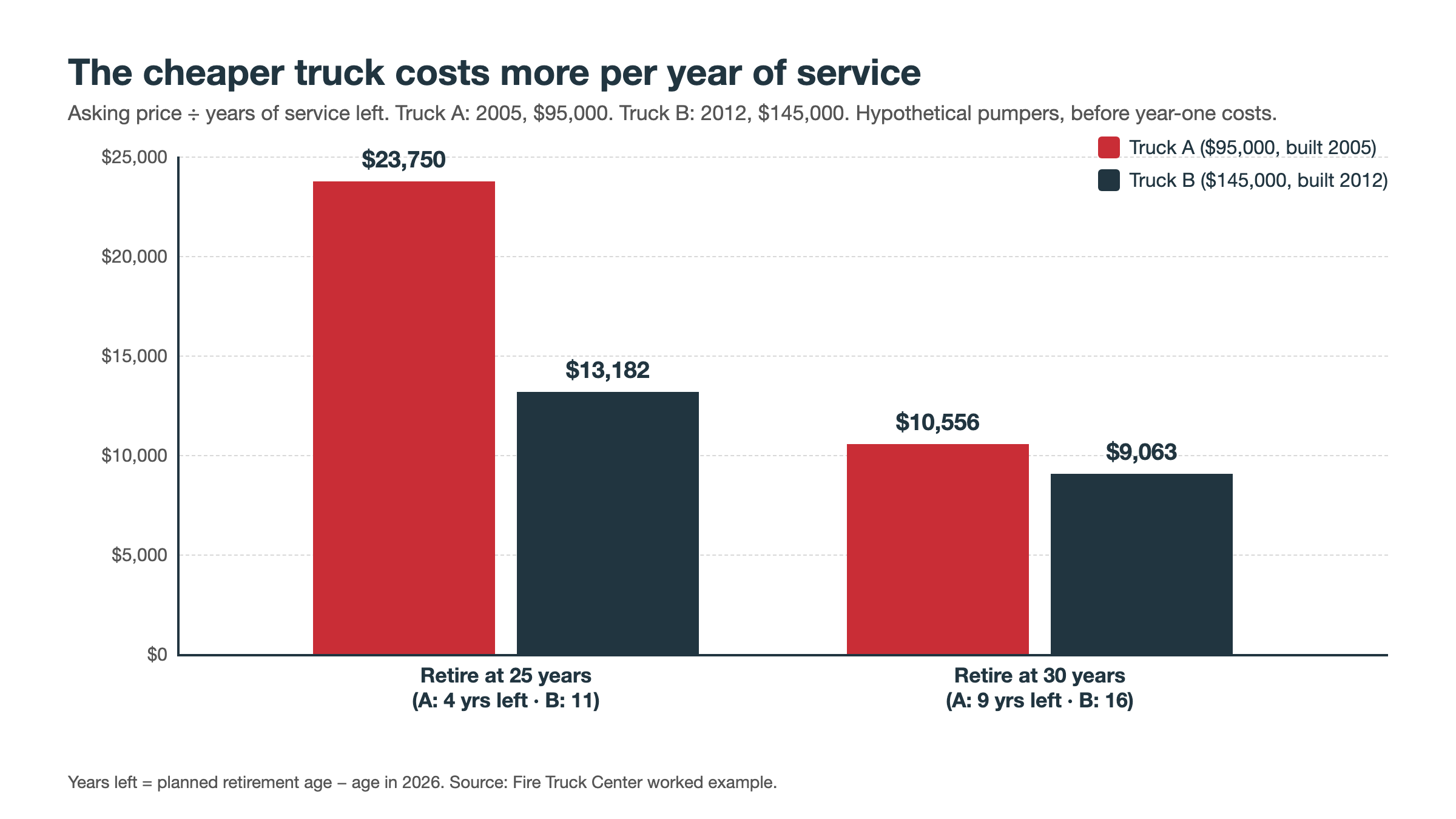
Truck A costs $50,000 less to buy. It also costs more per year at either retirement age, before a single repair. Add year-one costs and the gap usually widens, because the older truck is the one more likely to need tires, a pump test and pump work. Truck A also predates the 2009 edition, so it was built without the stability and seat belt warning requirements.
Truck A can still be the right buy. If you need a reserve pumper for five years and the budget is fixed, the lower price may matter more than the cost per year. The point of the number is to make that a decision your committee makes on purpose.
One more check before you sign: what happens if the truck turns out wrong? We give every truck a 30-day satisfaction guarantee with a full refund, and we pay the return freight. Ask any seller what their equivalent is, and put the answer on the score sheet next to the price.
Frequently asked questions
Is a newer used fire truck always the better buy?
No. A newer truck usually has more service years left and more of the current safety requirements, which often makes it cheaper per year. But a well-kept older truck with low miles and hours can beat a newer one that ran hard in a busy department. Compare the cost per service year and the inspection results, not the model year alone.
How old can a used fire truck be and still be worth buying?
It depends on the role and on its condition. NFPA’s Annex D guidance moves trucks older than 15 years to reserve and recommends replacing trucks older than 25. Many departments run older reserve units, but a truck built before the 1991 edition lacks fully enclosed seating and is best treated as a reserve or parts unit.
How often do fire truck tires need replacing?
NFPA 1911 calls for replacing fire apparatus tires at least every seven years, or sooner if they wear out. Read the four-digit DOT date code on each sidewall: the first two digits are the week and the last two are the year. A three-digit code means the tire was made before 2000.
Does NFPA require retiring a fire truck at a certain age?
No. The 15-year and 25-year figures come from Annex D, which is guidance, not a requirement. NFPA 1910, which now covers in-service inspection, maintenance, testing and retirement, is the standard that sets testing and maintenance requirements for trucks in service.
What matters more, miles or engine hours?
Look at both together. Hours often tell you more, because a fire truck can pump or idle for hours without moving. Our own buying cutoff is about 100,000 miles and about 10,000 hours. An unusual ratio between the two is a reason to check the truck’s history before trusting either number.
Should we buy a fire truck from a manufacturer that’s out of business?
You can, but price in parts and service first. Common components like the engine, transmission and pump usually have support. Proprietary cab, body and aerial parts can be hard to find. Ask a local apparatus shop whether they work on that make before you commit.
Talk to us about the two trucks you’re comparing
Fire Truck Center has been selling quality-tested used fire apparatus since 2015. Every truck we sell goes through a 150-point inspection, with third-party pump testing or aerial certification where it applies, and comes with a 30-day satisfaction guarantee.
If your committee is weighing two trucks, ours or anyone’s, call us at (215) 559-9119 or email help@firetruck.center. Send both listings and we’ll go through the comparison with you.
Sources
- NFPA — NFPA 1910: Standard for the Inspection, Maintenance, Refurbishment, Testing, and Retirement of In-Service Emergency Vehicles and Marine Firefighting Vessels (2024)
- Fire Engineering — The NFPA Apparatus Standard: Where We’ve Been, Where We Are Now, and Where We Are Going (August 2026)
- Tuolumne County Fire Department — 2022 Fleet Replacement Plan (2022)
- Firehouse — The Apparatus Architect, Part 20: What Does Annex D Mean To Me? (September 2004)
- MEL Safety Institute — Fire Apparatus Tires Best Practices (September 2023)
- City of Watertown, Minnesota — Fire Capital Project FC004, Ladder 11 (agenda item)
- FireRescue1 — Fire truck maker American LaFrance closes (February 2014)
- Midwest Fire — Best Practices for Purchasing New Fire Apparatus

 CALL US NOW