

Three federal routes pay for fire apparatus: the Assistance to Firefighters Grant, USDA Community Facilities Direct Loans and Grants, and state-administered Volunteer Fire Assistance awards. Which ones your department qualifies for depends almost entirely on the population you serve, and the thresholds are specific.
What is in this guide
Updated 15 October 2026 — we added a state-by-state table covering all fifty states, and corrected the fiscal-year label on the 2026 AFG cycle.
- What grants can actually buy a fire truck
- Which states will help you buy one — all fifty, one by oneNew
- What AFG funds, and what the match really costs
- Why SAFER will not buy a truck
- What rural and volunteer departments get outside AFG
- When to apply, and what is open year-round
- What to do when the grant does not cover the whole truck
- Frequently asked questions
Key Takeaways
- Population is the hinge for every apparatus grant. AFG cost share steps at 20,000 and 1 million residents, VFA stops at 10,000, and USDA Community Facilities stops at 20,000.
- AFG asks for a cash match of 5%, 10% or 15% depending on the population served. In-kind contributions are not allowed.
- SAFER does not buy fire trucks. It funds staffing, and it is the most common misunderstanding in this category.
- USDA Community Facilities names fire trucks as an eligible purchase and takes applications on a rolling basis, so it is open right now.
- FY2025 AFG closed on 22 June 2026. The next window is expected around May 2027, which makes the months before it the time to prepare.
What grants can a fire department use to buy a fire truck?
Four programs matter, and only three of them will pay for apparatus. Find your population in the left column and read across.
| Population served | AFG | USDA Community Facilities | VFA | SAFER |
|---|---|---|---|---|
| 5,000 or fewer | Yes, 5% cash match | Yes, grant up to 75% with low median income | Yes, 50/50, around $10,000 | No, staffing only |
| 5,001 to 10,000 | Yes, 5% cash match | Yes, grant up to 55% | Yes, 50/50, around $10,000 | No, staffing only |
| 10,001 to 12,000 | Yes, 5% cash match | Yes, grant up to 55% | No, over the limit | No, staffing only |
| 12,001 to 20,000 | Yes, 5% cash match | Yes, grant up to 15% with low median income | No, over the limit | No, staffing only |
| 20,001 to 1 million | Yes, 10% cash match | No, over the limit | No, over the limit | No, staffing only |
| Over 1 million | Yes, 15% cash match | No, over the limit | No, over the limit | No, staffing only |
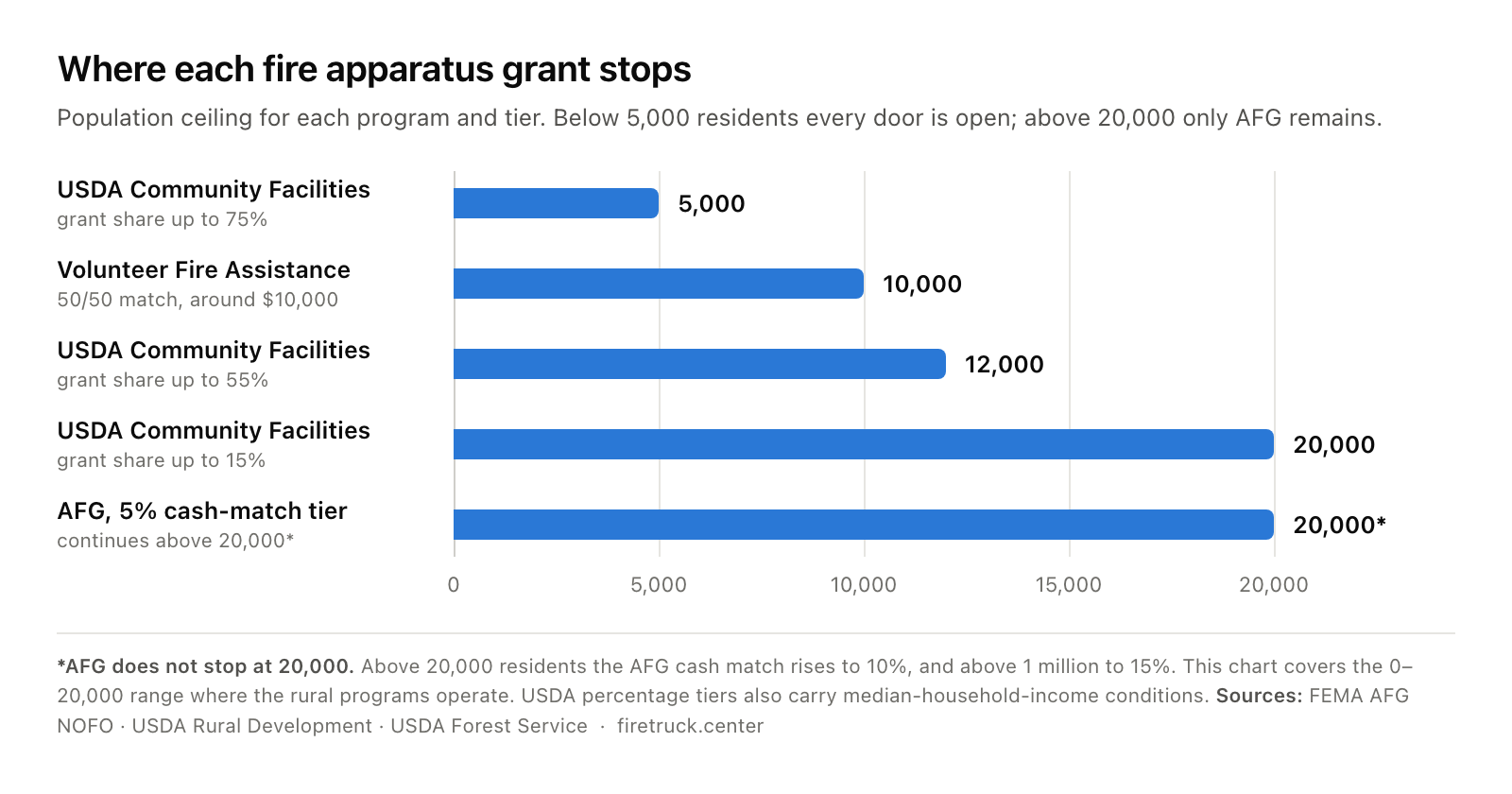
Two things fall out of that table immediately. Small rural departments have the most doors open and the most generous terms, and every route except AFG closes above 20,000 residents. If you serve a mid-size city, AFG is effectively your only apparatus grant.
The other thing worth knowing before you start is what you are applying for. A grant application is stronger when it names a real truck at a real price rather than an estimate, so it is worth looking at what a used fire truck costs and seeing what a grant-funded budget buys before you write anything.
Which states will help you buy a fire truck?
Federal money is only half the picture, and the state half is wildly uneven. We checked all fifty states at both the state fire marshal and the state forestry agency, because in several states only one of those two offices runs anything that reaches apparatus. Seventeen states have a route to apparatus money. The other thirty-three do not.
Nine of those seventeen lend rather than grant, at 2–3% interest, and that is the part most departments do not know exists. A chief told there are no grants open may still be eligible for a state loan at a rate no bank will match.
| State | Program | Maximum | What it says about a used unit |
|---|---|---|---|
| New Mexico | Fire Protection Grant · grant | $600,000 | Used is allowed, but needs three consecutive years of pump tests, five years of maintenance records and a certified EVT report |
| Delaware | Volunteer Fire Service Revolving Loan · loan at 2.0% | $600,000 new $125,000 used |
Used is eligible but capped far lower than new, over five years instead of ten |
| Arizona | DFFM fire district apparatus grant · grant, no match | $400,000 | Type 3 and Type 6 engines and tactical water tenders, and the state has confirmed to us that a used unit may be bought with it — one of the few places that is true. But the money is dormant: the $5 million was one-time federal relief, and as of October 2026 the department reports no movement on the bill meant to replace it |
| New York | Emergency Services Revolving Loan · loan at 2.5% | $375,000 or 75% | Silent on condition. Apply before you buy — it cannot reimburse costs already incurred |
| Illinois | Fire Truck Revolving Loan · loan, 0%–1.10% | $350,000 | Silent on condition. Brush trucks are a separate $100,000 line whose rate depends on where the truck was built |
| Pennsylvania | Fire & EMS Loan Program · loan at 2.0% | $272,177 used $340,276 new |
Used is financed at 80% of cost, new at only 50% |
| Iowa | Fire Fighting Equipment Revolving Loan · loan | $25,000–$150,000 | Pumpers, tankers and ladder trucks named. NFPA compliance is judged by the fire marshal |
| Kentucky | Fire Commission Low Interest Loan · loan at 3.0% | $125,000 | Equipment must meet the NFPA standard in force when it was built, not the current edition |
| Arkansas | Rural Services Block Grant · grant, 10% match | $100,000 | Pumper, tanker, brush and service trucks named. Population under 3,000 and 51% low-to-moderate income |
| Washington | HB 1168 Operations Grant · grant, no match | $20,000 next round | Eligible projects include vehicle “acquisition, refurbishment, or conversion” — and the state has confirmed that includes buying a unit a vendor has already refurbished. Earlier rounds reached $100,000 and $50,000 |
| North Carolina | Volunteer Fire Department Fund · grant | $40,000 | Bought thirteen apparatus last year — four pumpers, six brush and three service trucks |
| Texas | Rural VFD Assistance Program · grant, 90/10 | Not published | A dedicated Truck Grants category; the state reimburses 90% of cost |
| Virginia | Aid to Localities · formula allocation | By population | Vehicles are an eligible use. There is no application — it reaches the locality every June |
| Ohio | Small Government Revolving Loan · loan | $600,000 pool | That ceiling is the whole annual pool, not a per-department cap. Rate unpublished |
| New Jersey | VESO Loan Program · loan | Not published | Vehicles are an eligible use; rate and ceiling are not published |
| Nevada | Federal Excess Property, via state forestry | No purchase cost | Convertible surplus vehicles rather than cash |
| California | Cal OES surplus apparatus | Purchase price | The state sells surplus apparatus directly to departments |
Two rows are worth reading twice. Pennsylvania finances 80% of a used apparatus and only 50% of a new one — on a $300,000 unit that is $240,000 lent against $150,000. Delaware does the exact opposite, capping used at $125,000 while lending $600,000 on new. There is no national answer to whether a state will fund a used truck. There is a Pennsylvania answer and a Delaware answer, and they point in opposite directions.
What about the other thirty-three states? Most run a Volunteer Fire Assistance or Fire Capacity grant through the state forestry agency, passed down from the US Forest Service. Those are real programs with real money, but they award roughly $3,500 to $25,000 and they are not apparatus money. Several bar vehicles outright in writing: Kentucky excludes trucks, cars, ATVs, UAVs and utility-type vehicles, Maryland states that grants will not be approved for vehicle purchases, and Louisiana allows no single item over $10,000. Where no rule names vehicles, a per-item cap usually does the same job quietly.
Five states — Connecticut, Maine, New Hampshire, Rhode Island and Vermont — have no state apparatus program at all, and Massachusetts runs only fire-education grants. For a department in those states, AFG, USDA Community Facilities and conventional financing are the whole picture. That is not a cheerful answer, but it is better to know it in week one than in month six.
Two more are worth knowing even though neither will buy you a truck. Tennessee and Florida will pay your federal match. Tennessee’s $20 million equipment program excludes fire trucks outright, but the money may be used to help departments pay or reimburse the cost share for federal grants. Florida’s Firefighter Assistance Grant funds a cost-share subsidy for AFG apparatus awards. Federal money cannot be used to match another federal grant, but state money matching federal is allowed — so in those two states a department can win AFG for a vehicle and cover its 5–15% share from the state.
Terms were verified against each administrator’s own published documents in October 2026. Windows move every year and a few programs publish no figures at all, so confirm anything here with the administering office before you budget against it. If you spot something out of date, tell us and we will correct it.
What does AFG fund, and what will it cost your department to match?
One thing AFG will not do: buy a used truck. The FY2025 notice lists “used or refurbished apparatus” among its ineligible vehicle activities, alongside leasing, installment purchase, and converted vehicles not originally designed for firefighting. FEMA’s Fire Grants Help Desk confirmed this to us in writing in October 2026 and said it expects the same criteria to carry into the next cycle. AFG is a new-apparatus program. If a used unit is what your budget actually reaches, the state loans above are the better route — and a trade-in can still cover the cash match on a new AFG build, provided the allowance is itemised separately in the purchase documents rather than folded into a discounted price.
AFG funds apparatus directly. Vehicle Acquisition is one of its named activities, alongside Operations and Safety and the Regional program, so a fire truck is not an edge case you have to argue for.
The cost share is where departments get caught out. FEMA’s Assistance to Firefighters Grant program requires the applicant to provide non-federal funds of at least:
- 5% when the jurisdiction serves 20,000 residents or fewer
- 10% when it serves more than 20,000 but not more than 1 million
- 15% when it serves more than 1 million
Two details matter more than the percentages. The match must be cash. In-kind contribution is not allowable for AFG, so donated labor, a trade-in or equipment you already own will not count toward it. And the percentage is calculated on the federal award, so a department serving 8,000 people that wins $250,000 needs $12,500 in actual money available.
For scale on the FY2025 cycle, FEMA made $291.6 million available through AFG, with applications open from 19 May to 22 June 2026.
Does the SAFER grant pay for fire apparatus?
No. SAFER funds people, not equipment.
This is worth stating plainly because SAFER is the larger program by dollars. In FY2025 it carried $324 million against AFG’s $291.6 million, and it turns up constantly in searches for fire department funding. Departments reasonably assume the bigger fire grant must cover the biggest purchase.
SAFER exists to increase or maintain the number of trained front-line firefighters. It runs two activities: hiring firefighters, and recruitment and retention of volunteers. For hiring, eligible costs are salary and associated benefits, and overtime is not reimbursable. There is no apparatus category and no equipment category.
If your problem is staffing, SAFER is the right program and it is generously funded. If your problem is a truck that should have been replaced five years ago, SAFER cannot help and applying to it costs you a cycle.
Name a real truck in your application
Browse Fire Truck Center’s current inventory — pumpers, aerials, tankers and brush trucks. Every unit inspected, certified and individually priced.
What can rural and volunteer departments get outside AFG?
Two programs, and between them they are the most underused money in the fire service.
USDA Community Facilities Direct Loan and Grant Program. This is the one most departments have never heard of, and it names fire trucks as an eligible purchase outright. It serves rural areas with populations of 20,000 or fewer, and applicants can be municipalities, counties, special-purpose districts, non-profits or tribal governments. The grant share is tiered:
- up to 75% for communities of 5,000 or fewer with median household income below the poverty line or 60% of the state non-metropolitan median
- up to 55% for communities of 12,000 or fewer
- up to 15% for communities of 20,000 or fewer with median household income below the poverty line or 90% of the state non-metropolitan median
It is a loan and grant program, so the grant is usually paired with a low-interest direct loan covering the rest. For a small, low-income community, a 75% grant share is better than anything AFG offers.
Volunteer Fire Assistance. VFA is federal money from the USDA Forest Service passed to state forestry agencies, which award it to departments in rural areas. A rural community here means 10,000 residents or fewer.
Awards run on a 50/50 match and are generally capped around $10,000, with particular attention to departments in the wildland-urban interface. That will not buy a truck on its own, but it will cover a skid unit, pumps or protective equipment, and it frees other money for apparatus.
VFA rules and deadlines vary by state, because each state forestry agency runs its own program. Your state forester is the right first call, not a federal office.
When do you apply, and which programs are open year-round?
The calendars are completely different, and this is the practical difference between waiting eight months and applying this week.
It runs one window a year. FY2025 opened 19 May and closed 22 June 2026, so the next is expected around May 2027. If the window is shut, AFG is not an option this year regardless of need.
Community Facilities takes applications on a rolling basis through state offices, and its application window was open as of September 2026. There is no cycle to wait for.
Deadlines are set state by state, so this is a phone call rather than a website check.
AFG’s match is cash and must be available. An award you cannot match is an award you lose.
Applications are stronger, and awards are easier to spend inside their period of performance, when the apparatus is identified and priced rather than hypothetical.
What do you do if the grant does not cover the whole truck?
Assume it will not. AFG pays most of an award but never the match, VFA caps out around $10,000, and USDA’s grant share tops out at 75% only for the smallest and lowest-income communities. Almost every grant-funded apparatus purchase has a gap.
Two things close it. The first is buying used. A grant that covers 55% of a $900,000 new pumper still leaves $405,000 to find.
The same award against an inspected, certified used unit can cover the truck outright. A used truck stretches an award further than any application-writing trick, which is worth weighing when you are comparing a new build against a used truck.
The second is financing the remainder. A grant and a municipal lease-purchase are complements rather than alternatives, and the common structure is a grant covering part of the cost with the balance financed. Our guide to pairing a grant with a municipal lease-purchase covers how the tax-exempt mechanism works and why most leases avoid a voter referendum.
One practical note on documentation. Grant-funded purchases have to survive an audit, and a truck with a current third-party NFPA pump test, current aerial certification where applicable, and a documented inspection file is far easier to justify than an as-is auction buy. Every truck we sell goes through a 150-point inspection with third-party certification, which is as useful in a grant file as it is on the apparatus floor.
Frequently asked questions about fire department grants
Can a volunteer fire department get a grant for a fire truck?
Yes, and volunteer departments often have the most routes available. If you serve 10,000 residents or fewer you may qualify for VFA through your state forester, and if you serve 20,000 or fewer you may qualify for USDA Community Facilities, which names fire trucks as eligible. AFG is open to volunteer departments at the lowest cost-share tier of 5%.
What is the difference between AFG and SAFER?
AFG funds equipment, apparatus, training and safety. SAFER funds staffing, meaning salaries and benefits for hiring firefighters plus volunteer recruitment and retention. SAFER will not pay for a fire truck under any activity. If you need apparatus, AFG is the FEMA program that applies.
How much does a fire department have to match on an AFG grant?
At least 5% for jurisdictions of 20,000 residents or fewer, at least 10% for more than 20,000 up to 1 million, and at least 15% above 1 million. The match must be non-federal cash. In-kind contributions, donated labor and trade-in value do not count toward it.
Are there grants for fire trucks that are open all year?
Yes. The USDA Community Facilities Direct Loan and Grant Program accepts applications on a rolling basis through USDA Rural Development state offices, so there is no annual window to wait for. AFG runs one application period a year, and VFA deadlines are set individually by each state forestry agency.
Will a grant cover the entire cost of a fire truck?
Rarely. AFG always requires a cash match, VFA awards are generally capped around $10,000, and USDA’s grant share reaches 75% only for the smallest, lowest-income communities. Most departments close the gap by buying a used apparatus, financing the balance through a municipal lease-purchase, or both.
Talk to us before you write the application
Fire Truck Center has been selling quality-tested used fire apparatus since 2015 from 1991 Hartel Ave, Levittown, PA 19057, with hundreds of trucks delivered across 49 states. Every truck gets a 150-point inspection with third-party pump testing and certification, and a 30-day satisfaction guarantee.
A grant application is stronger when it names a real truck at a real price. Tell us your population, your apparatus type and the award you are chasing, and we will tell you what is in stock, what the documentation looks like, and what it would take in trade. Call (215) 559-9119 or email help@firetruck.center.
Sources
- FEMA — Assistance to Firefighters Grants
- FEMA — Staffing for Adequate Fire and Emergency Response (SAFER)
- FEMA — DHS Makes $648 Million Available to Help Firefighters and First Responders (18 May 2026)
- USDA Rural Development — Community Facilities Direct Loan & Grant Program
- FEMA — FY2024 AFG Notice of Funding Opportunity (cost-share bands)
- USDA Forest Service — Volunteer Fire Assistance, administered by state forestry agencies

 CALL US NOW