

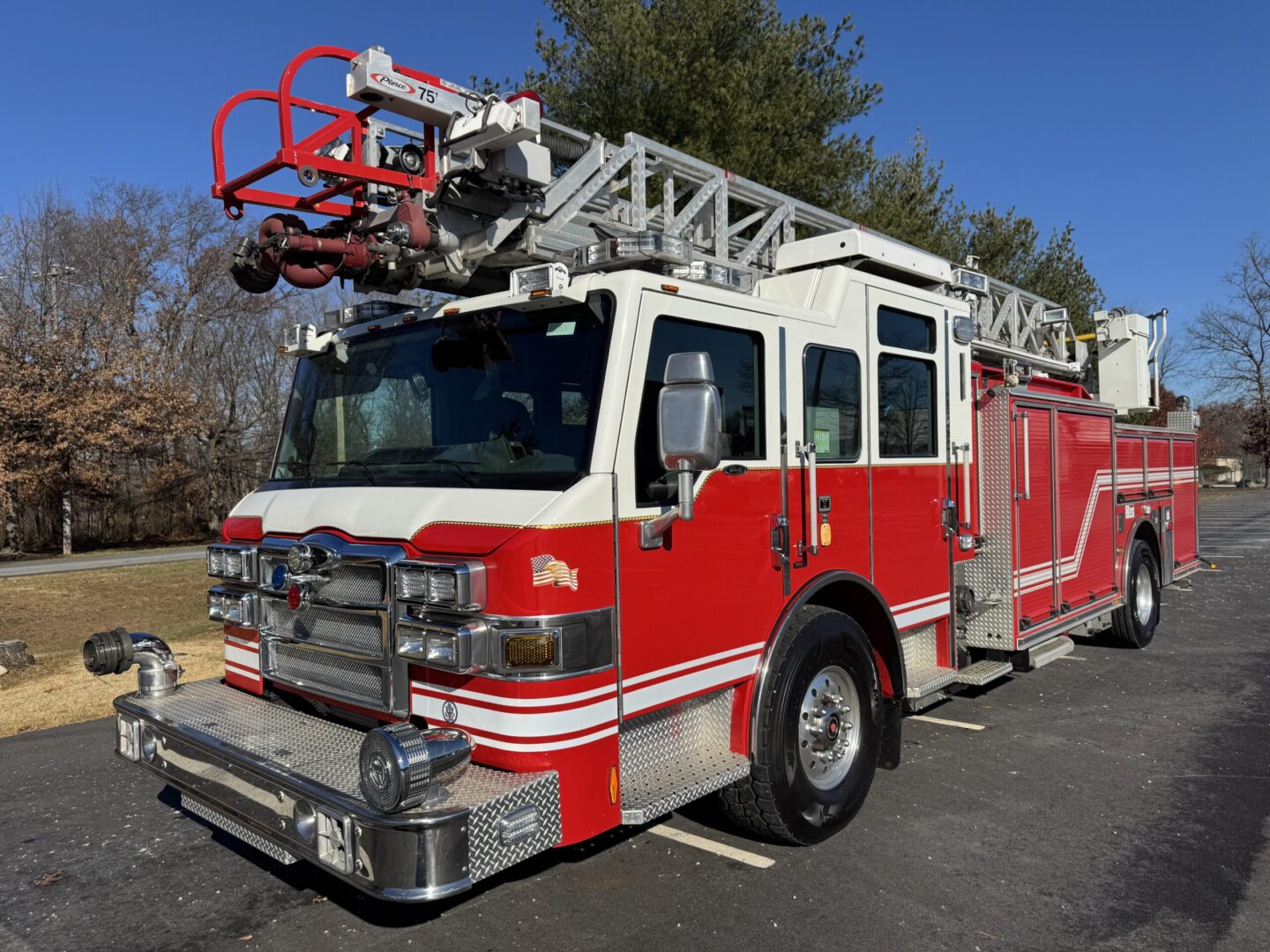
Fire trucks are sold at auction mainly through municipal surplus platforms like GovDeals, Municibid, JJ Kane, Purple Wave, and Wisconsin Surplus, where apparatus averaged just over $16,000 on GovDeals in 2025. Every one of those platforms sells as-is, none certifies that the truck works, and none provides or warrants a pump test, a load test, or a road test. What you are allowed to do with the truck before you bid is set by the individual seller, and it is usually a walk-around by appointment.
The winning bid is not the price of the truck. It is a down payment on a number you cannot see yet.
One thing up front: Fire Truck Center buys at these same auctions, reconditions what comes off them, and sells the results. We have an obvious interest in how you read this, so weigh it accordingly. There is a section below on when the auction is genuinely the right call, and we meant it.
Key Takeaways
- Apparatus averaged just over $16,000 on GovDeals in 2025, but verified sales run from $1,715 for a Pierce pumper that would not start to $423,730 for a 2021 E-One.
- No auction platform provides or warrants mechanical testing. JJ Kane’s terms say its condition reports “do not include road testing or load testing of mechanical condition” and that there is “no certification of operability.” What you can physically check is whatever the individual seller allows, and it is usually a visual walk-around.
- The market already prices the risk. A 75-foot Smeal aerial sold for $4,950 in the same channel where a 1998 tanker-pumper made $70,400. Municipal records put a corroded aerial torque box repair at $108,940 and $152,000.
- No pump test or aerial certification comes with the truck. NFPA 1910 requires pump testing annually and aerial nondestructive testing at least every five years, and neither transfers with the sale.
- The auction still makes sense for simple trucks, close-by lots, support units, and departments with a mechanic and a shop. It rarely makes sense for an aerial.
Where do fire trucks at auction come from, and what do they sell for?
Fire trucks reach auction when a department retires them, and they are sold through municipal surplus platforms on behalf of the town, city, or district that owned them. Apparatus averaged just over $16,000 on GovDeals in 2025, but the real spread is enormous, because condition is doing all the work.
Here are completed sales recorded on the platforms themselves, from Wisconsin Surplus auction results and Purple Wave’s published market-value data for fire apparatus:
| Truck | Condition noted in the listing | Sale price |
|---|---|---|
| 2021 E-One Typhoon 1500 GPM pumper | DOT and pump tests completed 2025, seller has title | $423,730.56 |
| 1998 International 4900 tanker-pumper, 2,000 gal | 31,094 miles | $70,400 |
| 2006 Peterbilt 357 pumper, 3,000 gal | Rollover damage, no title issued | $22,000 |
| 1994 International 4900 with 75-foot Smeal aerial | Sold as-is | $4,950 |
Two of those deserve a second look. A 75-foot aerial ladder truck sold for $4,950, less than a used pickup, and the listing recorded nothing beyond “sold as-is.” Whether that reflects the ladder, the drivetrain, or something else, the listing does not say, and neither could the bidder. And someone paid $22,000 for a pumper listed with no title issued, which leaves the buyer to find out whether the paperwork they do get is enough to register it at home.
One clarification on where you are shopping. GovDeals, Municibid, JJ Kane, Purple Wave, and Wisconsin Surplus run actual auctions. TruckPaper is a classifieds marketplace whose own terms describe it as “solely a passive conduit” that never becomes party to the sale. Auctioneers post lots there, so it turns up in the same searches, but the terms governing your purchase are the individual auctioneer’s.
For a baseline on what apparatus is worth outside the auction channel, our guide to what used fire apparatus sells for in 2026 breaks the ranges down by type.
What does “as-is, where-is” mean when you are buying a fire truck?
On a fire truck, as-is means the seller disclaims every warranty of merchantability and fitness, makes no promise the truck will run when you get it home, and in most cases treats your bid as legal proof that you already inspected it. It is not boilerplate. It is the entire allocation of risk, and it lands on you.
The wording is blunter than most buyers expect. Wisconsin Surplus sells items as is, where is, how is and “WITH ALL FAULTS, known, apparent, unknown or otherwise,” states that “all Bidders rely solely on their personal inspection,” and adds that “there are no returns, refunds or adjustments.” JJ Kane’s purchaser terms say in capitals that there is “no certification of operability” and that neither auctioneer nor seller warrants the item will function once removed from the auction site.
Two clauses matter more than the rest, and almost nobody reads them.
The misdescription claim dies when the truck leaves the lot. GovDeals’ standard terms do warrant that property will conform to its description and will refund the purchase price if it does not. Then: “Please note upon removal of the property, all sales are final.” Your one protection expires at the gate. If the truck is not what the listing said, you find that out before you load it or you never find it out at all.
Bidding can count as inspecting. Denver’s seller terms on GovDeals state that “submission of a bid shall be prima facie evidence that the bidder/buyer did, in fact, make an inspection,” and that no claim will be considered for a failure to inspect. You can be held to an inspection you never performed, on a truck you never saw.
What can you not check before you bid?
Nobody hands you a pump test, a load test, or a road test. Every platform disclaims mechanical inspection and pushes the job onto you, and what you are able to do on the lot is set by the individual seller. In practice that means a visual walk-around by appointment during posted hours, which leaves the expensive half of a fire truck unexamined.
JJ Kane states the limit plainly: its condition reports cover “the visible condition of the Auction Item’s major systems and attachments observed on the day of inspection” and “do not include road testing or load testing of mechanical condition.” Purple Wave says the auctioneer “does not perform mechanical inspections on Items and the listings are not intended to be substitutions for independent inspection by the Buyer.” The message is consistent: verifying this truck is your problem, and your access is limited.
What that leaves unverified:
- The pump. A visual check tells you a pump exists. It does not tell you whether it makes rated flow at rated pressure, which is the only thing that matters.
- The aerial. Ladder condition is a structural question answered by nondestructive testing, not by looking at it.
- The frame and torque box. Corrosion here is internal. Reaching it means pulling the aerial device, body, and outriggers, which is why it turns up during a repair rather than during a walk-around.
- Tank, plumbing, and valves. Leaks show up under pressure, and nothing gets pressurized at a surplus lot.
- Everything electrical. Warning lights, scene lights, and pump panel instrumentation are only testable powered up.
Two platforms do give you a pre-removal remedy, and they work differently. GovDeals warrants that property will conform to its description and will refund if it does not, but only before you take it. Wisconsin Surplus goes further and tells buyers to test at pickup, in its words to “start it, plug it in, turn it on, make sure it is as it was described,” with a hard condition attached: if you find a major discrepancy and want a refund, “you must LEAVE the item.” Take possession and the refund is gone. That is the strongest buyer protection in the set, and it arrives after you have already paid.
If you are going to bid anyway, work through our pre-purchase inspection checklist first, so you at least know what your eyes can and cannot settle.
What does a bad auction buy cost?
A failed pump or aerial is not a negotiating point. It is a five- or six-figure invoice. This is the number every other guide to buying at auction tells you to budget for and then never puts a figure on.
The market already prices this, and the numbers are stark. In one channel a 1994 International with a 75-foot Smeal aerial sold for $4,950 while a 1998 tanker-pumper sold for $70,400. A working ladder truck went for less than a used pickup.
That gap is not a bargain waiting to be claimed. It is what a structure nobody is allowed to test is worth.
Here is why the gap is that wide. Two municipal repair records show what a corroded aerial costs once somebody finally opens it up.
South Burlington, Vermont put its ladder truck through the annual third-party inspection required of in-service apparatus. It failed, with a rusted main frame and torque box. The repair came to $152,000 and was expected to take about four months, with the truck out of service throughout.
Evanston, Illinois got a quote of $108,940 on a 2006 Pierce Dash 105-foot aerial after its servicing vendor found “significant holes about 12 feet long” inside the torque box and UL reported the metal thickness was “nearing a point of instability.” That figure was $73,940 of quoted work plus a $35,000 allowance for whatever the teardown turned up, because reaching a torque box means pulling the aerial device, body, and outriggers off the truck.
Two things about those numbers, stated plainly. Neither truck was bought at auction, and in Evanston’s case years of service passed between the purchase and the finding, so neither is evidence about how a truck was acquired. They are here for one reason: to price the repair. That is the invoice waiting behind a $4,950 aerial, and it is the number every other guide on this topic tells you to budget for without ever naming.
Here is what the common failure points cost, and whether you can catch them before you bid.
| Failure point | Can you verify it before bidding? | Real cost |
|---|---|---|
| Pump fails its annual test | No, no platform provides a pump test | Pump refurb $23,000 to $28,400; mechanical seal replacement $5,840 to $7,592; one department logged $14,117 for pump and gearbox repairs |
| Aerial fails certification | No | $152,000 for a rusted aerial frame and torque box that failed annual testing |
| Frame or torque box corrosion | Only visually, and visual checks miss it | $108,940 quoted to reach and repair a torque box on a 2006 Pierce aerial |
| Water tank | No | Poly tank upgrade $21,000 to $26,400 installed |
| Engine or transmission | Rarely, and never under load | In-frame engine rebuild $48,000 to $56,900; Allison 4000 transmission rebuild $17,750 to $21,375 |
| Missing or branded title | Sometimes, if the listing discloses it | Potentially the entire purchase, if you cannot register it |
| Transport off the lot | Yes, but rarely budgeted | Roughly $2.75 to $4.00 per mile long-haul, per one broker’s published rates, plus $600 to $3,000 more if it will not run |
Refurbishment figures are from a fire apparatus refurbisher’s published price list, circa 2023. Testing and repair invoices are from published municipal records.
Two more things the table cannot show you.
Certification is a pass or fail event, not a haggle. NFPA 1910 requires in-service fire pumps to be performance-tested annually, and aerial devices to be inspected and tested annually with nondestructive testing at least every five years. An aerial that fails has to be repaired and retested before it can go back in service, and on a 30-year-old ladder whose builder is no longer in business, finding a shop your authority having jurisdiction will accept is its own problem.
Nobody publishes what a five-year aerial NDT costs. We looked. UL, MISTRAS, and the independent test houses are all quote-only.
The public numbers that exist are municipal invoices: around $430 for an annual pump service test in one Wisconsin department’s 2025 report, and $1,295 for an aerial device test and inspection in a Pennsylvania borough’s 2019 minutes. Anyone quoting you a confident range for aerial NDT is guessing.
Can you title it, register it, and get it home?
Not always, and not necessarily by driving it. Title is guaranteed on one of the five major platforms, the firefighter CDL exemption is optional by state and does not follow you across state lines, and the clock to pay and physically remove the truck is shorter than most buyers plan for.
Title. JJ Kane guarantees the seller’s free and clear title, though not the timing, and the name on it is locked to your bidder registration. Purple Wave explicitly does not guarantee title and tells bidders to run the VIN past their own motor vehicle department, because undisclosed title brands are the buyer’s problem.
Municibid disclaims warranty of title in its platform terms. GovDeals says a title or certificate will be issued on removal, subject to whatever restrictions the listing carries. Settle this before you bid, not after.
Driving it home. A fire truck clears the commercial driver’s license weight threshold without difficulty. The Group B threshold is 26,001 pounds, and rural tankers can exceed 50,000.
There is a firefighter exemption in the federal rules, and it does less than people assume. Under 49 CFR 383.3(d), a state may, at its discretion, exempt firefighters operating emergency vehicles, and “the use of this waiver is limited to the driver’s home State unless there is a reciprocity agreement with adjoining States.” The exemption is also written around emergency response, not around collecting a truck you just bought. For context on how narrowly the agency reads these carve-outs, FMCSA guidance on the separate motor carrier exemption states that “related operations” does not include “the pre-positioning of fire trucks or rescue vehicles in anticipation of emergencies, or the use of such vehicles in training or emergency preparedness exercises.” Ask your state DMV before you plan the trip.
The clock. Purple Wave requires payment by 4:00 p.m. on the second business day after the auction, charges a 15% default fee if you miss it, and caps card payments at $3,000, so on a fire truck you are wiring funds. GovDeals allows five business days to pay and ten business days to remove.
JJ Kane allows ten calendar days to remove, “without exception,” by scheduled appointment. One Wisconsin Surplus fire department auction closed on a Wednesday with payment due in five days and the truck off the property in seven.
Seven days to arrange a heavy haul across several states is not much time, and the hauling is your cost, your arrangement, and your risk. One broker publishes long-haul heavy equipment rates of roughly $2.75 to $4.00 per mile, with example lanes at $4,800 for Houston to Los Angeles and $4,100 for Chicago to Miami, and says an inoperable machine adds $600 to $3,000 or more. Treat those as one company’s advertised rates rather than a market price, and get your own quotes before you bid.
One more thing to read on every listing: emissions and bidder restrictions. Lots located in California routinely carry notices about emissions compliance, and some are restricted to licensed dealers. Both are stated on the listing, and both are easy to skim past.
When is a fire truck auction the right call?
Often. An auction is a good route when the truck is mechanically simple, when you can physically get to the lot, when your department has a mechanic and a bay, and when the rig is going into support service rather than becoming your first-due engine.
The conditions that make an auction work:
- Simple apparatus. Brush trucks, tankers, utility and support units. Fewer certified systems means fewer pass-or-fail gates and a much smaller downside. A commercial chassis with a tank and a small pump is something most shops can assess and fix.
- A lot you can drive to. Getting your own mechanic in front of the truck during the inspection window closes most of the information gap. Distance is what turns a used truck purchase into a lottery ticket.
- In-house maintenance. A department with its own mechanic can absorb a $6,000 surprise. One that farms everything out at shop rates often cannot.
- A disclosed, documented truck. They exist. One 2021 E-One pumper sold through Wisconsin Surplus listed completed DOT and pump tests from the prior year and a clear title in hand. That is a real inspection you did not have to pay for.
- A truck young enough to have a future. NFPA 1910’s Annex D, which is guidance rather than a requirement, suggests departments think hard about keeping apparatus over 15 years old in first-line service and replacing anything over 25. A public input in the current revision cycle proposes moving those to 20 and 30. Either way it is a sane screen.
Plenty of volunteer departments have bought well at auction and put good trucks in service for a fraction of any other route. The failure mode is not the auction. It is bidding on a certified system, an aerial or a pump, that you were never allowed to test.
Auction or dealer, how should your department decide?
It comes down to who absorbs the unknown. At auction you do, in exchange for a lower number. From a dealer you pay more up front because the inspection, the pump test, and the certification have already been done and paid for by someone else.
| Auction | Reconditioned from a dealer | |
|---|---|---|
| Price | Lowest, plus a buyer’s premium of roughly 9% to 17% | Higher, inclusive |
| Pre-purchase testing | Not provided or warranted | Completed before sale |
| Pump and aerial certification | Not included, not implied | Documented |
| Recourse if it fails | None after removal | Per the dealer’s guarantee |
| Timeline | Days to pay, days to remove | Weeks, delivered |
| Who carries the repair risk | You | The seller |
Price the buyer’s premium in properly, because it is neither a rounding error nor uniform. Purple Wave charges a flat 10%. JJ Kane charges 12% to 17% depending on the state, plus a $125 administrative fee on titled items.
Municibid charges a tiered buyer’s fee starting at 9%. GovDeals premiums are set by each selling agency and vary lot to lot, so read the bid box on the specific listing rather than assuming a platform rate.
Fire Truck Center sits on the other side of that table. Our trucks go through a 150-point inspection that includes pump testing and aerial certification where applicable, and most come with a 30-day satisfaction guarantee, delivered nationwide from Levittown, Pennsylvania. We have been doing this since 2015.
That work is not a favor; it is the same work an auction buyer inherits, done before the truck is priced instead of after. To compare the two routes on speed rather than price, our breakdown of how long each buying route takes has the timelines, and the difference between a reconditioned truck and one sold as-is covers what reconditioning includes.
Frequently Asked Questions
Can a civilian buy a fire truck at auction?
Yes. Municipal surplus auctions are open to the public, and private buyers regularly purchase decommissioned apparatus for farms, film work, contracting, and collections. The practical limits are the same ones departments face: you inherit an as-is vehicle with no certification, you need to confirm the title will transfer in your state, and you have to arrange removal within the auction’s deadline.
Do you need a CDL to drive a fire truck?
Usually yes, because most apparatus exceeds the 26,001-pound threshold for a Class B commercial driver’s license. Federal rules let each state exempt firefighters operating emergency vehicles, but that waiver is optional, applies only in the driver’s home state unless a reciprocity agreement exists, and is written around emergency response rather than moving a newly purchased truck. Check with your state DMV before you plan to drive one home.
Does an auction fire truck come with a current pump test or aerial certification?
No. Auction platforms state plainly that there is no certification of operability, and a pump test or aerial certification does not transfer with the sale. NFPA 1910 requires in-service pumps to be tested annually and aerial devices to be tested annually with nondestructive testing at least every five years, so budget for that testing as a condition of putting the truck in service, not as an optional extra.
What is the cheapest a fire truck sells for at auction?
Apparatus has sold for as little as a few thousand dollars, and non-running trucks go lower still. A 1994 International with a 75-foot Smeal aerial sold for $4,950 on Purple Wave, against a 1998 tanker-pumper that made $70,400 in the same channel. A price that low is the market telling you what the repair bill looks like.
How much does it cost to ship a fire truck?
One heavy equipment transport broker publishes long-haul rates of roughly $2.75 to $4.00 per mile, with sample lanes such as $4,800 from Houston to Los Angeles and $4,100 from Chicago to Miami, and adds $600 to $3,000 or more for equipment that will not run. Fire trucks move on a lowboy or step-deck trailer, and rural tankers can exceed 50,000 pounds. Get your own quotes before bidding, since removal deadlines can be as short as seven days.
Thinking about a lot that closes this week? Send us the listing and we will tell you what we would check and what we would worry about, no obligation. Or skip the unknown and look at used fire trucks we have already inspected and certified, each one 150-point inspected, pump-tested, and backed by our 30-day guarantee, delivered nationwide. Call (215) 559-9119.
Sources
- NFPA 1910, Standard for the Inspection, Maintenance, Refurbishment, Testing, and Retirement of In-Service Emergency Vehicles and Marine Firefighting Vessels
- UL Solutions, fire department pump performance testing
- UL Solutions, fire department aerial device testing and inspection
- City of Evanston, approval of repair of the Evanston Fire Department aerial
- Fire Apparatus & Emergency Equipment, South Burlington VT aerial frame repairs
- SVI Refurb, fire truck refurbishment price list
- Town of Peshtigo Fire Department 2025 annual report
- Steelton Borough council minutes, June 17 2019
- GovDeals standard terms and conditions
- GovDeals seller terms, City and County of Denver
- JJ Kane purchaser terms and conditions
- Purple Wave auction terms
- Purple Wave, completed fire truck and emergency vehicle sales
- Wisconsin Surplus user agreement and terms of use
- Wisconsin Surplus, City of Pewaukee Fire Department auction
- Municibid terms of use
- Municibid buyer’s fees
- TruckPaper terms of use
- GovDeals, used fire truck prices
- 49 CFR 383.3, commercial driver’s license exceptions
- FMCSA regulatory guidance, exemption for fire trucks and rescue vehicles
- BAH Logistics, heavy equipment shipping rates

 CALL US NOW