

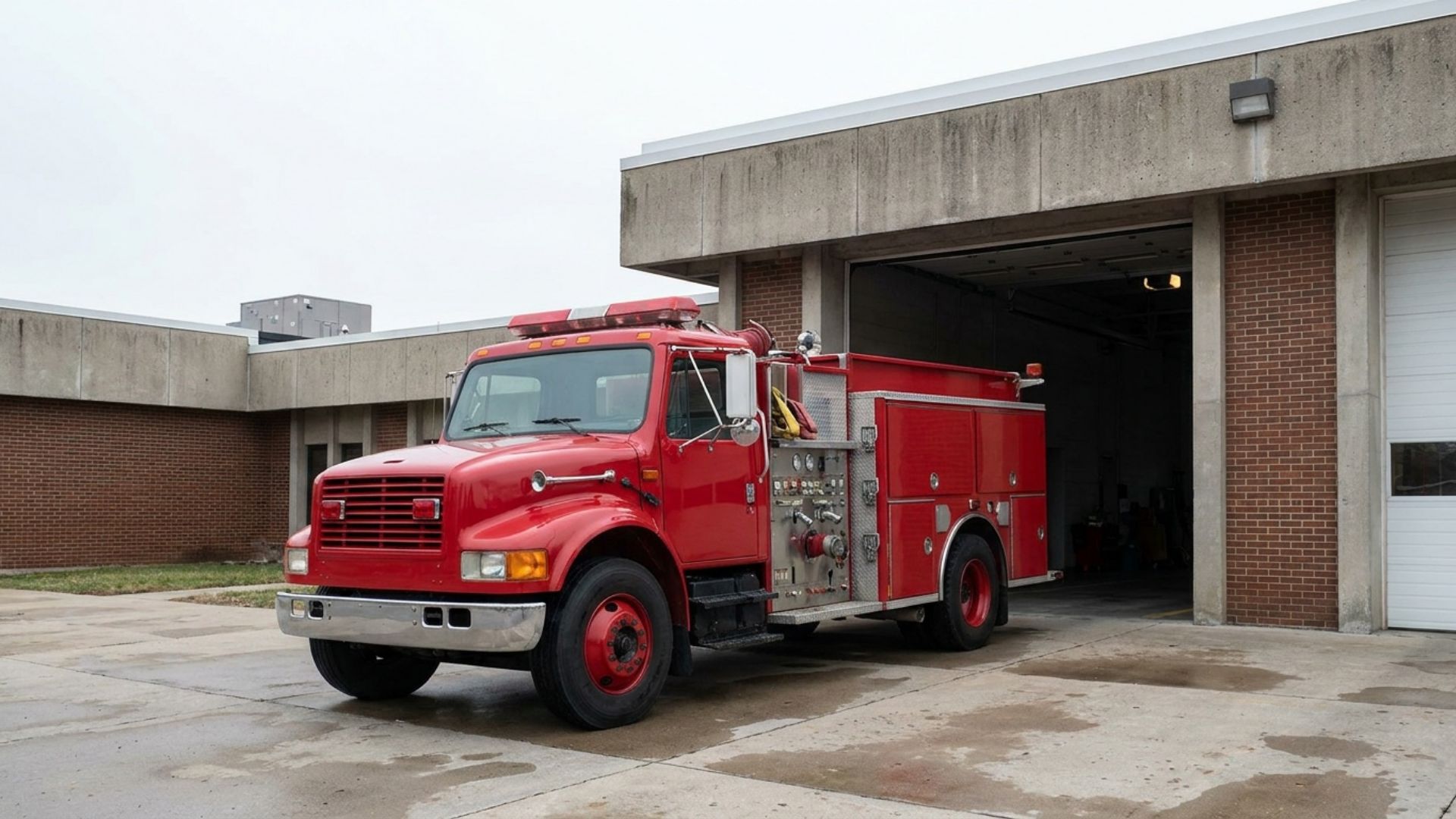
A fire truck runs from about 24 feet long for a commercial-chassis pumper to 63 feet for a tiller aerial, and stands 9 to 13 feet tall. Body width barely moves — nearly every apparatus configuration measures 98 to 100 inches across. Length and height are the numbers that change, and they change with configuration, not with brand.
Key Takeaways
- Fire apparatus length spans 24 to 63 feet depending on configuration. Width is close to fixed at 98 to 100 inches.
- The legal width allowance for an emergency vehicle is 102 inches, measured exclusive of mirrors. A legal-width truck is wider than 102 inches in your doorway.
- NFPA sets no size or weight limit on apparatus. Road law does, and state width law is not uniform.
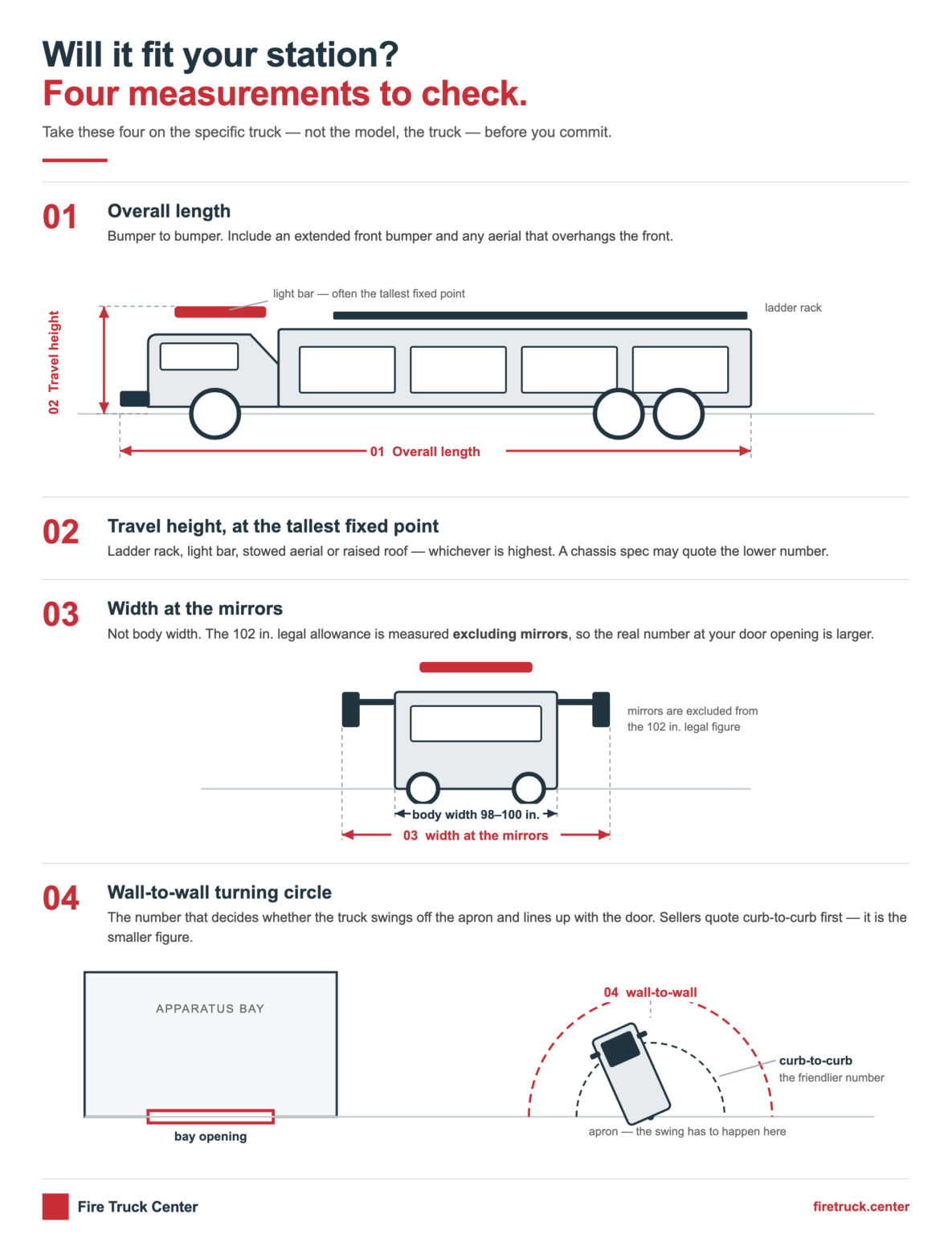
- Four measurements decide bay fit: overall length, travel height at the tallest fixed point, width at the mirrors, and the wall-to-wall turning circle.
- Height is a specification decision, not a fixed fact. One published 100-foot aerial spec capped overall height at 140 inches purely to clear 12-foot doors.
How long is a fire truck?
A fire truck’s overall length depends on what the truck is built to do. A commercial-chassis pumper can be as short as 24 feet. A tiller aerial runs to 63 feet. Everything else falls between.
These are the typical ranges by configuration, from the Fire Apparatus Manufacturers’ Association size and weight tables:
| Configuration | Width (in.) | Height (ft.) | Length (ft.) |
|---|---|---|---|
| Commercial chassis pumper — single rear axle | 98–100 | 9–12 | 24–35 |
| Custom chassis pumper — single rear axle | 98–100 | 9–12 | 30–34 |
| Commercial chassis tanker — tandem rear axle | 98–100 | 10–12 | 30–40 |
| Custom chassis tanker — tandem rear axle | 98–100 | 10–12 | 34–40 |
| Industrial foam pumper — single rear axle | 98–100 | 10–12 | 30–36 |
| Aerial ladder — single rear axle | 98–100 | 10.5–12.5 | 36–43 |
| Aerial ladder — tandem rear axle | 98–100 | 10.5–12.5 | 39–43 |
| Aerial platform, mid-mount — tandem rear axle | 98–100 | 9.5–11.5 | 46–51 |
| Aerial platform, rear-mount — tandem rear axle | 98–100 | 11.5–13 | 46–48 |
| Aerial ladder, tiller — tractor tandem rear axle | 98–100 | 10.5–11.5 | 56–63 |
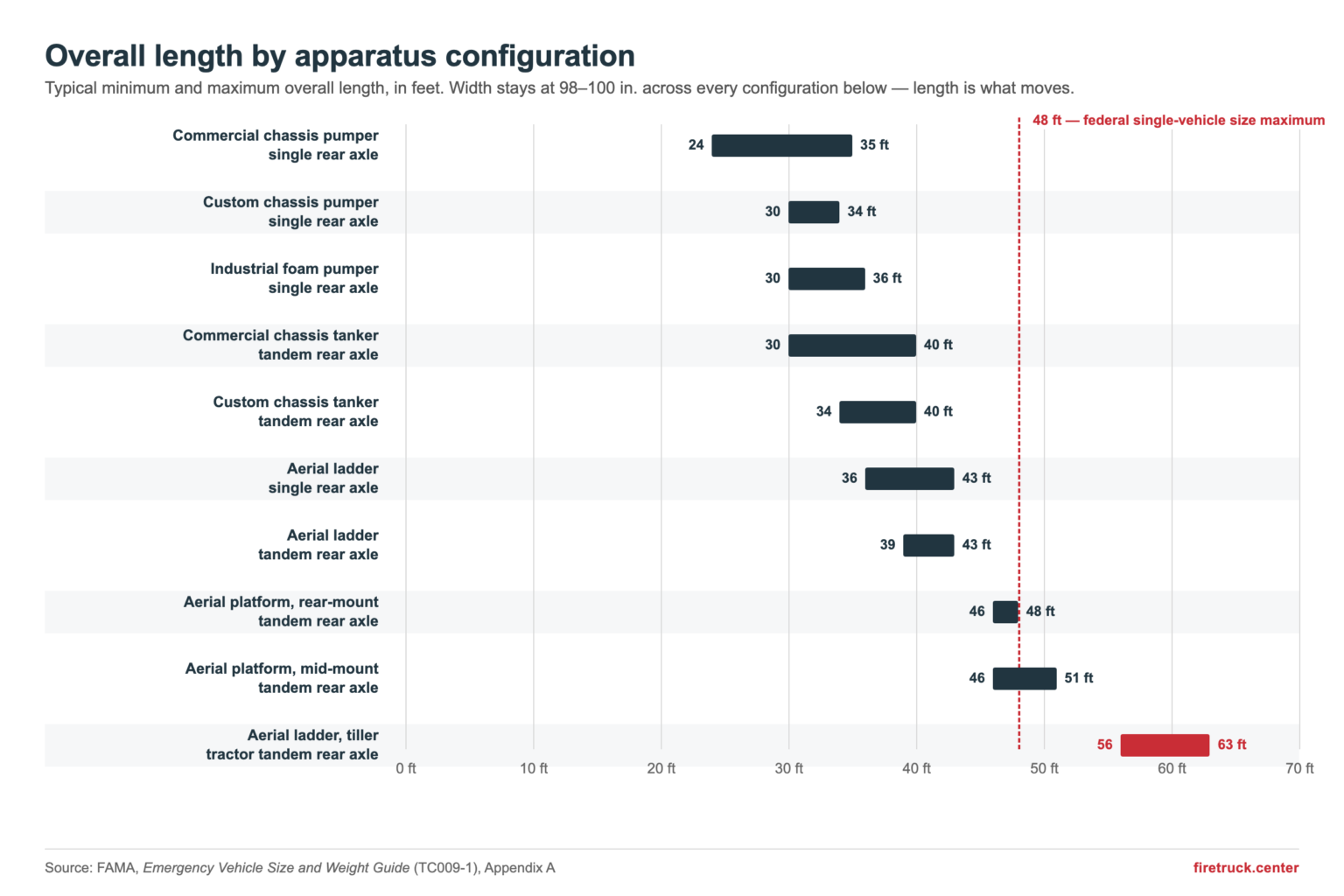
Two things in that table are worth sitting with. The first is how little width varies. The second is that a mid-mount platform is shorter in height than a rear-mount platform — 9.5 to 11.5 feet against 11.5 to 13 feet — while being longer on the ground. If your problem is a low door header, the taller-looking truck may be the one that fits.
If you are still sorting out which type your department needs, our guide to fire truck types covers what each one is built for.
Configuration choices move these numbers. A top-mount pump panel and an extended front bumper both add length. A raised cab roof and a rear-mounted aerial both add height. When you browse used apparatus by type, you are choosing a footprint as much as a capability.
How wide and how tall is a fire truck?
Fire apparatus body width sits at 98 to 100 inches across effectively every configuration. Height runs 9 to 13 feet, and that is where used buyers get caught.
Width first, because there is a trap in it. An emergency vehicle may exceed otherwise applicable size limits up to 102 inches wide — but that figure is measured exclusive of rear view mirrors, turn signal lamps, handholds for cab entry and egress, splash and spray suppressant devices, load-induced tire bulge, and a fixed step up to three inches deep. A truck that is legally 102 inches wide is meaningfully wider than 102 inches when you drive it at a door opening. Mirrors are the first thing people hit.
Height is the other one. The height on a spec sheet may describe the chassis and body. It may not include the ladder rack, the light bar, the stowed aerial, or a raised cab roof. Travel height is the tallest fixed point on the vehicle, and that is the number your door header cares about.
Ask for it specifically.
Measuring a bay against a specific truck?
Browse Fire Truck Center’s current inventory — pumpers, aerials, tankers and brush trucks. Every unit inspected, and we will measure any of them against your door opening before you commit.
Does NFPA limit how big a fire truck can be?
No. The NFPA apparatus standard intentionally excludes any reference to vehicle size or weight limitations. FAMA states this plainly in its size and weight guide. Departments often assume otherwise.
What sets the ceiling is road law. Federal regulation permits states to treat emergency response vehicles as nondivisible loads, and the size maximums an emergency vehicle may reach are 102 inches wide, 162 inches tall — 13.5 feet — and 48 feet for a single vehicle or 65 feet for a combination vehicle.
State law is where this gets local. FAMA’s own state survey found width treated three different ways: some states exempt emergency vehicles entirely, some cap at 96 inches, some at 102 inches. Check your state rather than trusting a national figure.
One note on standard numbers, because they changed. Apparatus contracted for after January 1, 2024 falls under NFPA 1900, which replaced NFPA 1901 along with three other documents. For a used truck, the standard that governs the vehicle you are buying is NFPA 1910 — inspection, maintenance, refurbishment, testing and retirement of in-service vehicles.
What four measurements tell you if a fire truck fits your station?
Four numbers decide whether a truck can reach, enter and live in your station. Get all four in writing before you commit.
Bumper to bumper. Include an extended front bumper and any aerial that overhangs past the front of the vehicle.
Ladder rack, light bar, stowed aerial, raised roof — whichever is highest.
Not body width. The legal width figure excludes mirrors, so body width understates what has to pass through your door.
This is the number that decides whether the truck can swing off the apron and line up with the door. Sellers and builders often quote curb-to-curb first because it is the smaller, friendlier figure. Wall-to-wall is the one that matches a building.
Ask for the wheelbase too. Apparatus purchasing committees routinely ask builders to supply wheelbase alongside both curb-to-curb and wall-to-wall turning radii, which tells you these are normal numbers for a seller to have.
How much clearance should an apparatus bay have?
Measure the building against all four numbers, not only the two obvious ones.
Door opening width against width at the mirrors. Door header height against travel height. Bay depth against overall length, plus the room your crew needs to work around the truck once it is inside. Apron depth against the wall-to-wall turning circle.
Approach, departure and breakover angles matter if your apron slopes — FAMA lists all three among the criteria infrastructure designers should request from their local department, alongside turning circles and aerial stabilizer jack spread.
For an aerial, add the stabilizer footprint. Jack pads are typically 24 inches square, sized so ground pressure stays under the 75 psi ceiling the apparatus standard sets. That is a question about what your apron is made of, not only how big it is.
What if the truck you want doesn’t fit your station?
Spec to the building. That sounds obvious and it is what experienced buyers do. One published specification for a 100-foot four-section rear-mount aerial set a maximum 140-inch overall height for the explicit purpose of fitting through 12-foot doors, at roughly 42 feet 6 inches overall length. The building came first and the truck was written to it.
On used apparatus your levers are configuration rather than a custom build, and there are more of them than most buyers expect. A mid-mount platform sits lower than a rear-mount. A single-axle aerial is shorter than a tiller. A side-mount pump panel is shorter than a top-mount.
Within used aerial inventory the spread between the shortest and tallest configuration is well over a foot of height.
We measure length, width at the mirrors and travel height on every truck before it ships, because a truck that will not go in the building is not a truck the department can use. If the fit is close, tell us the door opening and the header height and we will check it against the unit. Once fit is settled, the next question is condition — our used fire truck inspection guide walks through what to verify before you buy.
Frequently Asked Questions
How long is a fire truck in feet?
Fire trucks run from about 24 feet to 63 feet long. A commercial-chassis pumper starts around 24 feet, custom pumpers run 30 to 34 feet, aerial ladders 36 to 43 feet, mid-mount platforms 46 to 51 feet, and tiller aerials 56 to 63 feet.
How wide is a fire truck?
Fire apparatus bodies measure 98 to 100 inches wide across nearly every configuration. The legal allowance for an emergency vehicle is 102 inches, but that measurement excludes mirrors, turn signal lamps, handholds and tire bulge, so the real width at the mirrors is greater.
How tall is a fire truck?
Fire trucks stand 9 to 13 feet tall. Pumpers run 9 to 12 feet, aerial ladders 10.5 to 12.5 feet, and rear-mount aerial platforms 11.5 to 13 feet. Travel height includes the ladder rack, light bar and stowed aerial, which a chassis specification may leave out.
What is the turning radius of a fire truck?
Turning radius varies with wheelbase and configuration, so ask the seller for the specific vehicle’s figures. Request the wall-to-wall turning circle rather than curb-to-curb — wall-to-wall accounts for body overhang and is the number that determines whether the truck clears a building.
How big does an apparatus bay need to be?
Size the bay against four measurements from the specific truck: overall length plus working room, door width against the truck’s width at the mirrors, door header height against travel height, and apron depth against the wall-to-wall turning circle. A sloped apron also needs approach and departure angles checked.
Does a fire truck need a special permit for its size?
It depends on the state. Federal regulation lets states treat emergency response vehicles as nondivisible loads and permit them accordingly, and state width law varies between full exemption, a 96-inch cap and a 102-inch cap. Confirm the rule in every state the truck will be driven through.
Talk to us about fitting a truck to your station
Fire Truck Center has been selling quality-tested used fire apparatus since 2015, and has delivered hundreds of trucks to departments in about 49 states. Every unit goes through a 150-point inspection, with third-party NFPA pump tests and aerial certifications where they apply, before it leaves us.
If you are working through a bay-fit question on a specific truck, send us the door opening width and the header height and we will measure the unit against them. Call (215) 559-9119 or email help@firetruck.center. Every truck carries our 30-day satisfaction guarantee — if it is not right, it comes back and we pay the return freight.
Sources
- Fire Apparatus Manufacturers’ Association — Emergency Vehicle Size and Weight Guide, TC009-1 (2017)
- Fire Apparatus Manufacturers’ Association — Apparatus Standard Changes, TC005 (2023)
- NFPA — NFPA 1900, Standard for Aircraft Rescue and Firefighting Vehicles, Automotive Fire Apparatus, Wildland Fire Apparatus, and Automotive Ambulances (2024 edition)
- NFPA — NFPA 1910, Standard for the Inspection, Maintenance, Refurbishment, Testing, and Retirement of In-Service Emergency Vehicles and Marine Firefighting Vessels (2024 edition)
- NFPA — NFPA 1901 standard development, last stand-alone edition 2016
- Fire Apparatus Magazine — Bill Adams, Apparatus Purchasing: Specify Enough Ground Ladders (21 June 2023)
- Fire Engineering — William C. Peters, Apparatus Purchasing: a Series of Choices, Compromises, and Trade-Offs (1 June 2014)
- Pierce Manufacturing — Fire Apparatus Design

 CALL US NOW