


Most fire trucks weigh between 30,000 and 60,000 pounds, or 15 to 30 tons. A pumper on a single rear axle is usually rated between 33,000 and 55,000 pounds, a tandem-axle aerial between 54,000 and 77,000 pounds, and a light wildland engine is capped by its type class at 14,000 to 26,000 pounds.
The range is that wide because most of a fire truck’s weight is the load, not the truck. Water, foam, hose, ground ladders, tools and crew all ride on the same axles, and the same chassis can leave the factory at two very different weights depending on what a department specified.
If you are buying rather than settling an argument, the headline number is the least useful one on this page. What decides whether a truck works for you is what it is rated to carry, axle by axle, measured against your bridges, your roads and your bay floor. Those figures are published, and they are the ones to ask for before you look at the used fire trucks we have in stock.
Key Takeaways
- A fire truck’s weight is mostly its load. Water alone runs 8.34 pounds a gallon, so a 1,000-gallon tank adds 8,340 pounds and a 3,000-gallon tanker carries more than 12 tons of water before you count the vehicle.
- GVWR is a rating the manufacturer assigns, not a measurement. Federal rules define it as the manufacturer’s specified loaded weight. What the truck weighs is whatever a certified scale says.
- Each axle carries its own limit, the GAWR, measured at the tire-ground interface. A truck can sit under its GVWR and still be over on a single axle.
- Fire apparatus gets its own federal weight allowance. A state cannot enforce a limit below 24,000 pounds on a single steering axle, 33,500 on a single drive axle or 86,000 pounds gross against an emergency vehicle, against 20,000 and 80,000 for a commercial truck.
- How much water a chassis can safely carry is a published figure: 1,500 gallons on a single rear axle with a T-shaped tank, about 2,000 with an elliptical tank, about 4,000 on a tandem rear axle.
How much does a fire truck weigh?
Weight tracks the apparatus class and the number of axles under it. The Fire Apparatus Manufacturers’ Association publishes axle rating ranges for every common configuration, and those ranges are the most honest answer to the question, because they show what the chassis is built to carry rather than one truck’s scale ticket.
| Configuration | Front GAWR | Rear GAWR | Axle ratings combined |
|---|---|---|---|
| Pumper, commercial chassis, single rear axle | 12,000–18,000 lb | 21,000–31,000 lb | 33,000–49,000 lb |
| Pumper, custom chassis, single rear axle | 18,000–24,000 lb | 24,000–31,000 lb | 42,000–55,000 lb |
| Tanker, commercial chassis, tandem rear axle | 12,000–18,000 lb | 34,000–56,000 lb | 46,000–74,000 lb |
| Tanker, custom chassis, tandem rear axle | 18,740–22,800 lb | 40,000–56,000 lb | 58,740–78,800 lb |
| Aerial ladder, single rear axle | 20,000–22,800 lb | 24,000–35,000 lb | 44,000–57,800 lb |
| Aerial ladder, tandem rear axle | 20,000–22,800 lb | 34,000–54,000 lb | 54,000–76,800 lb |
| Aerial platform, mid-mount, tandem rear axle | 21,500–24,000 lb | 40,000–62,000 lb | 61,500–86,000 lb |
| Aerial platform, rear-mount, tandem rear axle | 21,500–24,000 lb | 46,000–62,000 lb | 67,500–86,000 lb |
| Tiller, single rear tractor axle | 21,500–24,000 lb | 27,000–31,000 lb | 70,000–79,000 lb |
| Tiller, tractor tandem rear axle | 21,500–24,000 lb | 34,000–44,000 lb | 77,000–92,000 lb |
Tiller figures include a tiller axle rated 21,500 to 24,000 pounds. The combined column adds the published axle ratings together; a manufacturer can set the GVWR lower than that sum, so treat it as the ceiling the axles allow rather than a quoted GVWR.
Wildland apparatus sits far below all of this, and its weight is capped by definition. The National Wildfire Coordinating Group types engines partly by gross vehicle weight rating: a Type 5 engine tops out at 26,000 pounds, a Type 6 at 19,500 pounds and a Type 7 at 14,000 pounds. Types 1 through 4 carry no GVWR cap at all.
Two real trucks give the middle of the range a shape. A 2017 Rosenbauer Commander pumper with a 750-gallon tank and a 1,500 gpm pump is rated at 47,000 pounds with a 27,000-pound rear axle. A 2011 Sutphen SL75 with a 75-foot aerial and a 500-gallon tank is rated at 54,000 pounds.

How much does the water alone weigh?
Water weighs 8.34 pounds per gallon. A 750-gallon tank adds about 6,255 pounds when it fills, a 1,000-gallon tank about 8,340 pounds, and a 3,000-gallon tanker picks up roughly 25,020 pounds, which is more than 12 tons of water before anything else is counted.
That is why the tank is the first thing to check against a chassis, and why the U.S. Fire Administration publishes limits on how much water a given configuration should carry:
- Single rear axle, T-shaped tank (common on pumper-tankers and square-side tankers): no more than 1,500 gallons.
- Single rear axle, elliptical tank: about 2,000 gallons.
- Tandem rear axle: generally up to about 4,000 gallons.
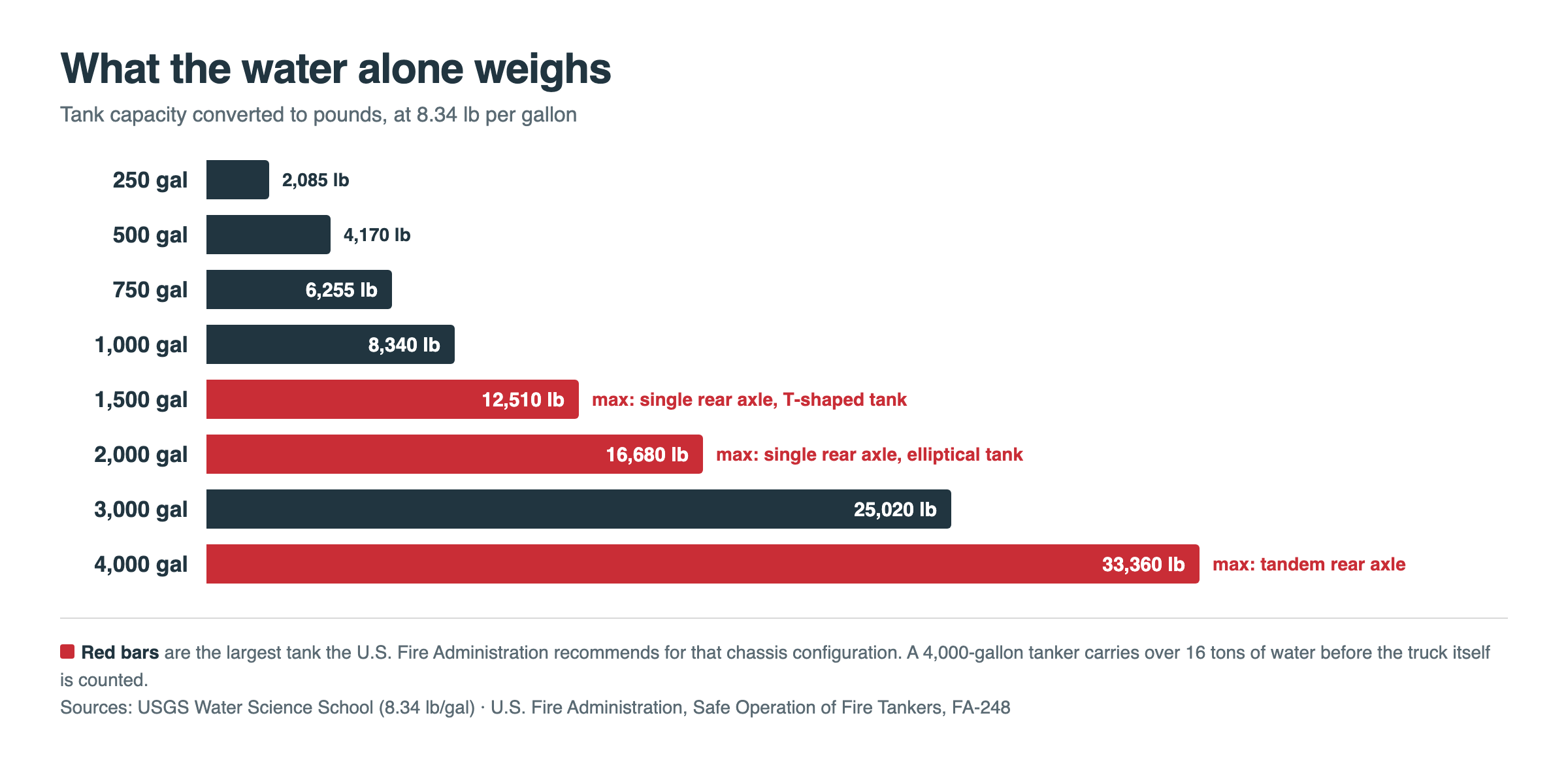
Those numbers shift with the chassis GVWR, the pump and the amount of hose and equipment carried. They are a starting point, not a permit.
The warning behind them is worth repeating, because it has killed firefighters. Surplus and converted chassis are the common trap: a vehicle with a 5,000-pound rated load capacity has room for roughly 600 gallons of water once you account for the tank and equipment, and departments have put 1,000 and 2,000-gallon tanks on exactly that kind of chassis. Fuel tankers are the same problem in reverse, since most fuel products weigh 6.75 to 7.5 pounds a gallon and water is heavier than all of them. If you are sizing a rural water supply, start from the chassis rating and work backwards, and look at used tankers and water tenders that were built as tankers in the first place.
Need a truck that fits your roads?
Browse Fire Truck Center’s current inventory — pumpers, aerials, tankers and brush trucks. Every unit inspected, pump tested and certified before it leaves.
How is GVWR different from what the truck weighs on a scale?
GVWR is a rating, not a measurement. Federal regulation defines gross vehicle weight rating as “the value specified by the manufacturer as the loaded weight of a single vehicle.” It is a number the manufacturer assigns to the finished vehicle. What the truck weighs is whatever a certified scale reads on the day, with the tank full and the compartments packed the way your department packs them.
The two drift apart in service. A truck delivered comfortably inside its rating gains weight every time a department adds a tool mount, a reel, a second set of irons or a heavier hose bed, and none of that shows up on the spec sheet. The apparatus standard puts the responsibility for staying inside the rating on the purchaser once the truck is in service, not on the builder.
There is a second reason the spec sheet is not the whole answer. The GVWR can be set lower than the sum of the axle ratings, so adding the GAWRs together tells you what the axles allow, not what the vehicle is certified for. When both numbers are published, the lower one governs.
How much weight is each axle allowed to carry?
Each axle has its own rating, the GAWR, and a truck can be under its GVWR while an individual axle is over. Federal regulation defines gross axle weight rating as “the value specified by the vehicle manufacturer as the load-carrying capacity of a single axle system, as measured at the tire-ground interfaces,” which means the tires are part of the rating and a tire change can alter it.
Side to side matters as much as front to rear. NFPA 1901 requires a fully loaded apparatus to hold side-to-side tire load variation to no more than seven percent of the total tire load on that axle. On a 23,000-pound rear axle that allows a difference of 1,610 pounds between the left and right wheels. It is an easy limit to breach without noticing: a pump panel on one side, a generator and a cord reel on the other, and a crosslay loaded from one side only will all push a truck toward it, and the consequence shows up in handling and rollover behaviour rather than on a gauge.
The only way to know where a specific truck sits is to weigh it loaded, with each wheel position on the scale rather than the whole vehicle at once.
Does a fire truck have to obey normal road weight limits?
Not the standard ones. Federal law gives emergency vehicles their own weight floors, and they are well above what a commercial truck gets. Under Title 23 of the U.S. Code, a state may not enforce a weight limit against an emergency vehicle below the figures in the right-hand column, up to a maximum gross weight of 86,000 pounds.
| Weight limit | Standard federal limit | Emergency vehicle floor |
|---|---|---|
| Single steering axle | 20,000 lb | 24,000 lb |
| Single drive axle | 20,000 lb | 33,500 lb |
| Tandem axle | 34,000 lb | 62,000 lb |
| Tandem rear drive steer axle | 34,000 lb | 52,000 lb |
| Gross vehicle weight | 80,000 lb | 86,000 lb |
Congress added that provision in the FAST Act in December 2015, and it defines an emergency vehicle as one designed for use under emergency conditions to transport personnel and equipment and to support the suppression of fires and the mitigation of other hazardous situations. Separately, federal rules let states issue special permits for nondivisible vehicles without regard to axle, gross or Federal Bridge Formula requirements, which is the mechanism most states use for apparatus that sits outside the usual numbers.
The 86,000-pound ceiling is not an abstraction. The heaviest standard configuration on the table above, a rear-mount aerial platform on a tandem rear axle, reaches exactly 86,000 pounds of combined axle rating at the top of its range. A tractor-drawn tiller spreads its load across three axle groups and can be rated higher still, which is why the statute carries a separate figure for a tandem rear drive steer axle.
None of this helps with a posted local bridge. A statutory floor on state enforcement does not change what a county bridge was engineered to carry, and the practical guidance from the apparatus manufacturers is unchanged: know the roads and bridges in your district, carry detailed maps of your coverage zone, and plan routes that avoid low overpasses and bridges the apparatus should not be on. Fire apparatus averages under 5,000 miles a year, so the question is almost never wear. It is whether a particular crossing holds on a particular night.
What does weight change when you are buying a used fire truck?
Three things, and all of them come before price. Whether the truck clears your bridges and your bay floor. Whether its axle ratings match the way you intend to load it. And what a scale says rather than what the spec sheet claims.
Ask for three numbers on any truck you are serious about: the GVWR, the individual axle ratings, and a loaded scale weight by wheel position if the seller has one. A listing that publishes GVWR and axle ratings is telling you something a listing that publishes neither is not. The 2017 Rosenbauer pumper above lists both, and its 27,000-pound rear axle is a useful illustration of why the federal provision exists: that single drive axle is rated 7,000 pounds above the 20,000-pound standard limit, and sits well inside the 33,500 pounds the emergency vehicle floor allows.

Weight also quietly sets your running costs, since a heavier truck is harder on brakes, tires and the bridges you cross, and it interacts with the licence class your drivers hold.
This is where inspection earns its keep. In the founder’s words:
“Inspecting a fire truck before it gets sold is the most critical part of our sales process. We take a lot of pride in making sure all major components are inspected — the engine, transmission, axles, brakes, suspension, all key electrical components, lighting packages, sirens.”
Axles, brakes and suspension are the three systems weight punishes first, and they are three of the items on our 150-point inspection. Every truck we sell carries a 30-day satisfaction guarantee on top of it. If you are weighing cost against capability, our used fire truck price guide covers what the classes run, and if the constraint is the building rather than the road, how long, wide and tall a fire truck is covers bay fit.
Frequently asked questions about fire truck weight
How much does a fire truck weigh in tons?
Most fire trucks weigh 15 to 30 tons. A single-rear-axle pumper rated 33,000 to 55,000 pounds is about 16 to 27 tons, and a rear-mount aerial platform rated to 86,000 pounds is 43 tons.
How much does a fire truck weigh with water?
Add 8.34 pounds for every gallon the tank holds. A 750-gallon pumper gains about 6,255 pounds when it fills, a 1,000-gallon engine about 8,340 pounds, and a 3,000-gallon tanker about 25,020 pounds, which is over 12 tons of water alone.
How much does a fire truck weigh empty?
An empty fire truck weighs less than its in-service weight by the weight of its water, hose, ground ladders, tools and crew. Tank water is normally the largest single item, which is why the empty and loaded figures for the same truck can differ by several tons.
How much does a ladder truck weigh?
A single-rear-axle aerial ladder carries axle ratings totalling roughly 44,000 to 58,000 pounds, and a tandem-rear-axle aerial 54,000 to 77,000 pounds. A tractor-drawn tiller spreads its load over three axle groups and can be rated as high as 92,000 pounds combined.
How much do airport fire trucks weigh?
ARFF vehicles are among the heaviest apparatus on the road because of how much water and foam they carry. An FAA Index E airport needs at least 6,000 gallons of water on its vehicles, and 6,000 gallons of water alone weighs 50,040 pounds, or 25 tons.
Can a fire truck legally be heavier than a semi truck?
Yes. A commercial truck is held to 80,000 pounds gross on the Interstate system, while federal law bars a state from enforcing a limit below 86,000 pounds gross against an emergency vehicle, with higher per-axle floors as well.
Talk to us about whether a truck fits your roads and your bay
Fire Truck Center has sold reconditioned, quality-tested used fire apparatus since 2015, and we have delivered to departments in about 49 states. Every truck goes through a 150-point inspection, with third-party NFPA pump tests and aerial certifications where they apply, and every one carries a 30-day satisfaction guarantee: a full refund within 30 days for any reason, with us paying the return freight.
If you have a weight constraint to work around, a posted bridge on your first-due route, a bay floor rating, or a licence class your drivers hold, call us at (215) 559-9119 or email help@firetruck.center. Tell us the number you have to stay under and we will tell you honestly which of our trucks clears it and which do not.
Sources
- U.S. Government Publishing Office — 23 U.S.C. § 127, Vehicle weight limitations: Interstate System (2023 edition)
- Federal Highway Administration — Compilation of Existing State Truck Size and Weight Limits (2003)
- Electronic Code of Federal Regulations — 49 CFR § 571.3, Definitions (current)
- Fire Apparatus Manufacturers’ Association — TC009-1 Emergency Vehicle Size and Weight Guide (revised 3 October 2025)
- U.S. Fire Administration — Safe Operation of Fire Tankers, FA-248 (2003)
- U.S. Geological Survey — A Million Gallons of Water: How Much Is It?, Water Science School (accessed 12 October 2026)
- National Wildfire Coordinating Group — Equipment, PMS 200: Standards for Wildland Fire Resource Typing (accessed 12 October 2026)
- Fire Apparatus & Emergency Equipment — Are You Overweight?, Grady North (10 July 2017)
- The Rig — Deciphering and Navigating NFPA 1900, Bill Adams (September 2023)
- Fire Truck Center — 2017 Rosenbauer Commander Pumper, stock F052 (accessed 12 October 2026)
- Fire Truck Center — 2011 Sutphen SL75 75′ Aerial Ladder, stock F074 (accessed 12 October 2026)

 CALL US NOW