


A fire engine carries water, a pump and hose, and its job is getting water on the fire. A fire truck carries the aerial ladder, ground ladders and forcible-entry tools, and its job is access, ventilation and rescue. In everyday speech, “fire truck” also covers any fire apparatus, which is why both words get used for one vehicle.
That answer is good enough for a conversation. It’s not good enough to buy from. Neither NFPA nor the federal government uses the phrase “fire truck” at all, and plenty of aerials carry a bigger pump than the engine parked next to them. If you’re reading listings, the spec sheet decides what you’re looking at — not the word in the ad title.
Key Takeaways
- A fire engine (also called a pumper) carries the pump, tank and hose. A fire truck carries the aerial device and the ladders. Those are the traditional roles, not hard rules.
- NFPA defines a pumper as fire apparatus with a permanently mounted pump of at least 750 GPM, a water tank and a hose body. It has no definition for a “fire truck.”
- The federal resource typing system classifies an “Engine – Fire (Pumper)” and an “Aerial Apparatus – Fire” separately. A nationally typed aerial is required to carry a 500 GPM pump.
- “Fire trucks don’t carry water” is a generalization, not a specification. Quints carry a pump, tank, hose, ground ladders and an aerial on one chassis.
- When you buy used, read four numbers instead of the ad title: pump rating in GPM, tank capacity in gallons, aerial length in feet, and the date of the last pump test or aerial certification.
What is the difference between a fire truck and a fire engine?
The difference is the job the vehicle is built to do. A fire engine is built to move water: it carries a pump, an onboard tank and hose, and it arrives to get a line in service. A fire truck is built for access and rescue: it carries an aerial device, a long complement of ground ladders, forcible-entry tools, saws and fans, and the crew on it opens the building up, ventilates it and searches it.
Fire departments split the work the same way they split the apparatus. An engine company stretches lines and puts water on the fire. A truck company forces entry, throws ladders, ventilates and searches. Ask a firefighter and you’ll hear the crews named after the rigs.
Clackamas Fire District puts it about as plainly as it can be put on its own public FAQ: a truck has a big ladder on top and an engine doesn’t, and engines carry more water.
Where it gets muddy is ordinary English. “Fire truck” is what almost everyone calls any red apparatus with a light bar, including engines. That usage isn’t wrong, it’s just imprecise, and it carries straight over into how trucks get advertised.
If you’re shopping, treat the word as a hint and nothing more. Our used pumpers for sale are engines in the strict sense, and half the people who call about them say “truck.”
What does NFPA actually call a fire engine and a fire truck?
NFPA doesn’t use the phrase “fire truck.” Its apparatus standard governs automotive fire apparatus, and within that it defines a pumper as a fire apparatus with a permanently mounted fire pump of at least 750 GPM capacity, a water tank and a hose body, whose primary purpose is to combat structural and associated fires. The aerial vehicle is aerial fire apparatus.
That standard is now NFPA 1900, which consolidated four separate documents — NFPA 414 for aircraft rescue and firefighting vehicles, NFPA 1901 for automotive fire apparatus, NFPA 1906 for wildland apparatus, and NFPA 1917 for ambulances. The current edition is 2024.
The pumper chapter sets floors, not targets. To be a pumper, the apparatus needs:
- A fire pump with a minimum rated capacity of 750 GPM
- A water tank with a minimum certified capacity of 300 gallons
- At least 40 cubic feet of enclosed, weather-resistant compartmentation for equipment
- 800 feet of 2.5-inch or larger hose, and 400 feet of 1.5-inch to 2-inch hose
- Ground ladders meeting NFPA 1931: a straight ladder with roof hooks, an extension ladder and an attic ladder
Two things in that list are worth sitting with. First, the minimums are low — 750 GPM and 300 gallons is a small engine by modern practice, and most real pumpers run well past both. Second, a pumper carries ground ladders too. The standard requires three of them. Ladders aren’t what separates an engine from a truck; the aerial device is.
There’s also a smaller class. NFPA defines a mini pumper as apparatus with a pump of at least 250 GPM, a tank and a hose body, built to get on scene first and start an attack.
How does the federal typing system classify engines and aerials?
The federal system classifies two separate resources and calls neither one a fire truck. FEMA’s Resource Typing Library defines an “Engine – Fire (Pumper)”, typed 1 through 4 by pump capacity and tank size, and an “Aerial Apparatus – Fire”, typed 1 and 2 by how far the aerial reaches. This is the vocabulary departments use when apparatus gets ordered to an incident.
Here is the engine table as published:
| Engine type | Pump capacity | Tank capacity | Minimum personnel |
|---|---|---|---|
| Type 1 | 1,000 GPM | 300 gallons | 4 |
| Type 2 | 500 GPM | 300 gallons | 4 |
| Type 3 | 150 GPM | 500 gallons | 3 |
| Type 4 | 50 GPM | 750 gallons | 2 |
Read that table twice, because it runs backwards from what most buyers assume. As the type number climbs, the pump gets weaker and the tank gets bigger. A Type 1 engine moves 1,000 GPM on a 300-gallon minimum tank. A Type 4 moves 50 GPM on a 750-gallon minimum tank. The reason is that the high-numbered types are wildland engines, built to haul water into country with no hydrants and to pump while rolling, not to push big volume at a structure fire.
So a listing that brags about a large water tank isn’t describing a more capable structural engine. It may be describing a less capable one. Types 5 through 7 extend further down the same scale under the wildland typing standard, and we’ve written separately about how apparatus gets typed from Type 1 through Type 6.
The aerial table is shorter, and it contains the detail that undoes the usual explanation:
| Aerial type | Aerial device | Pump | Ground ladders | Minimum personnel |
|---|---|---|---|---|
| Type 1 | 76–100 ft or greater | 500 GPM | 115 feet | 4 |
| Type 2 | 55–75 ft | 500 GPM | 115 feet | 4 |
A nationally typed aerial apparatus has to carry a 500 GPM pump and 115 feet of ground ladders. Not optionally. The pump is part of the type definition at both levels.
One note on status, since it matters if you’re citing these: FEMA lists the aerial definition as published and the engine definition as interim guidance.
Looking at listings and not sure what you are reading?
Every unit in our inventory shows its pump rating, tank size and aerial length on the listing, so you can check the spec instead of the label.
Do fire trucks really carry no water and no pump?
Often, but not reliably, and never as a rule you can shop by. The claim that fire trucks carry no water and no pump describes traditional big-city ladder trucks. It doesn’t describe the federal definition, it doesn’t describe what NFPA contemplates, and it doesn’t describe a large share of what is for sale.
Three things cut against it:
- Federal typing requires a pump on an aerial. Both aerial types carry a 500 GPM minimum, as above.
- NFPA’s apparatus standard has provisions for a pumper fitted with an aerial device, including the pump flow that device’s waterway needs and the ladder belts the crew has to have.
- A quint is both vehicles at once. It carries a pump, a water tank, hose, ground ladders and an aerial device — five functions, which is where the name comes from. If you want the full picture on that configuration, a quint does both jobs and carries the maintenance load of both.
The clearest way to show this is with real trucks. In October 2026, two units sat on our lot at the same time:
- A 2011 Sutphen SL75 75-foot aerial ladder — pump 2,000 GPM, tank 500 gallons, 85,582 miles.
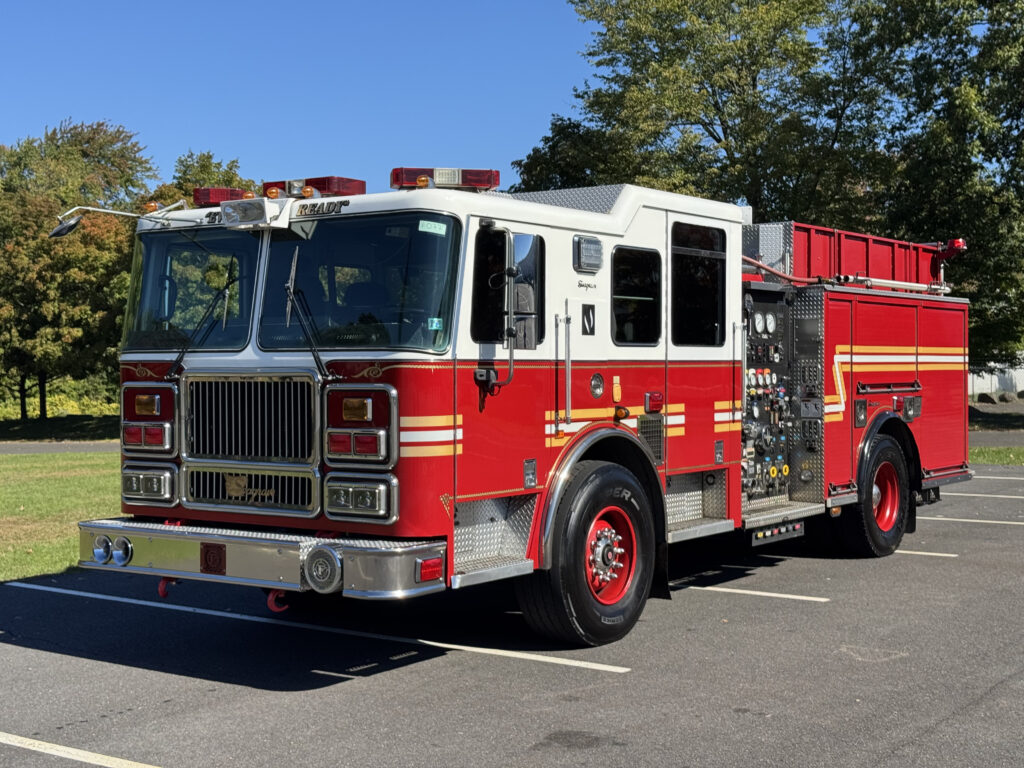
- A 2007 Seagrave pumper — pump 1,500 GPM, tank 750 gallons, 82,735 miles.

The aerial had the bigger pump. The pumper had the bigger tank. Both numbers are printed on the listings, and anyone can click through and check them against what this article says. That is the whole argument in two rows: the category name told you which one had the ladder, and nothing else.
If you want to compare the two classes side by side, the used aerial and ladder trucks sit in a separate category from the engines for exactly that reason.
Why does the difference matter when you buy used apparatus?
It matters because sellers use the words loosely and a spec sheet doesn’t. Read four numbers instead of the ad title:
- Pump rating in GPM. This tells you what class of engine you’re looking at, and whether it meets what your insurance rating assumes.
- Tank capacity in gallons. Read it against your water supply, not in isolation. A big tank matters in country with no hydrants and matters much less on a hydranted grid.
- Aerial length in feet. Measured against the buildings in your district, not against the tallest one in the county.
- The date of the last pump test or aerial certification. A rating on paper from eight years ago is a claim. A current third-party test is evidence.
The distinction also decides what can go wrong, which is the part most articles on this question skip. A straight aerial generally has no pump, so there’s no pump to wear out. A straight engine has no aerial ladder, so there’s no aerial to wear out.
A quint has both systems, so you have to inspect the pumping system and the aerial ladder with its structural components. Buying one of each isn’t the same inspection problem as buying one of both.
On an engine, the pump is the thing. It has to hold vacuum, it can’t leak, and it has to perform at its rating under a third-party test. On an aerial, the structure is the thing: the ladder, the turntable, the pedestal, the torque box.
That is also where the expensive surprises live. If something like a torque box needs replacing, you’re easily looking at a $100,000 repair. That is why we spend most of our inspection time on an aerial’s structural condition, and why we walk away from aerials with corrosion we don’t like.
This is the reason every truck we sell goes through a 150-point inspection, with the pump test or aerial certification performed by a third party rather than by us. On a ladder truck that testing can take a full day. A buyer shouldn’t have to take a dealer’s word for a GPM figure, and on a used truck the certificate is worth more than the sticker. If you want the longer version, here is what to check on a used fire truck.
Which one does your department actually need?
Most departments buy an engine first, because nearly every call needs water and a crew. An aerial earns its place when you have buildings taller than your ground ladders reach, or commercial structures you need to work from above. A quint is the compromise when you need both jobs covered and you can’t staff two rigs.
Work it in this order:
- Water supply. Hydranted district, and tank size is a convenience. Rural district, and tank size is the plan. Standard pumps run from about 1,250 GPM up to 2,000 GPM, and a rescue pumper’s tank usually starts around 500 gallons.
- Building height. Departments generally know their own ground. The common aerial lengths are 60, 75 and 100 feet, and longer exists — we’ve carried ladder trucks up to 135 feet, which is about the top of the market.
- Staffing. This is the one that gets underweighted. A straight aerial has no pump, so it needs a separate pumper working alongside it, and now you’re staffing and operating two pieces of apparatus instead of one. For a volunteer department running thin on a weekday afternoon, that can be the deciding factor on its own.
- Budget. The two classes don’t cost the same, and an aerial carries both a higher purchase price and a more expensive failure mode. Our used fire truck price guide walks through the current ranges by type.
We don’t try to steer departments away from a quint when a quint is what they’re asking for. The honest trade is that one rig covering both jobs means one set of crew and two systems to maintain, and the department is usually the best judge of which of those constraints binds hardest.
Frequently asked questions
Is a fire engine the same as a pumper?
Yes. In the fire service and in NFPA’s apparatus standard, “engine” and “pumper” describe the same vehicle: fire apparatus with a permanently mounted pump of at least 750 GPM, a water tank and a hose body.
Do fire trucks carry water?
Many do. A nationally typed aerial apparatus is required to carry a 500 GPM pump, and quints carry a pump, a tank and an aerial together. Traditional big-city ladder trucks often carry neither, so check the spec sheet rather than assuming.
What is the difference between an engine company and a truck company?
The job, not just the vehicle. An engine company stretches hose lines and puts water on the fire. A truck company handles forcible entry, ground ladders, ventilation, and search and rescue.
How many gallons does a fire engine hold?
NFPA sets the minimum at 300 gallons for a pumper, but most real engines carry more. Tanks of 500 to 1,000 gallons are common, and the pumpers on our lot in October 2026 carried 750 gallons.
Why does everyone call every fire truck a fire truck?
Because it works as a catch-all. “Fire truck” is ordinary English for any piece of fire apparatus, and neither NFPA nor the federal resource typing system uses the phrase at all, so nothing official ever corrects it.
What should I check first on a used fire engine versus a used aerial?
On an engine, the pump: that it holds vacuum, doesn’t leak, and passes a current third-party pump test. On an aerial, the structure: the ladder, turntable, pedestal and torque box, confirmed by a current certification.
Talk to us about the right apparatus for your district
Fire Truck Center has been selling quality-tested used fire apparatus since 2015, and we’ve delivered hundreds of trucks to departments in 49 states. Every truck is reconditioned and put through a 150-point inspection, with NFPA pump tests and aerial certifications performed by a third party, before it goes out. Every purchase carries a 30-day satisfaction guarantee.
If you’re working out whether your next truck should be an engine, an aerial or a quint — or you’re looking at a listing and can’t tell which one it is — call us at (215) 559-9119 or email help@firetruck.center. Tell us your water supply, your tallest building and how many people you can put on a rig, and we’ll tell you what fits.
Sources
- NFPA — NFPA 1900, Standard for Aircraft Rescue and Firefighting Vehicles, Automotive Fire Apparatus, Wildland Fire Apparatus, and Automotive Ambulances, 2024 edition (2024)
- FEMA — Resource Typing Definition for Fire Management and Suppression: Engine – Fire (Pumper), 4-508-1276 (2017)
- FEMA — Resource Typing Definition for Fire Management and Suppression: Aerial Apparatus – Fire, 4-508-1273 (2017)
- Cattaraugus County, New York — Minimum Equipment on Engines/Pumpers from NFPA 1901, 2009 edition (2009)
- NWCG — Standards for Wildland Fire Resource Typing, PMS 200 (December 2021)
- Pierce Manufacturing — Pumper Fire Apparatus: Overview and Examples (June 22, 2022)
- Clackamas Fire District — What is the difference between a fire truck and a fire engine? (December 2016)

 CALL US NOW