


Most fire trucks hold between 300 and 1,000 gallons of water. A fire truck’s water tank, sometimes called a booster tank, is an onboard supply carried for the first minutes of an attack. NFPA 1901 set the minimum for a pumper at 300 gallons. Tankers and water tenders carry far more, from 1,000 to 4,000 gallons.
The number most people want is the range. The number that matters is how long it lasts, and the answer there is shorter than almost anyone expects.
Key Takeaways
- A pumper built to NFPA 1901 carries at least 300 gallons and a pump rated at a minimum of 750 gpm. The tank empties in 24 seconds at that flow.
- Through the 200 gpm handline the same standard requires the truck to carry, 300 gallons lasts 90 seconds.
- Federal wildland engine crews must hold back at least 10 percent of the tank for engine protection and drafting, so published capacity is never usable capacity.
- A Type 4 wildland engine’s minimum tank is 750 gallons. A Type 1 structural engine’s is 300. The bigger, faster truck carries less water.
- Ladder trucks carry the least. Four of the aerials on our lot today sit at exactly 300 gallons and two carry no water at all.
How much water does a fire truck hold?
A pumper, which is what most people are looking at when they say fire truck, holds 300 to 1,000 gallons. NFPA 1901 set 300 gallons as the floor: the standard called for a water tank with a minimum certified capacity of 300 gallons, alongside a fire pump rated at a minimum of 750 gpm. Those requirements now live in NFPA 1900, which absorbed the older apparatus standards when NFPA renumbered the apparatus standards.
Above the pumpers sit the apparatus built to haul water rather than fight with it. A mobile water supply unit, which the fire service calls a tanker or a water tender, runs from 1,000 gallons at the small end to 4,000 and beyond. Departments without hydrants buy them specifically to shuttle water to the scene, and they are a different purchase from an engine. If that is the capability you are costing out, start with used tankers and water tenders rather than a larger pumper.
Below the pumpers are brush and wildland units, where tanks run from 50 gallons on a pickup-chassis patrol unit up to 750 on a heavy wildland engine.
So the honest answer is that the question has no single number. Capacity tracks what the truck is built to do, and the range across apparatus types spans a factor of eighty.
How much water does each type of fire truck carry?
The clearest published figures come from the interagency engine typing standard, which sets the minimum a unit must carry to be called a given type. Types 1 and 2 are structural engines. Types 3 through 7 are wildland.
| Engine type | Tank minimum (gal) | Pump minimum (gpm) | At rated pressure (psi) | Maximum GVWR (lb) |
|---|---|---|---|---|
| Type 1 (structure) | 300 | 1,000 | 150 | — |
| Type 2 (structure) | 300 | 500 | 150 | — |
| Type 3 (wildland) | 500 | 150 | 250 | — |
| Type 4 (wildland) | 750 | 50 | 100 | — |
| Type 5 (wildland) | 400 | 50 | 100 | 26,000 |
| Type 6 (wildland) | 150 | 50 | 100 | 19,500 |
| Type 7 (wildland) | 50 | 10 | 100 | 14,000 |
Read the first two rows together and the counterintuitive part shows up. A Type 1 structural engine has to carry only 300 gallons, but its pump has to move 1,000 gpm. A Type 4 wildland engine carries at least 750 gallons and needs a pump rated at just 50.
That inversion is the whole logic of apparatus design. A Type 1 works where there are hydrants, so it is built to move enormous volumes of someone else’s water. A Type 4 works where there is nothing, so it carries its own and gives up flow to do it.
Bigger and more expensive does not mean wetter. For how this plays out across the wildland types, see how Type 3 and Type 6 wildland engines compare.
Water tenders are typed on the same principle, by how much they carry and how fast they can give it up.
| Water tender type | Tank capacity (gal) | Pump minimum (gpm) | Maximum refill time (min) |
|---|---|---|---|
| Support S1 | 4,000 | 300 | 30 |
| Support S2 | 2,500 | 200 | 20 |
| Support S3 | 1,000 | 200 | 15 |
| Tactical T1 | 2,000 | 250 | — |
| Tactical T2 | 1,000 | 250 | — |
Go looking for these numbers yourself and you will find different figures on different pages, most of them correct. The interagency standard publishes the minimum to qualify for a type. Individual agencies publish the ranges they operate.
A Type 6 engine qualifies at 150 gallons, and the National Park Service describes its Type 6 fleet as 150 to 400 gallons. Same apparatus, two different kinds of number.
How long does a fire truck’s water actually last?
This is the question nobody answers, and the arithmetic needs no guesswork, because NFPA 1901 specified the tank, the pump and the nozzles in the same equipment list. A pumper had to carry one handline nozzle flowing at least 200 gpm and two flowing at least 95 gpm.
Put the standard’s own numbers against each other and a 300-gallon tank gives you this:
- At 95 gpm, from one of the smaller required handlines: 3 minutes 10 seconds.
- At 200 gpm, from the larger required handline: 1 minute 30 seconds.
- At 750 gpm, the minimum rated pump capacity: 24 seconds.
A Type 1 structural engine is starker still. Its 300-gallon minimum tank against its 1,000 gpm minimum pump is 18 seconds of water.
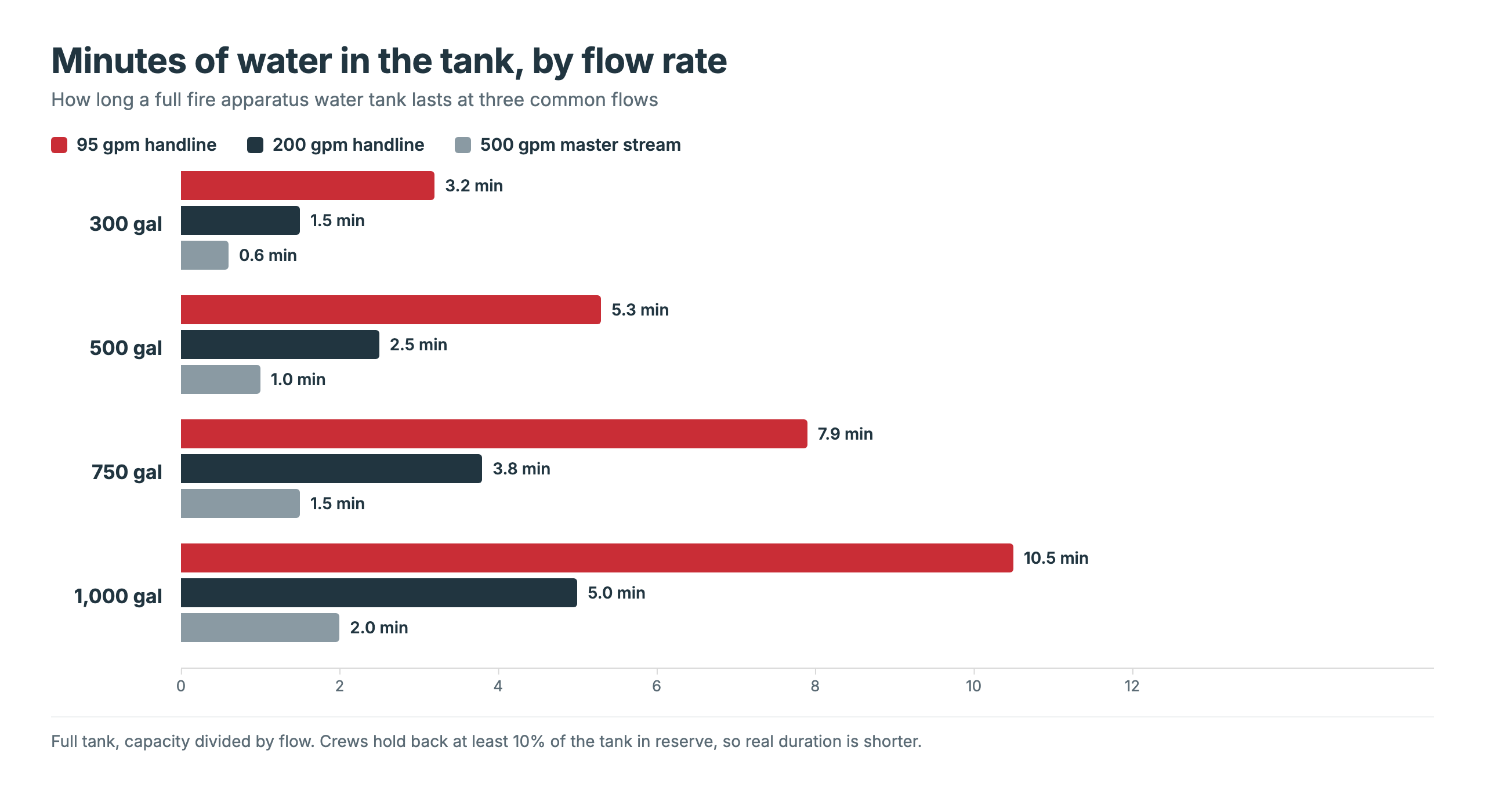
Nothing is wrong with those trucks. The tank was never meant to put out the fire. It buys the crew the time it takes to get a supply line in from a hydrant or a drafting source, and on a 500-gallon aerial working a single handline that window is a few minutes. This is why water supply dominates rural apparatus decisions and barely registers in cities.
It also explains why departments do not simply order the largest tank available. Water weighs 8.33 pounds per gallon, so 1,000 gallons adds more than four tons before you count hose, ladders, tools or crew. Every gallon is paid for in payload and braking, which is covered in what all that water does to the scale.
Why can’t a crew use the whole tank?
Published capacity and usable capacity are two numbers. The interagency standards require that engine and tactical water tender operators keep at least 10 percent of the tank’s pumpable capacity in reserve, held back for engine protection and for drafting.
The practical effect is a quiet reduction across the board. A 500-gallon Type 3 fights fire with roughly 450 gallons. A 300-gallon pumper is working with about 270, which cuts its 200 gpm window from 90 seconds down to 81.
This rule binds federal wildland engines and tactical tenders rather than every municipal engine in the country. Even where it does not formally apply, running a tank dry risks the pump, so crews leave a margin anyway. Treat any tank rating as a ceiling you will not reach.
Why do ladder trucks carry the least water?
The apparatus most people picture when they hear fire truck is an aerial, and it is the driest thing on the lot. An aerial device, its hydraulics, its stabilizers and the ladder itself consume the weight budget that a pumper spends on water. Something has to come off, and the tank is first.
On our own inventory today, every available aerial carrying water is at 500 gallons or less, four of them sit at exactly 300, and two carry no water whatsoever. A ladder truck with no tank and no pump is doing a job that has nothing to do with water supply: reach, ventilation, rescue and an elevated stream fed by someone else’s pump.
That split is also where the naming confusion starts, and it is worth reading the difference between a fire truck and a fire engine if the terms have ever tripped you up.
What tank sizes actually show up on the used market?
General guides tend to lead with the top of the range, and you will read that tankers often exceed 3,000 gallons. True of the new-build market. Not what a used lot looks like.
Across the 32 units available on our lot as this was written, 23 carry a published tank figure, and they break down like this:
| Tank size (gal) | Units available | Typically |
|---|---|---|
| 200 | 1 | Mini pumper or brush unit |
| 250 | 1 | Brush truck |
| 300 | 5 | Aerials and rescue pumpers |
| 400 | 1 | Aerial |
| 500 | 5 | Aerials and smaller pumpers |
| 750 | 3 | Pumpers |
| 1,000 | 6 | Full-size pumpers |
| 4,000 | 1 | Tanker |
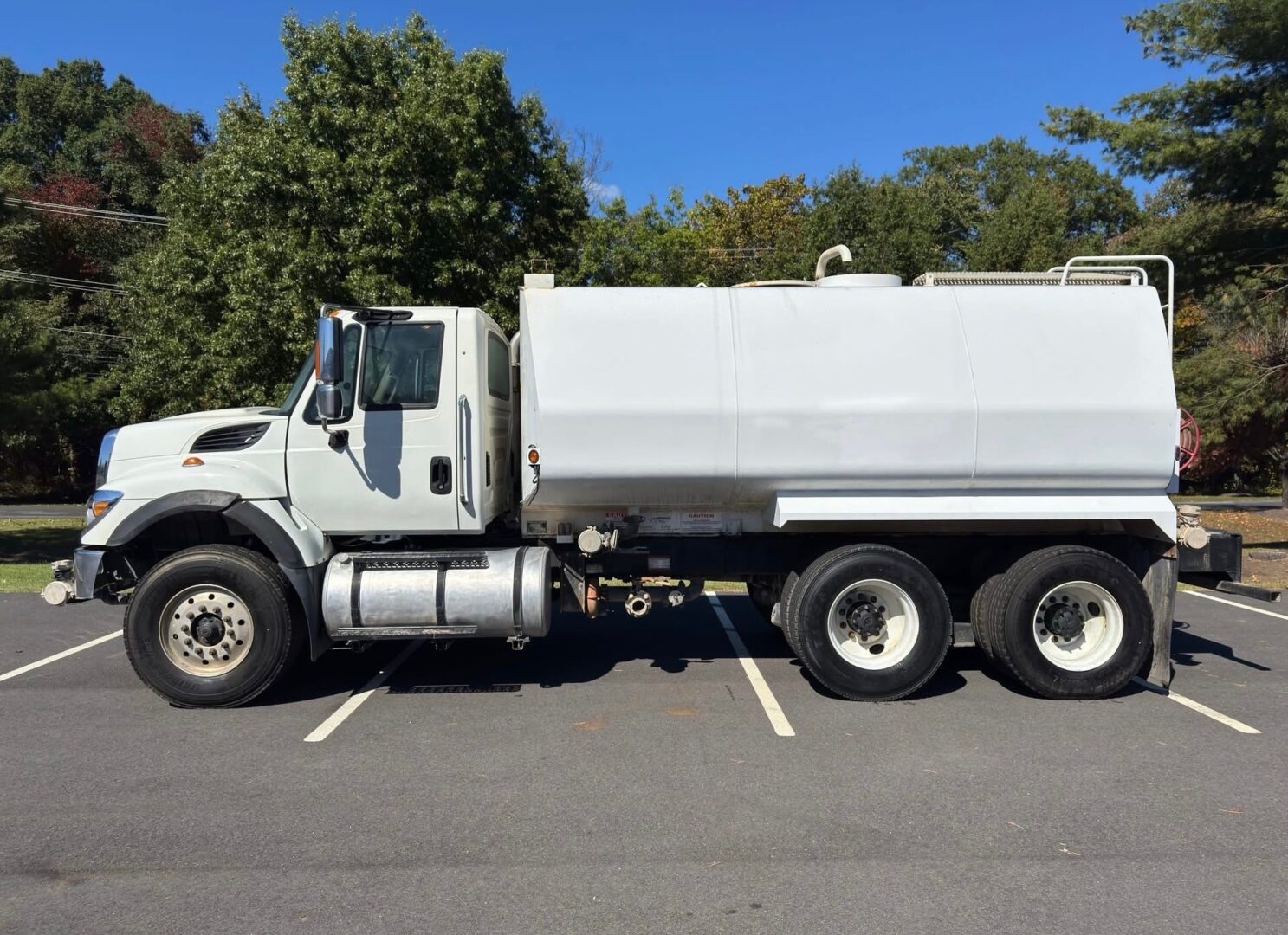
Three things stand out. Every available structural pumper falls between 500 and 1,000 gallons, with six sitting at exactly 1,000, among them a Pierce Dash and a Rosenbauer Spartan. Exactly one unit on the lot carries more than 1,000 gallons, and it is a 4,000-gallon International 7400 tanker on a 6×4 chassis. And 300 gallons, the old NFPA floor, is one of the most common figures on the lot, because that is where the aerials cluster.
If you are buying, that distribution is the useful part. A department replacing a first-due engine is shopping a 500 to 1,000 gallon market and will find plenty of it. A department that needs to move 3,000 gallons is shopping a much thinner one, and that unit comes along when it comes along.
Frequently asked questions
How many gallons of water does a fire truck use per minute?
It depends entirely on which line is open. NFPA 1901 required a pumper to carry one handline nozzle flowing at least 200 gpm and two flowing at least 95 gpm, and a Type 1 engine’s pump has to be rated at a minimum of 1,000 gpm. A single interior attack line in the 95 to 200 gpm range is the common case.
How long can a fire truck spray water without a hydrant?
Usually between one and five minutes on tank water alone. A 300-gallon tank lasts 90 seconds at 200 gpm and a 1,000-gallon tank lasts five minutes at the same flow. Subtract the mandatory 10 percent reserve and those windows get shorter still, which is why establishing a supply line is an early priority on any working fire.
Is the water in a fire truck drinkable?
Treat it as not drinkable. Apparatus tanks are plumbed for firefighting rather than for potable water, they sit full for long periods between uses, and many trucks inject Class A foam concentrate into the same system. Departments that supply drinking water at an incident bring it separately.
Do all fire trucks carry water?
No. Aerials, heavy rescues and squads are frequently built with no tank and no pump at all, because their job is reach, extrication or equipment transport. Three of the units available on our lot right now carry no water: two aerials and a light rescue.
How much water does a tanker or water tender hold?
Water tenders start at 1,000 gallons and run to 4,000 in the interagency typing standard, with support tenders also rated on how fast they can refill, from 15 minutes for the smallest to 30 for the largest. Tankers above 4,000 gallons exist and are usually purpose-built on a commercial chassis.
Does a bigger tank mean a better truck?
No, and the typing standards show why. A Type 1 structural engine qualifies with 300 gallons while a Type 4 wildland engine needs 750. Tank size indicates what the apparatus was designed to do, so match it to your water supply. A department with hydrants on every corner gains little from 1,000 gallons, and one drafting from a pond gains a great deal.
Talk to us about matching tank capacity to your water supply
Fire Truck Center has been selling quality-tested used fire apparatus since 2015. Every unit goes through a 150-point inspection before it is listed, we deliver nationwide, and we back each truck with a 30-day satisfaction guarantee. We also tell departments when the truck they asked about is the wrong size for the water supply they described, which happens more often than you might think.
If you are working out what tank capacity your next apparatus needs, call us at (215) 559-9119 or email help@firetruck.center. Tell us what your water supply looks like, hydrants, draft sites or shuttle, and we will tell you which units on the lot fit it.
Sources
- National Interagency Fire Center — Interagency Standards for Fire and Fire Aviation Operations, Chapter 14: Firefighting Equipment (January 2023)
- Cattaraugus County, New York — Minimum Equipment on Engines/Pumpers from NFPA 1901 (2009)
- National Fire Protection Association — NFPA 1900 Standard Development (accessed October 2026)
- National Fire Protection Association — NFPA 1901 Standard Development (accessed October 2026)
- USDA Forest Service — Retardant Mixers for SEAT Bases (2006)
- National Park Service — Wildland Fire Engines (October 2019)
- Fresno County Fire Protection District — Guidelines for Calculating NFPA 1142 Minimum Water Supply (2023)

 CALL US NOW