


A fire truck pump test is a measured check that the fire pump still delivers its rated capacity at its rated pressure while drafting from a static water source. It is run when the apparatus is accepted, once every year after that, and again any time the pump or the drive train has been repaired.
That test is not the same thing as a pump certification, and on a used truck the difference decides how much the paperwork in front of you is worth.
Key Takeaways
- A pump certification is a one-time, independently witnessed test of a new pump. The organization that performs it may not be owned or controlled by the manufacturer or the vendor selling the truck.
- A pump service test is the annual check. The department that owns the truck is allowed to run it and sign it with its own mechanics.
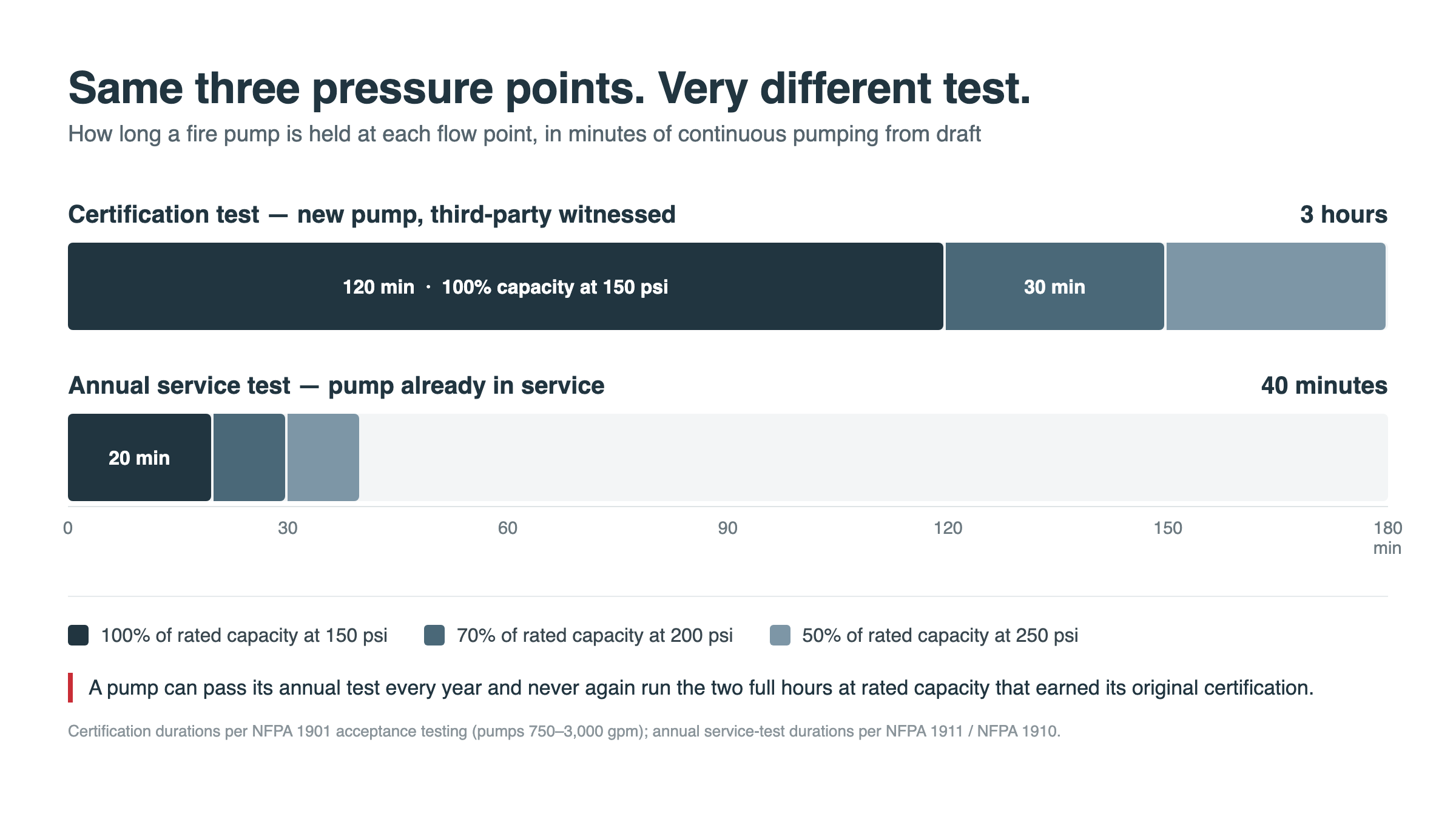
- Both tests use the same three pressure points. Certification holds them for three hours; the annual test holds them for forty minutes.
- The vacuum test is what apparatus fails most often, and the cause is usually a bad gasket or a worn primer rather than a worn-out pump.
- A pump rated under 750 gpm was never third-party certified at all, so asking for its certificate means asking for a document that does not exist.
What is a fire truck pump test?
A fire truck pump test measures whether the pump still makes its rated flow at rated pressure, drafting from static water through hard suction. A 1,500 gpm pump has to move 1,500 gallons a minute at 150 psi net pump pressure, pulling water up out of a pit rather than taking it from a hydrant.
The test happens at three points in an apparatus’s life. It is performed when a new truck is accepted, annually once it is in service, and again after any repair to the pump or the drive train. Fresno’s fire department writes exactly that into its apparatus manual, and insurance engineering guidance says the same: an initial delivery test, annual service tests after it, and another test whenever the pump has been repaired or modified.
That third trigger matters more than departments expect. A pump that was rebuilt in March does not inherit the test it passed in January.
Rated capacity is also a drafting number, not a hydrant number. The rating assumes 20 feet of suction hose and 10 feet of lift, which is why a real test is run from a pit or a pond instead of off a plug. If you are shopping used pumpers for sale, the test paperwork is the only evidence you have that the pump on the truck still does what the plate on the pump panel claims.
What is the difference between a pump test and a pump certification?
A certification is a one-time test of a new pump, witnessed and signed by an accredited organization with no ownership tie to the manufacturer or vendor. An annual pump service test is a recurring check of a pump already in service, and the department that owns the apparatus may perform and document it itself.
The two come from two different standards. New apparatus is built to NFPA 1900, the 2024 standard that absorbed the old NFPA 1901. In-service testing lives in NFPA 1910, which absorbed NFPA 1911, 1912, 1925 and 1071. If the numbers on your paperwork look unfamiliar, the standards were renumbered in 2024 and most test forms in circulation still carry the old ones.
The independence requirement is the part buyers miss. Under NFPA 1901 section 4.7, a certifying organization has to be accredited to ISO/IEC 17020 or ISO/IEC 17065, has to be primarily engaged in certification work, and “shall not be owned or controlled by manufacturers or vendors of the product that is being tested.” It also has to witness the tests in person or through verifiable automated recording, and it must refuse to certify a system if any component requiring testing does not pass.
There is no partial credit. Section 4.7.5 allows “no conditional, temporary, or partial certification of test results.”
An annual service test carries none of that structure. Department personnel may run it as long as they have proper measuring equipment, a qualified witness, and documentation. Three tests get confused with each other, so here is where each one sits:
| Certification test | Acceptance test | Annual service test | |
|---|---|---|---|
| Standard | NFPA 1900 (formerly 1901) | NFPA 1900 (formerly 1901) | NFPA 1910 (formerly 1911) |
| When | At the factory, before delivery | At delivery, before the truck goes in service | Every year, and after pump or drive-train repair |
| Who performs it | Accredited third party, no ownership tie to the seller | Buyer and department, with the manufacturer present | The owning department’s own staff, or a third party |
| How long the pumping runs | Three hours from draft | Repeat of the pump test against bid spec | Forty minutes from draft |
| What it proves | The pump met the standard when new | The delivered truck matches what was ordered | The pump still performs this year |
| Happens again? | No, one time only | No, one time only | Yes, every year |
What does a pump have to do to pass its annual service test?
The pump has to hold a vacuum, make its rated flow at three descending capacities and rising pressures, keep its pressure-control device in range, and read accurately on its own gauges. Start to finish, the pumping portion is about forty minutes.
The vacuum test comes first and is the simplest. With the pump drained, intakes capped and discharges closed, the primer has to pull 22 inches of mercury and hold it for five minutes without losing more than 10 inches. Above 2,000 feet of elevation the required vacuum drops by 1 inch of mercury for every additional 1,000 feet, because thin air cannot support the same column.
Then the pump runs three legs from draft:
- 100% of rated capacity at 150 psi net pump pressure, for 20 minutes
- 70% of rated capacity at 200 psi net pump pressure, for 10 minutes
- 50% of rated capacity at 250 psi net pump pressure, for 10 minutes
A few other checks ride along with those legs:
- Priming speed — suction from draft within 30 seconds on a pump rated up to 1,250 gpm, or 45 seconds at 1,500 gpm and above
- Pressure control — checked at 150, 90 and 250 psi, with any pressure jump beyond 30 psi counting as a failure
- Gauge accuracy — gauges within 10 psi, flowmeters within 10 percent
- Tank-to-pump flow — at least 500 gpm from the on-board tank
- Overload run — many departments add a short run at 165 psi to see how much engine is left in reserve
Here is the part worth holding on to. A certification test uses those same three pressure points, but it runs the pump for three hours: two full hours at 100% of rated capacity, then half an hour at 70%, then half an hour at 50%. The annual test asks for 20 minutes at full capacity. A pump can pass its annual service test every year for a decade and never again be asked to do what it did to earn its original certification.
What actually makes a pump fail?
The vacuum test is the one apparatus fails most often, and the cause is usually cheap. Trade guidance is blunt about it: the vacuum test is the test apparatus has trouble passing, mostly because of simple problems such as bad gaskets.
That is a useful thing to know, because it reframes a failed test. A pump that will not hold 22 inches of mercury is leaking air somewhere, and the suspects are ordinary: suction hose gaskets, a worn or oil-starved primer, a leaking drain valve, a discharge valve that is not seating, a tank-to-pump valve left weeping, or a packing gland past its service life. None of those mean the pump itself is finished.
Our own shop looks at the same two things. Asked what gets checked before a truck goes out, the founder’s answer was short: “Checking the motor for problems, checking the pump for leaks or vacuum issues. When we find something wrong, we have to fix it because of the satisfaction guarantee.”
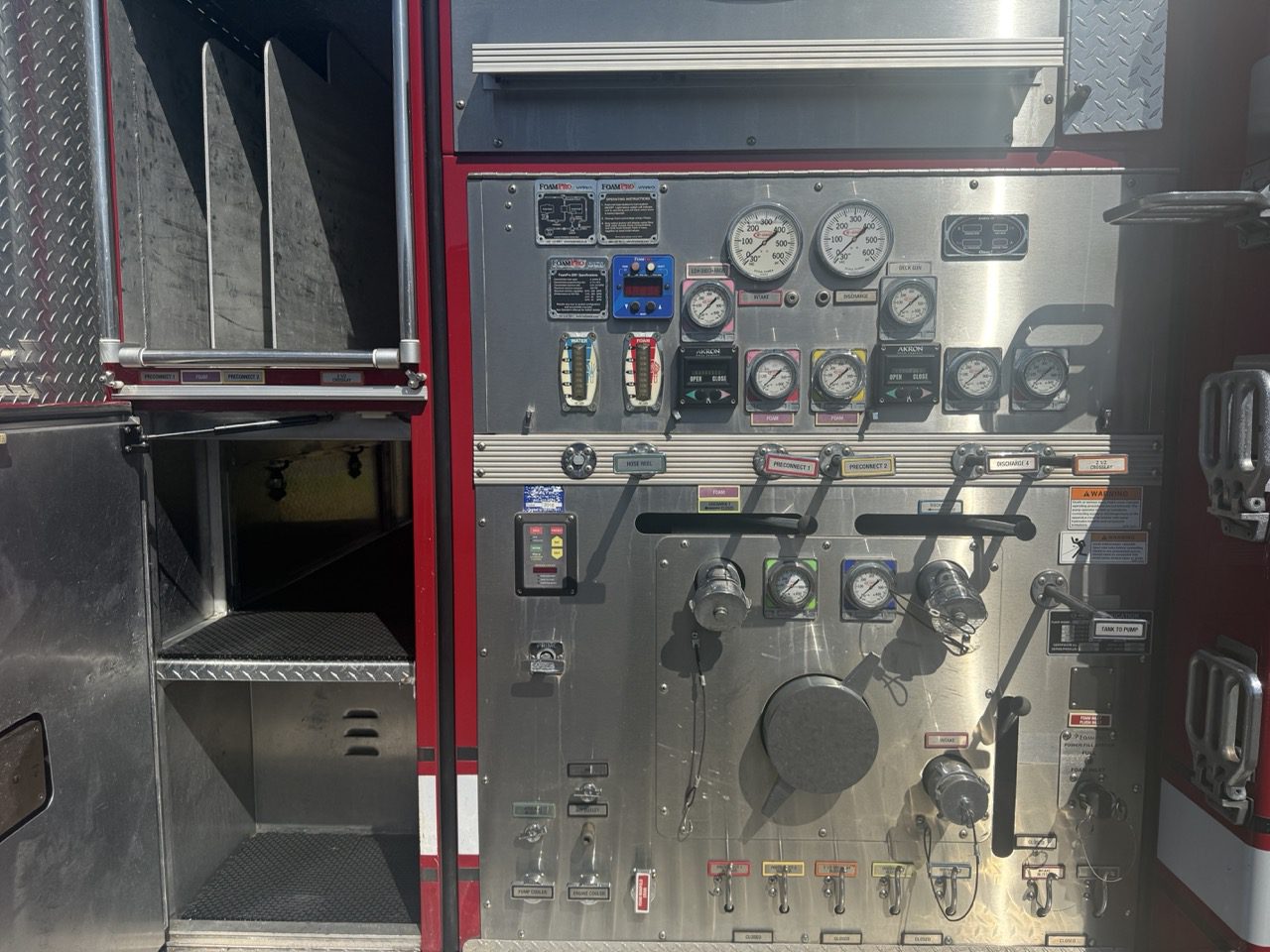
The failures that cost real money show up on the capacity legs instead. A pump that holds vacuum but cannot make 100% at 150 psi is losing efficiency inside, usually through impeller wear, worn clearance rings, or a transfer valve that is not fully shifting. A pump that makes capacity but spikes on the pressure-control test has a governor or relief-valve problem. Gauges that read 15 psi off are a calibration job, not a pump job, and they still fail the test.
Three things get watched the whole time the engine is running, and any of them can end a test early: engine temperature and oil pressure, transmission overheating, and leaks at the pump casing or its connections. When you walk the truck in person, those are the same places to put your hands and your eyes.
Who is allowed to perform and sign the test?
Certification has to come from an accredited organization with no ownership tie to the seller and no financial stake in the product. The annual service test can be run by the owning department’s own mechanics, provided they have the measuring equipment, a qualified witness, and proper documentation.
That asymmetry is the single most useful fact in this article for a used buyer. The annual pump test certificate in a truck’s folder may have been produced entirely in-house by the department selling it. Fresno assigns its own pump testing to its Repair and Maintenance Section, and that is normal practice, not a shortcut. It is how the standard is written.
It is also not fraud, and it does not make the document worthless. It does mean the document carries a different weight than a certification signed by an organization that is legally barred from having a stake in the sale.
Third-party testing is widely available, and the firms that do it also test hose, ground ladders and aerial devices on the same visit. For our own inventory we do not test in-house at all. The founder’s description of how we handle it: “All tests are performed by a third party — one of the two major testing companies in the area. They can take a whole day (e.g., for a ladder truck). Very thorough process following NFPA standards, sufficient for customers to understand they’re purchasing a vehicle that meets their needs.”
One more wrinkle decides what you can even ask for. Third-party certification under NFPA 1901 attaches to five systems: fire pumps, industrial supply pumps, aerial devices, line-voltage electrical systems and air systems. Pumps under 750 gpm are not on that list, and neither are water tanks, foam systems or low-voltage electrical, which the manufacturer tests itself. A brush truck or minipumper with a 500 gpm pump therefore has no independent pump certification by design.
What pump paperwork should come with a used fire truck?
Ask for three documents: the most recent annual service test, the original pump certification if the truck still has it, and a test dated after any pump or drive-train repair. Then read who performed each one and whether the test was run at draft.
Work down the list in this order:
- The most recent annual service test. Check the date first. A test older than twelve months tells you the truck is already out of compliance with its own standard.
- Who signed it. An accredited third-party firm and the selling department’s own shop are both legitimate. They are not equally independent, and you are entitled to know which one you are holding.
- Where it was run. A test taken at draft exercises the primer and the pump’s ability to hold prime. A test run off a hydrant does not, so a hydrant-fed test leaves the priming system unproven.
- The capacity numbers, against the pump plate. The sheet should show actual flow at or above rated capacity at 150 psi, plus the 70% and 50% legs. Compare them to what the pump is rated for, not to each other.
- Any repair since the test. A pump or drive-train repair after the test date voids the usefulness of that test. Ask for a retest.
- The original certification, if it exists. On a pump at or above 750 gpm this is the document that proves the pump once held full capacity for two hours. On a smaller pump, do not expect one.
Every truck we sell goes through a 150-point inspection, and the pump test is done by an outside testing company rather than our own shop. That is the standard we would tell any buyer to hold a seller to, including us. If you are buying a used pumper, getting documented proof on the pump is the part of the purchase worth slowing down for.
How often does a fire truck pump need to be tested?
Annually, and again after any repair to the pump or drive train. A new pump is also tested when the apparatus is accepted, and NFPA 1910, published in 2024, is the standard that governs testing of in-service apparatus.
Is a pump certification the same as a pump test?
No. A certification is a one-time independent test of a new pump, and the certifying organization may not be owned or controlled by the manufacturer or vendor. An annual pump test is a recurring service check that the department owning the truck is allowed to run itself.
Who can perform a fire truck pump test?
An annual service test can be performed by qualified department personnel who have proper measuring equipment, a qualified witness and documentation, or by a third-party testing company. Certification of a new pump must come from an accredited independent organization with no ownership tie to the manufacturer or vendor.
What happens if a fire truck pump fails its test?
The pump is repaired and retested, because there is no partial pass. NFPA 1901 section 4.7.5 allows no conditional, temporary or partial certification of test results, and a certifying body must refuse certification if any component requiring testing does not pass.
Does a 500 gpm pump have a pump certification?
Usually not, and that is normal. Third-party pump certification applies to fire pumps rated at 750 gpm or more, so on a smaller brush-truck or minipumper pump the manufacturer tests it instead and no independent certificate is issued.
Why is a fire truck pump test run from draft instead of a hydrant?
Because the pump’s rating is a drafting rating, measured through 20 feet of suction hose at 10 feet of lift. A test run from a hydrant skips the priming system entirely and never shows whether the pump can pull and hold a prime.
Talk to us about the pump paperwork on a specific truck
Fire Truck Center has been selling quality-tested used fire apparatus since 2015, from our yard in Levittown, Pennsylvania to departments in nearly every state. Every truck goes through a 150-point inspection before it is listed, pump testing is done by an outside testing company, and every sale carries a 30-day satisfaction guarantee.
If you are looking at a used pumper and want to know what its pump paperwork shows, call us at (215) 559-9119 or email help@firetruck.center. Tell us the unit and we will pull the test documents and walk you through what passed, who tested it, and what was repaired.
Sources
- NFPA — NFPA 1910, Standard for the Inspection, Maintenance, Refurbishment, Testing, and Retirement of In-Service Emergency Vehicles and Marine Firefighting Vessels (2024 edition)
- NFPA — NFPA 1900, Standard for Aircraft Rescue and Firefighting Vehicles, Automotive Fire Apparatus, Wildland Fire Apparatus, and Automotive Ambulances (2024 edition)
- Fresno City Fire Department — Section 303.001, Apparatus Pump Test, Training and Equipment Manual (revised 27 May 2025)
- Fire Underwriters Survey — Apparatus Acceptance Terms of Reference for Fire Insurance Grading and Public Fire Protection Classification (2017)
- AXA XL Risk Consulting — PRC.12.5.1, Testing of Fire Pump-Equipped Automotive or Mobile Fire Apparatus (2020)
- FAMA — TC024, Pump Capacity Ratings Outline (2018)
- Fire Engineering — Annual Pump Testing
- Fire Engineering — Expanded Role for Third-Party Certification in Revised NFPA 1901 Standard
- Intertek — Fire Apparatus Testing

 CALL US NOW