


A wildland fire engine is a four-wheel-drive fire truck built to leave the pavement, carry its own water, and pump while it drives. Three numbers set its class: tank capacity, pump flow, and gross vehicle weight rating. Those numbers are a floor for dispatch, not a description of the truck in front of you.
Key Takeaways
- Pump-and-roll is the capability that separates a wildland engine from a structural one, and it comes from one of two things: a transmission power take-off, or a second engine driving a second pump.
- The federal agencies build well above their own minimums. The Forest Service Type 6 spec calls for a 300-gallon tank against a 150-gallon national floor, and its Type 3 spec calls for 600 against 500.
- Water is measured in minutes, not gallons. A 150-gallon tank runs under eight minutes through one quarter-inch tip at 100 psi, and under four minutes on two lines.
- On Types 5, 6 and 7 the weight cap is part of the class definition, and the national standard requires it met fully loaded, not empty.
- A truck types on the lowest spec it satisfies. A structural-size pump on a small tank still rosters as a Type 6.
What can a wildland fire engine actually do on a fire?
A wildland fire engine does four things a structural pumper cannot: it leaves the road, it carries its own water supply, it flows foam, and it pumps while moving. Everything else about the class follows from those four jobs.
The engine types run 1 through 7, and the National Wildfire Coordinating Group owns the wildland end of that range, Types 3 through 7. If you want the class-by-class breakdown, we have already written how the engine types are numbered. This page is about what the truck does once it gets there.
Two requirements in the national standard tell you more about these trucks than the tank sizes do. Engine Types 3 through 6 have to prime and pump water from a 10-foot lift, which is what lets a crew refill from a pond, a creek or a portable tank instead of a hydrant.
A Type 3, along with any tactical water tender, also has to carry a foam proportioner system. Foam is not an upgrade on a Type 3. It is part of the definition.
That combination is why a department covering grass, brush and interface ground buys one of these rather than a second structural engine. You can see the current used brush trucks and wildland engines in stock, and every one of them is pump-tested before it is listed.
How does pump and roll work, and what drives the pump?
Pump-and-roll means the pump keeps running while the truck is in gear and moving, and it is delivered by one of two hardware architectures. Both are spelled out in the Forest Service’s own build specifications.
A transmission power take-off. The federal Type 3 specification drives the fire pump off a PTO mounted on the chassis transmission: a 10-bolt unit rated at a minimum of 300 pound-feet of torque in intermediate duty, with 1350-series universal joints, feeding a Hale CBP 250 GPM single-stage pump mounted behind the cab. The shift is a two-position, positive-locking, electric-over-hydraulic control placed inside the cab where both the driver and the officer can reach it. The driveline design has to be submitted for approval before it is installed, with U-joint angles, sizes, torque ratings and phasing calculations.
A separate engine. The federal Type 6 specification does it differently. It bolts a Darley 1.5 AGE or a WATERAX BB-4 pump to a 24.8-horsepower Kubota DH902 four-cycle diesel in the rear compartment, with its own electric starter and a Forest Service qualified spark arrestor. The pump runs independently of road speed and road gear entirely.
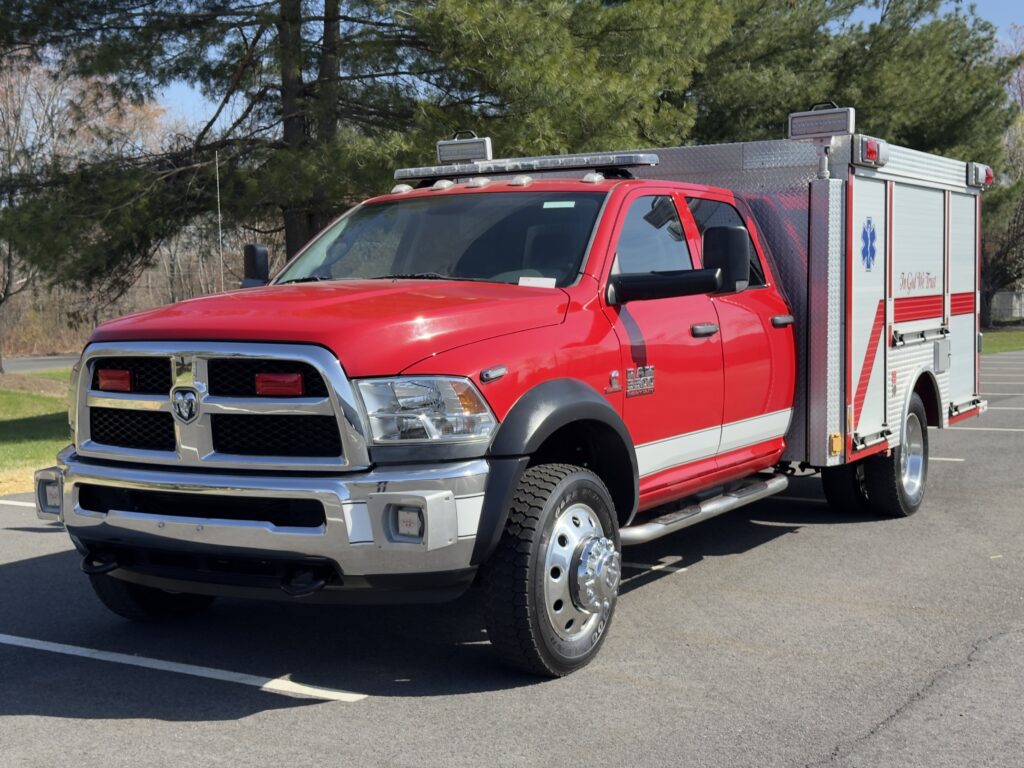
Plenty of Type 3 engines carry both: a large primary pump for volume and a small auxiliary for pumping on the move. Builders say so plainly, and so do the listings. One of the wildland units on our lot right now, a 2012 Freightliner M2 4×4 built by Ferrara, pairs a 1,250 GPM primary pump with a Hale auxiliary pump and a 750-gallon tank.
Two small details in the Type 3 spec give the design away. It requires a second electronic tank-level gauge on the cab centre console, in view of the driver’s seating position, because somebody is watching the water go down while the truck is rolling. And it requires an automatic override that returns the chassis engine to idle if pump discharge pressure drops below 50 psi, with a labelled toggle to defeat it when the operator needs to. The Type 6’s separate pump engine has the same protection at roughly 20 psi.
Any of that is expensive to find broken after you buy. Engage the pump drive and flow water with the truck moving before you sign.
How long does a wildland engine’s water actually last?
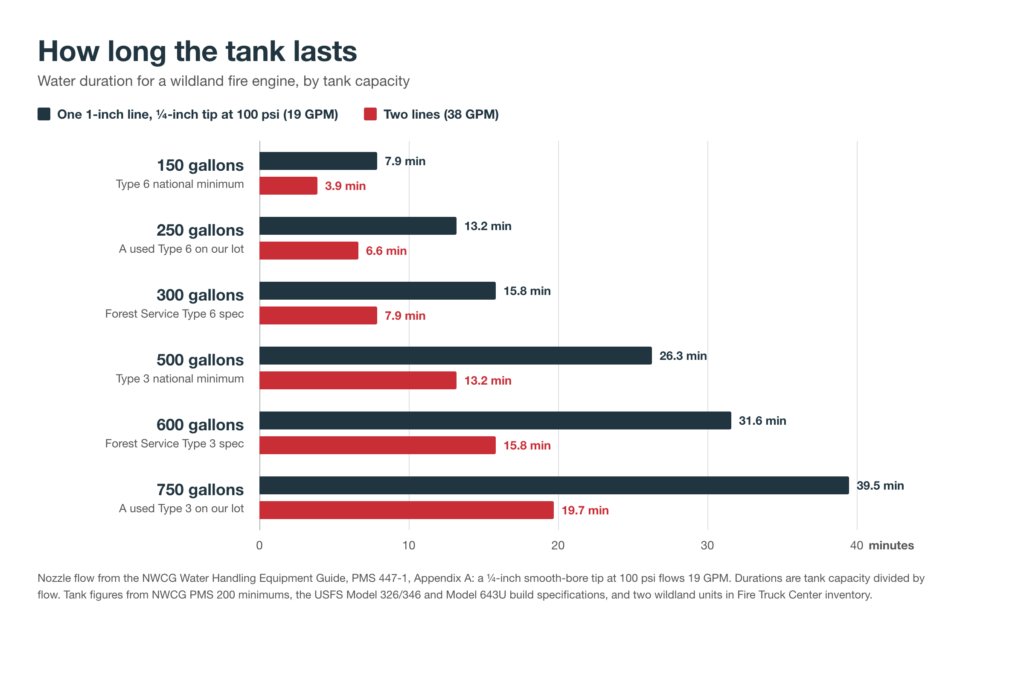
Not long. At 19 GPM through a quarter-inch smooth-bore tip at 100 psi, a 150-gallon tank runs dry in under eight minutes, and in under four minutes if the crew pulls two lines. Those nozzle flows come from the national water handling guide, and they are the arithmetic that matters more than the tank badge.
| Tank capacity | One line at 19 GPM | Two lines at 38 GPM |
|---|---|---|
| 150 gal — national Type 6 floor | 7.9 minutes | 3.9 minutes |
| 250 gal — a real used Type 6 | 13.2 minutes | 6.6 minutes |
| 300 gal — Forest Service Type 6 spec | 15.8 minutes | 7.9 minutes |
| 500 gal — national Type 3 floor | 26.3 minutes | 13.2 minutes |
| 600 gal — Forest Service Type 3 spec | 31.6 minutes | 15.8 minutes |
| 750 gal — a real used Type 3 | 39.5 minutes | 19.7 minutes |
A pump’s GPM rating is a pressure-dependent number too, which catches buyers out. The federal Type 3 pump is certified at 300 GPM at 150 psi net pump pressure, 200 GPM at 300 psi, and 100 GPM at 400 psi. The Type 6 pump is certified at 105 GPM at 150 psi, 70 at 250, and 40 at 300. Ask for more pressure and the same pump hands you less water.
So a wildland engine is a refill-cycle machine. The 10-foot-lift draft requirement, a nearby water source and tender support decide how long you can hold a line, and tank size only decides how long each cycle runs.
Foam is the one thing that does not run short. A 12-gallon Class A concentrate tank, proportioned at the 0.3 percent mid-point of the federal spec’s range, treats roughly 4,000 gallons of water. Water is the limiting resource, every time. For how the classes price out used, see what used apparatus costs by class.
How much water and hose can the truck legally carry?
On Types 5, 6 and 7 the weight cap is part of the class, and the national standard requires it met fully loaded. The caps are 26,000 pounds for a Type 5, 19,500 for a Type 6, and 14,000 for a Type 7, and the rule is explicit that all gross vehicle weight ratings apply with the truck loaded, not sitting empty on a scale.
Water weighs 8.34 pounds per gallon. Run the numbers on a Forest Service specification Type 6 and the squeeze shows up fast:
- 300 gallons of water: 2,502 pounds
- The hose the class itself requires, 300 feet of 1½-inch plus 300 feet of 1-inch, dry: 183 pounds
- Subtotal before anything else: about 2,685 pounds, roughly 14 percent of the 19,500-pound ceiling
Chassis, body, pump module, foam concentrate, tools, fuel and crew all come out of what is left. A Type 3 asks more again: its required hose load alone is 1,000 feet of 1½-inch and 500 feet of 1-inch, about 470 pounds dry.
Two honest caveats. First, Types 3 and 4 carry no weight cap at all in the typing standard, which is exactly how a legitimate Type 3 can be a 37-foot truck standing 10½ feet tall. The type number tells you nothing about whether the truck fits your bay or your bridge weights, so check that separately against the full picture on apparatus weight.
Second, the only authoritative weight rating for one specific truck is the sticker in its own door jamb. Read it.
Weight placement matters as much as weight. The wildland apparatus standard requires a 30-degree tilt test at estimated in-service weight before a tire lifts, and full baffling in the tank. Both exist because these trucks work across side slopes with a high load that moves.
Why does a used wildland engine often not match its advertised type?
Because a truck types on the lowest specification it satisfies, and on the used market the pump and the tank rarely came from the same class. A seller writes “Type 3” or “brush truck” in the listing title; the typing standard does the arithmetic differently.
Three wildland units available on our lot today show how it plays out:
- 2012 Freightliner M2 4×4 Ferrara — 750-gallon tank, 1,250 GPM primary pump, 20-gallon foam cell. It clears every Type 3 minimum with room to spare, and it carries the auxiliary pump that makes pump-and-roll real. A genuine Type 3.
- 2015 Ram 5500 with foam — 250-gallon poly tank, Waterous 200-100-DS diesel-drive pump rated at 200 GPM, 100 CFM onboard air compressor, 165 engine hours. Its tank falls short of the 400-gallon Type 5 minimum, so it types as a Type 6 — even though the pump moves four times the Type 6 minimum flow and that compressor is two and a half times the national CAFS figure of 40 cubic feet per minute.
- 2008 Pierce Contender on a GMC C5500 4×4 — 1,000 GPM Hale pump on a 200-gallon tank. That is a Type 1-class pump flow, and the 200-gallon tank still caps the truck at Type 6.

None of those three is a bad truck. The Ram is a strong initial-attack rig and the Pierce will move water off a hydrant all day. The point is that the roster line and the capability are two different facts, and you need both before you commit.
That matters on paper as well as on the fireground. Mutual-aid rosters and grant applications ask for a type, so a truck documented as something it cannot meet is a problem you inherit. Watch the standard numbers on hand-me-down spec sheets too: both federal build specs still cite NFPA 1906, and the national typing table still references NFPA 1901, but NFPA 1900 has absorbed both. We covered which NFPA standard applies now separately.
What should you check on a used wildland engine?
Check the seven things that are specific to wildland apparatus. The chassis, drivetrain, corrosion and paperwork walk-through is the same on any used rig, and it is already written up in the full used-apparatus inspection checklist.
- Pump drive. PTO off the transmission, or a separate engine? Find out which, then engage it and flow water with the truck in motion. That capability is most of what you are paying for.
- Draft from a 10-foot lift. Types 3 through 6 are required to do it. The federal Type 3 spec wants a dry pump taking suction and discharging in 30 seconds or less. Time it.
- Pump certification. The federal acceptance test is a continuous half-hour run at rated capacity and rated net pump pressure, plus a vacuum test on the primer. Ask for the certificate, not the assurance.
- Foam proportioner. Required on a Type 3. Run it and watch whether it holds its rate. The federal Type 6 system is specified to stay accurate from 5 to 200 GPM and from 0 to 400 psi.
- Tank and baffling. Full baffling is a standard requirement. A failed baffle sends water moving in the corners, and you will feel it in a turn before you ever see it.
- Ember guards and underbody protection. The federal specs call for chassis and cabin air intake ember guards with a maximum mesh opening of 0.039 inch, and fire-proof sleeving on air, fuel and electrical lines below the frame rails. These get removed for service and not put back.
- Weight rating against the class you intend to roster. Door-jamb sticker, fully loaded, compared to the cap for that type.
Every truck we list goes through a 150-point inspection and a third-party NFPA pump test before it reaches the website. Service-ready used brush and wildland units generally run $55,000 to $200,000 depending on chassis, pump and tank.
Frequently asked questions about wildland fire engines
What is the difference between a wildland engine and a brush truck?
“Brush truck” is what most departments call the small end of the wildland range, usually a Type 6 on a one-ton or Class 5 four-wheel-drive chassis with a 150-gallon minimum tank. “Wildland engine” covers the whole range, Types 3 through 7, including Type 3 rigs with 500-gallon-plus tanks on medium-duty chassis. Every one of them is required to pump and roll.
Can a wildland fire engine really pump water while it is driving?
Yes, and the capability is required on engine Types 3 through 7. The pump is driven either by a power take-off on the transmission or by a separate engine mounted with the pump, so it keeps turning independently of road speed. Crews use it to follow a running fire and to wet a line ahead of one.
How much water does a Type 6 brush truck carry?
The national minimum for a Type 6 is a 150-gallon tank, but very few are built to the floor. The Forest Service’s own Type 6 specification calls for a 300-gallon usable capacity, and used Type 6 rigs commonly carry 200 to 300 gallons. Confirm the tank size on the specific truck rather than assuming the minimum.
Do you need a foam system on a wildland engine?
A Type 3 engine has to have one. The typing standard requires a foam proportioner system on every Type 3 and on tactical water tenders. On smaller classes it is optional but close to universal, because foam stretches a small tank: a 12-gallon concentrate tank treats thousands of gallons of water at normal Class A proportioning rates.
Can a used wildland engine be re-typed into a different class?
Sometimes, and the national guidance says so directly: an engine can be reclassified from one type to another by changing its equipment complement, staffing or level of training. What you cannot change easily is the tank and the chassis weight rating, and those are usually what hold a truck in its class.
Is NFPA 1906 still the standard for wildland fire apparatus?
Not as a separate document. NFPA 1900 now combines NFPA 414, NFPA 1901, NFPA 1906 and NFPA 1917, so the wildland fire apparatus requirements live inside NFPA 1900. Plenty of existing specs and spec sheets still cite 1906 by number, including the Forest Service build specifications.
Talk to us about the wildland engine your district needs
Fire Truck Center has been buying and selling used fire apparatus since 2015, and we put every truck through a 150-point inspection and a third-party NFPA pump or aerial certification before it is listed. Most carry a 30-day money-back guarantee, and we deliver nationwide from Levittown, Pennsylvania.
Tell us the ground you cover and the class you need to roster, and we will point you at inspected wildland units that meet the type — or help you spec a build that does. Call (215) 559-9119 or email help@firetruck.center.
Sources
- National Wildfire Coordinating Group — Equipment, PMS 200 (April 2024)
- National Wildfire Coordinating Group — Standards for Wildland Fire Resource Typing, PMS 200 (2024)
- USDA Forest Service — Type 3 Fire Engine, Model 326/346 Apparatus Body Only Specification (2015)
- USDA Forest Service — Type 6 Fire Engine, Model 643U Apparatus Body Only Specification (February 2016)
- National Wildfire Coordinating Group — Water Handling Equipment Guide, PMS 447-1, Sixth Edition (2013)
- USDA Forest Service — Fire Engine Models (February 2025)
- National Fire Protection Association — NFPA 1900 Standard Development (2024)
- National Interagency Fire Center — Interagency Standards for Fire and Fire Aviation Operations, Chapter 14 (2025)
- U.S. Geological Survey — A Million Gallons of Water, How Much Is It? (2019)
- Pierce Manufacturing — Types of Fire Trucks: An Overview and Comparison (2024)
- Fire Apparatus Magazine — Considerations for Spec’ing Type 3 and Type 6 Wildland Engines and Fire Skids (July 2025)
 CALL US NOW