


Before you buy a used fire truck, ask 13 questions covering four things: pump and aerial certification, hours and service records, why the truck is being sold, and the seller’s own inspection and warranty. A used car arrives with a federal disclosure form and a signed mileage statement. A fire truck arrives with neither, so your questions are the diligence.
Key Takeaways
- The Federal Trade Commission’s Used Car Rule covers vehicles under 8,500 pounds GVWR. No fire apparatus qualifies, so there is no Buyers Guide window form and no federal duty to tell you it is sold without a warranty.
- Vehicles rated above 16,000 pounds GVWR are exempt from federal odometer disclosure. Nobody has to sign anything standing behind the mileage on a fire truck.
- An aerial carries two separate testing obligations: an annual test and a five-year non-destructive test by an ASNT Level II technician. That is three documents to ask for, not one.
- The aerial exam in the EVT certification track is a Master-level requirement, so “our technicians are EVT certified” tells you nothing about aerials. Ask which exams.
- A seller worth buying from answers all 13 of these in writing without being pushed. The hesitation is the signal, not the truck.
Why do the questions matter more on a fire truck than on a used car?
Because three federal rules that protect a used-car buyer all stop short of fire apparatus, and each one stops on a threshold the truck clears easily. That’s not a loophole somebody found. It’s how the rules are written.
| Rule | What it gives a used-car buyer | Why it does not reach a fire truck |
|---|---|---|
| Used Car Rule, 16 CFR 455 | The Buyers Guide window form, plus a duty to disclose before the sale that the vehicle comes with no warranty | It defines a covered vehicle as one with “a gross vehicle weight rating (GVWR) of less than 8500 lbs.” |
| Odometer disclosure, 49 CFR 580 | A written, signed mileage statement at transfer | It exempts “a vehicle having a Gross Vehicle Weight Rating … of more than 16,000 pounds” |
| Magnuson-Moss Warranty Act, 15 U.S.C. 2301 | Federal rules on written and implied warranties | It covers a “consumer product,” defined as property “normally used for personal, family, or household purposes” |
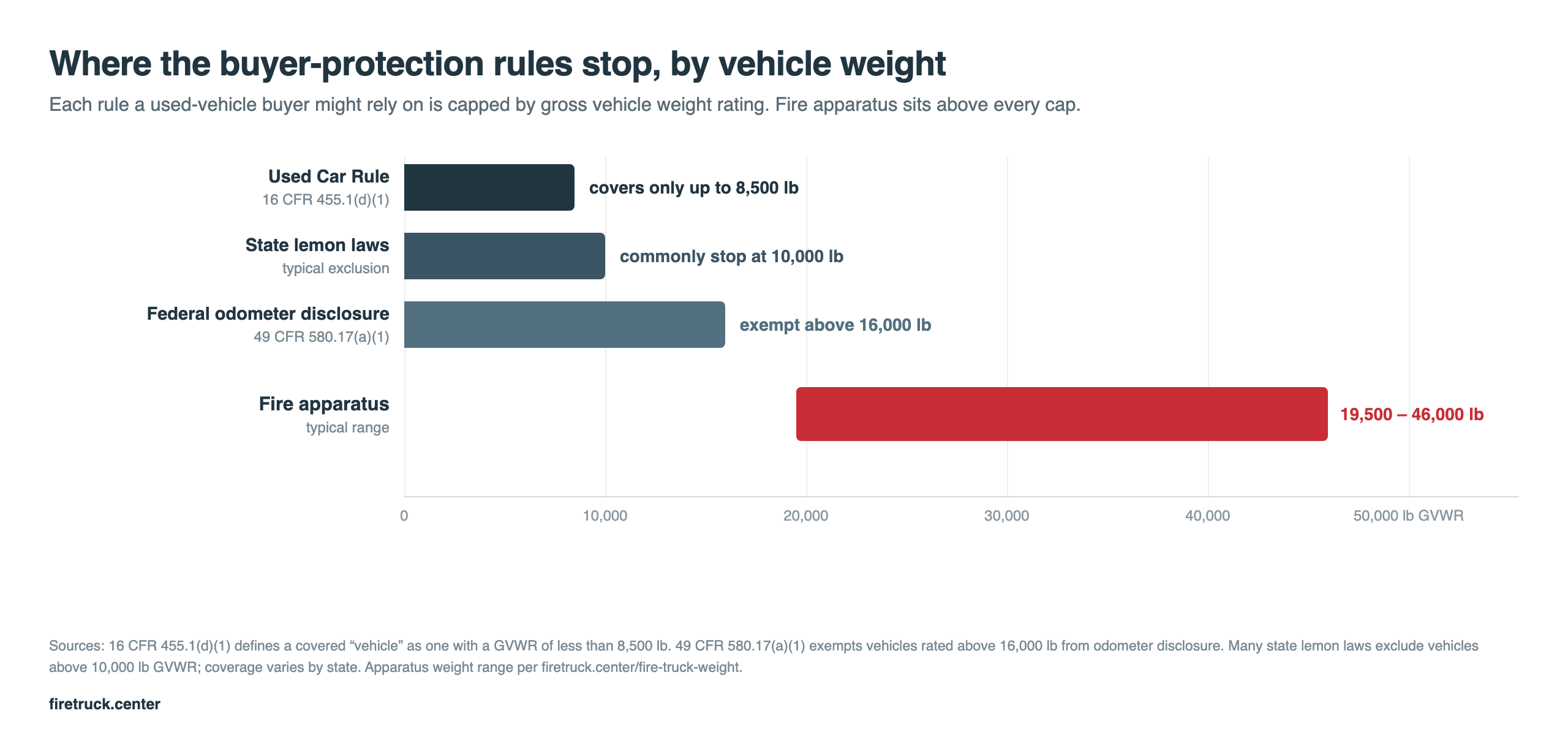
The lightest wildland apparatus runs around 19,500 pounds GVWR. A pumper runs 30,000 to 46,000. So every one of those thresholds is behind you before the conversation starts, and a pumper isn’t something anybody uses for household purposes.
Be careful what you take from that. One rule not applying is not the same as no law applying. The Federal Trade Commission Act still prohibits deceptive practices, your state’s consumer-protection statute still exists, and a written contract is still enforceable.
State lemon laws are where a remedy may still live, and they vary enough that you have to check your own. Many exclude vehicles above 10,000 pounds GVWR and vehicles bought for commercial use. Louisiana excludes both, and then its redhibition remedy reaches commercial vehicles anyway. None of this is legal advice, and a purchase this size is worth running past your county counsel.
What it does mean in practice is that no form is going to catch a problem for you. When you look at the used fire apparatus we have in stock or anyone else’s, the paperwork you end up with is the paperwork you asked for. The testing standard that governs what should exist is NFPA 1910, and it’s worth knowing which NFPA standard applies to the truck you are looking at before you start asking.
What should you ask about pump and aerial certification?
Ask for documents by name and date. Do not ask whether the truck is certified, because the answer is always yes and it costs the seller nothing to say.
1. What is the date of the most recent annual pump service test, and what were the results at each test pressure?
A pump test is an annual obligation, and the certificate records performance at several pressures rather than one headline number. A seller who has the document will read you the date and the figures. A seller who says “it pumps fine” doesn’t have it. Our own guide to what a pump test certificate has to say covers what you are looking for on the page.
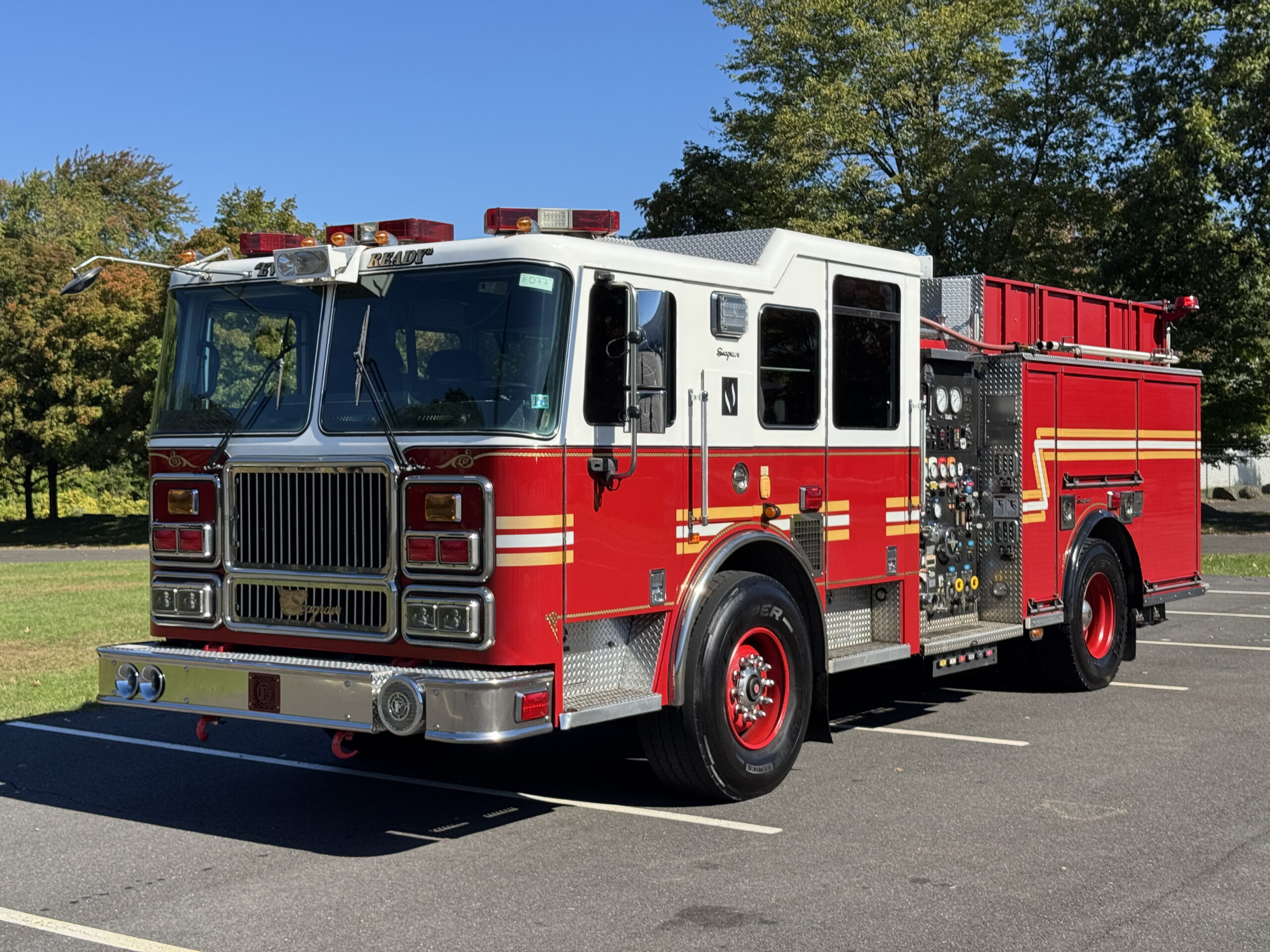
2. If it has an aerial, has it had its five-year non-destructive test, who performed it, and were they ASNT Level II?
Aerials carry two tests, not one. There is an annual visual and operational test, documented. Separately there is a five-year non-destructive test, which has to be completed by a qualified technician certified to Level II as specified by ASNT, using methods such as ultrasonic testing, radiography, metal hardness and liquid penetrant testing. Those are different events with different paperwork, and buyers collapse them into “it’s certified” constantly.
3. Can I have the written test report rather than a statement that it passed?
The report is the thing with information in it. A pass/fail line tells you somebody signed something. A report tells you what the pump did at 250 psi, or which section of the ladder the technician looked at and what the readings were. Ask for the document, and ask who holds the original.
What should you ask about hours, miles and service records?
Ask for engine hours, pump hours, and where each reading comes from. Mileage is the number with the least standing behind it, and there is a federal reason for that.
Federal odometer disclosure does not apply to a vehicle rated above 16,000 pounds GVWR. On a fire truck, that means nobody is required to make, sign or keep a mileage statement at transfer.
The rule exists because odometer fraud is widespread. NHTSA estimates more than 450,000 vehicles are sold each year with false readings, though that estimate covers all vehicles rather than apparatus. The point is narrower: the one document that would normally back up a mileage claim isn’t required here.
4. What are the engine hours and the pump hours, and what are those read from?
Two different meters measuring two different kinds of wear. A reserve engine can show low mileage and high hours because it idled at scenes for twenty years. Ask which gauge or module each figure came off. If you want the arithmetic, how engine hours compare with mileage works through it.
5. Can I see maintenance records for the full service life, rather than a summary?
The summary is written by the seller. The records are written by whoever turned the wrenches. What you want is the gap: a three-year hole in the file on a twenty-year-old rig is a question, not necessarily a problem.
6. Has the odometer or either hour meter ever been replaced?
A replaced meter resets the number and isn’t by itself a red flag. Dash clusters fail. What matters is whether the replacement is documented and whether anyone wrote down the reading at changeover. An undocumented replacement means the figure on the listing starts from an unknown.
What should you ask about why the truck is being sold?
Ask directly, and listen to how specific the answer is. The reason for the sale is the cheapest diagnostic available and the question buyers skip most often.
7. Why is the department selling it?
A planned replacement on a capital schedule is a different animal from a rig that came out of service and didn’t go back. Both are fine reasons to sell. They aren’t the same purchase. A specific answer sounds like a date, a replacement unit and a budget cycle.
8. What is the longest it was out of service, and what for?
This is the question that surfaces the pump rebuild, the transmission, the frame crack somebody repaired. Departments remember these events clearly because they hurt at the time.
9. Has it been in a collision, or had frame or body repair?
Apparatus gets backed into things. Ask what was hit, what was repaired and who did the work. One question on title and registration status is worth asking here too, then move on, because titling and branding on used apparatus deserves more room than it gets as an afterthought.
What should you ask the seller about inspection, warranty and delivery?
Ask who inspected the truck, what that person is certified to inspect, and what happens if the unit is not what the listing said. This is where the answers separate sellers.
10. Who inspected this truck, and which EVT exams does that technician hold?
“Our technicians are EVT certified” is where most buyers stop, and it’s the wrong place to stop. The EVT Certification Commission’s fire apparatus track runs three levels.
Level I requires the F1 and F2 exams. Level II adds F3 on fire pumps and F4 on electrical systems. The aerial exam, F5, sits at Level III, the Master level.
So a technician certified to Level II has never sat an aerial exam. If you are buying an aerial, the useful question is which F-series exams the technician who signed off on this truck holds. EVTCC treats each exam as a standalone credential, so a technician can hold F5 without holding Master. Ask for exams, not for a level.
Every unit we sell goes through a 150-point inspection before it is listed, and it comes with a 30-day satisfaction guarantee, which is our answer to this question and to the next one. Ask any seller for theirs in the same terms.
11. What does the warranty cover, in writing, and for how long?
Written, itemized, with a term on it. Since Magnuson-Moss doesn’t reach apparatus, whatever is written down is close to the whole of what you have. Ask what is excluded, who performs the work, and whether the truck has to come back to the seller for it.
12. Can my own driver-operator run the pump and drive it before we commit?
A seller confident in the truck says yes and helps you schedule it. Bring the person who will operate it, not only the chief. They’ll notice things in ten minutes that a spec sheet never shows.
13. What comes with it, and what is being removed before delivery?
Hose, nozzles, ladders, SCBA brackets, the hydraulic tools, the radio. Some of it is going back to the selling department and some of it is in the deal. Get the list in writing before you agree on a number, because replacing a full complement of hose and appliances changes the arithmetic. Our used fire truck price guide covers what apparatus itself runs.
Which answers should end the conversation?
The disqualifier is almost never the condition of the truck. It’s a seller who won’t put an answer in writing. Every row below is recoverable if the seller fixes it; what is not recoverable is unwillingness.
| The answer you hear | Why it is a problem | What to do |
|---|---|---|
| “It’s certified, don’t worry about it.” | Certification is a dated document with results on it. A reassurance isn’t a document. | Ask for the report by date. No document, no deposit. |
| “I can’t release the service records.” | On a municipal rig those records are usually public, and there is rarely a reason to withhold them. | Ask why. Ask the selling department directly if it is a consignment. |
| “The hours are approximate.” | Hours are read off a meter. An approximation means nobody looked, or the meter was replaced. | Ask for a photograph of the hour meter and the dash. |
| “We can sort the paperwork after delivery.” | Once the truck is on your apron, your leverage is gone. | Make every document a condition of the sale, in the purchase agreement. |
| “Our techs are EVT certified” with no level or exams named | The aerial exam is Master level. The phrase covers technicians who have never tested an aerial. | Ask which exams. If nobody can answer, hire your own inspector. |
| “You can look at it, but we don’t let people pump it.” | Running the pump is the cheapest test there is. | Treat this as a decline. |
| A vague reason for the sale | A real reason has a date and a replacement unit attached to it. | Ask what replaced it and when. |
Two of these are worth a second call rather than a walk-away: records held by a third party, and a seller who needs a week to find a certificate. Paperwork gets lost. What should end it is a seller who treats the question itself as unreasonable.
When the answers hold up, go and look at the truck. Then work through a full inspection checklist on site, because everything above happens before you spend a day travelling, and none of it replaces putting your hands on the frame.
Frequently asked questions
Is a used fire truck sold as-is?
Often, yes, but you won’t get a federal form telling you so. The Federal Trade Commission’s Used Car Rule, which requires a Buyers Guide window form stating whether a vehicle is sold with a warranty or as-is, covers vehicles rated under 8,500 pounds GVWR. Fire apparatus sits well above that, so whether the sale is as-is is a term of your contract rather than a disclosure you are owed.
Does a used fire truck come with a warranty?
Only if the seller gives you one in writing. The Magnuson-Moss Warranty Act applies to consumer products, which it defines as property normally used for personal, family or household purposes, and a fire truck isn’t one. Dealers commonly offer their own warranty or guarantee. Ask for the term, the exclusions and who performs the work.
Should I get my own inspection or trust the seller’s?
Get your own on any unit you are serious about, and treat the seller’s inspection as information rather than verification. A third-party inspection by a technician certified on the systems that matter, especially an aerial, costs a fraction of a pump rebuild. If the seller declines to allow one, that is the answer to a different question.
How do I check that a pump test certificate is current?
Read the date and the results, not the pass line. The annual pump service test produces a certificate recording performance at several pressures, and it should be within the last twelve months. Ask who performed the test and whether the original is available, then confirm that the unit identified on the certificate is the one you are buying.
Can I drive a used fire truck before I buy it?
Ask, and expect a yes from a serious seller. Bring a driver-operator from your own department and run the pump as well as driving the truck. Check what license your driver needs before the visit, because most apparatus is above the commercial driver’s license weight threshold and the firefighter exemption doesn’t usually cover a non-emergency drive.
What paperwork should come with a used fire truck?
Ask for the title, the annual pump service test certificate, the annual aerial test and five-year non-destructive test reports if it has an aerial, maintenance records for the full service life, and any warranty terms in writing. Make each one a condition of the sale rather than something to chase afterwards.
Talk to us about the truck you are looking at
Fire Truck Center has been selling quality-tested used fire apparatus since 2015, to departments in every size of district across the country. Every unit goes through a 150-point inspection before it is listed, carries a 30-day satisfaction guarantee, and leaves here service-ready rather than as a project.
If you are working through this list with a seller and an answer doesn’t sound right, send it to us. We’ll tell you what we would ask next, whether or not the truck is one of ours. Call (215) 559-9119 or email help@firetruck.center.
Sources
- eCFR — 16 CFR 455.1, General duties of a used vehicle dealer; definitions (current as of 20 Oct 2026)
- eCFR — 49 CFR 580.17, Exemptions (current as of 20 Oct 2026)
- Cornell Legal Information Institute — 15 U.S. Code § 2301, Definitions (read 22 Oct 2026)
- EVT Certification Commission — Certification Tracks (read 22 Oct 2026)
- NFPA — NFPA 1910, Standard for the Inspection, Maintenance, Testing, and Retirement of In-Service Emergency Vehicles (read 22 Oct 2026)
- NHTSA — Odometer Fraud (read 22 Oct 2026)
- Industrial Inspection & Analysis — Annual Testing and Five-Year NDT for Aerial Devices (read 22 Oct 2026)
- FireRescue1 — 6 questions to ask before you buy used fire apparatus (19 Oct 2017)
- findlemonlaw.com — Commercial Vehicles Under Louisiana Lemon Law (updated 25 May 2026)

 CALL US NOW