


Two numbers decide whether a used fire truck works for your department, and neither one shows up in most listings: how many firefighters it seats, and how much equipment it can carry.
A fire truck cab configuration is the combination of cab style, length, width and seating layout that sets how many firefighters a truck can legally carry. Compartment capacity, measured in cubic feet, sets how much equipment goes with them. NFPA puts a floor under both and requires the truck to carry a label stating its own seating count.
This is a walkaround guide. Each check below is something you can do standing at the truck, with a number you can write down.
Key Takeaways
- NFPA requires a label in the cab stating the number of people the truck is designed to carry. That label, not your seat count, is the governing number.
- Every seating position costs 250 lb of payload before anyone adds gear. NFPA’s own annex says that figure excludes SCBA and tools.
- A pumper needs at least 40 cubic feet of enclosed compartment space and 37 cubic feet of hose storage. Both are floors, and working pumpers carry several times the compartment minimum.
- Compartment volume converts to weight at about 8 lb per cubic foot. That turns a spec-sheet number into the load the chassis has to carry.
- Seat belts are the sharpest dividing line between a pre-2009 cab and a current one, and the size gap behind that change was measured on 951 firefighters.
What does a fire truck cab configuration tell you?
It tells you how many firefighters can ride legally, and how much of the truck’s weight allowance they consume.
NFPA 1901 sets two rules that govern this. Section 14.1.1 requires every crew riding position to sit inside a fully enclosed personnel area. Section 14.1.2 requires a label stating the number of personnel the vehicle is designed to carry, placed where the driver can see it.
Read that label first. Departments count seats and get the wrong answer, because a seat without a compliant belt isn’t a riding position. The label is what the manufacturer certified.
Cab configuration also decides what you can change later. Adding a seat to a cab that was not built for one means a new belt anchorage, a new seat frame and a recalculated weight distribution, which is rarely worth it on a used truck. Buy the seating you need.
If you are still deciding which kind of apparatus to shop for, start with which fire truck type do you need and come back here once you have narrowed it down. For current stock, browse our used pumpers for sale.
How many firefighters can a fire truck cab seat?
Most used fire apparatus seats between two and ten firefighters. The cab style sets the range, and the cab length sets where you land inside it.
| Cab type | Typical seats | What you get |
|---|---|---|
| Two-door commercial | 2–3 | Driver, officer, occasionally a centre position. Common on tankers and brush trucks. |
| Four-door commercial | 4–5 | A crew bench behind the front seats, usually forward-facing. |
| Short custom cab, around 60 in. | 4–6 | Pierce lists its Saber at four to six firefighters. |
| Mid custom cab, around 70 in. | 6–8 | The Pierce Enforcer is 96 in. wide with a seating capacity of 8. |
| Long custom cab, around 84 in. | 8–10 | Pierce lists the Velocity and Impel at 100 in. wide, seating capacity 10. |
Two measurements on a spec sheet mislead buyers, and both are worth knowing before you compare trucks.
Cab width is quoted skin-to-skin, on the outside. Pierce confirms its published widths are external, so a 100-inch cab does not give you 100 inches of shoulder room. Cab length is measured from the centreline of the front axle to the rear of the cab, which means a 70-inch cab is not 70 inches of crew space either. Part of that length sits over the engine.
NFPA sets minimums for the space itself. Section 14.1.8.1 requires at least 22 in. of seating space at shoulder level, and 14.1.8.2 requires a seat cushion at least 18 in. wide and 15 in. from front to back.
Exterior size is a separate question from interior room. If the truck also has to fit your building, work through whether it fits your apparatus bay before you commit.
What should you check on the seats and seat belts of a used fire truck?
Check four things in order: the capacity label, the belt type at every position, the belt length, and the edition of NFPA the truck was built to.
Belts are where a used cab shows its age fastest. NFPA 1901 requires a Type 1 lap belt to have at least 60 in. of effective web length with the seat all the way back and down. A single-retractor Type 2 lap-and-shoulder belt needs at least 110 in. A dual-retractor Type 2 needs 50 in. of shoulder belt and 60 in. of lap belt.
Those lengths arrived in the 2009 edition, and they came out of real measurement. NIOSH researchers measured 951 firefighters — 863 men and 88 women — and published the results in Applied Ergonomics. The belt lengths in use before the change ran 2,080 to 2,540 mm, and at the short end they accommodated 3% of male firefighters in full gear.
The same study found that NFPA’s 460 mm seat pan width accommodates 75% of male firefighters and 81% of female firefighters, measured without gear. The minimum is a floor, not a fit.
So pull every belt all the way out and measure it. A short belt on an older cab isn’t a defect you can argue down — it’s the standard the truck was built to.
Three more checks while you are in the cab:
- SCBA brackets. Each one needs a positive latching mechanical retaining device. Open and close every bracket.
- Loose equipment. Anything not needed during a response has to sit in an enclosed, latched compartment rated to hold its contents under 9 g longitudinally and 3 g in any other direction.
- Escape. Confirm every occupied area has a means of escape, and that the doors and handrails work from inside.
Which edition governed the build changes what you should expect to find. The NFPA 1900 and NFPA 1910 breakdown covers which standard applies to which truck.
How much compartment space does a fire truck need?
NFPA sets a floor, not a target. A pumper needs at least 40 cubic feet of enclosed, weather-resistant compartment space, and so does an aerial.
Hose storage is separate. Under NFPA 1901, a pumper needed 30 cubic feet for 2½-inch or larger hose, plus two areas of at least 3.5 cubic feet each for preconnected lines. NFPA 1900 folded those preconnect areas into the total and states a single 37-cubic-foot figure. The truck did not change; the way the spec sheet reads did.
Other apparatus types carry smaller minimums. An initial attack apparatus needs 22 cubic feet, and a mobile water supply apparatus needs 20.
Working pumpers carry far more than 40 cubic feet. The minimum exists so a manufacturer cannot deliver an apparatus with nowhere to put tools, and NFPA states plainly that it is up to the purchaser to specify more where more is needed.
Rescue bodies are a different problem, with walk-in and non-walk-in layouts that change both volume and access. We cover those in the heavy rescue truck guide.
How much weight will that compartment space carry?
Multiply the compartment volume by about 8 pounds per cubic foot. That is the average loading density NFPA’s own annex uses, and it converts a cubic-foot number into the weight the chassis carries.
The annex gives a range: a lightly loaded vehicle runs about 4 lb per cubic foot, average loading is 8, and a heavily packed one reaches 12.
| Compartment volume | Lightly loaded (4 lb/ft³) | Average (8 lb/ft³) | Packed hard (12 lb/ft³) |
|---|---|---|---|
| 40 ft³ (NFPA minimum) | 160 lb | 320 lb | 480 lb |
| 100 ft³ | 400 lb | 800 lb | 1,200 lb |
| 150 ft³ | 600 lb | 1,200 lb | 1,800 lb |
| 200 ft³ | 800 lb | 1,600 lb | 2,400 lb |
| 250 ft³ | 1,000 lb | 2,000 lb | 3,000 lb |
| 300 ft³ | 1,200 lb | 2,400 lb | 3,600 lb |
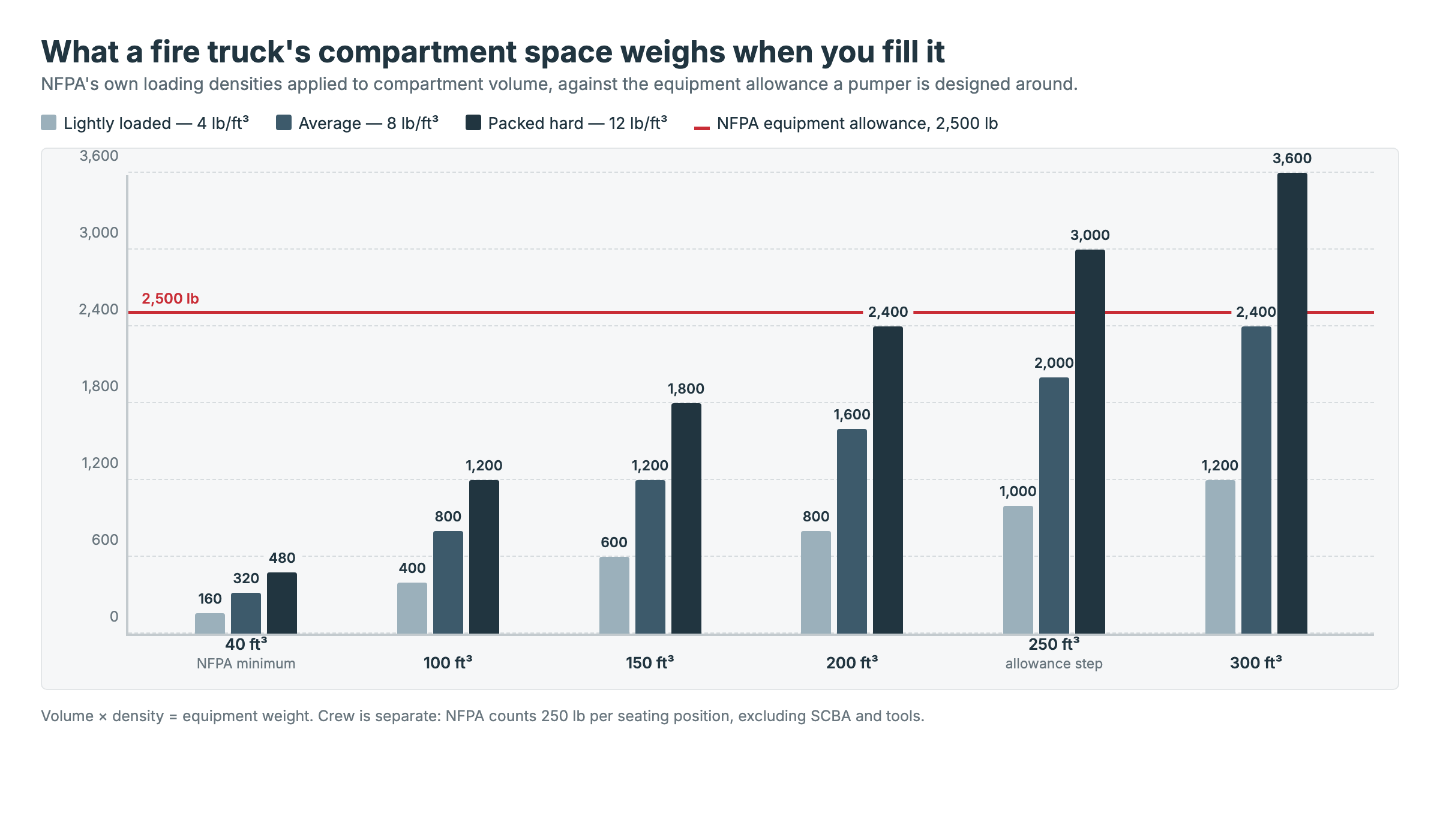
Now compare that against what the truck was designed to carry. NFPA’s miscellaneous equipment allowance for a pumper is 2,000 lb below 250 cubic feet of compartment space and 2,500 lb at 250 cubic feet or more. An aerial gets 2,500 lb. A mobile water supply apparatus gets 1,000 lb.
Read the 250-cubic-foot row again. At average loading it lands at 2,000 lb, right on the design allowance. Packed hard it reaches 3,000 lb, which is 500 lb past the 2,500 lb the chassis was engineered around.
Then add your crew. NFPA 1901 section 12.1.2(4) puts 250 lb in every seating position when the in-service weight is calculated, and the annex is explicit that this figure does not include the weight of SCBA and tools, because those are counted elsewhere.
A ten-seat cab therefore commits 2,500 lb of the truck’s rating to people alone, matching the entire equipment allowance for a large pumper. Seats you do not staff are payload you gave away.
Run the whole calculation against the truck’s axle ratings before you buy. Our guide to what a fire truck weighs covers GVWR, axle limits and where the margin usually disappears.
Should you buy a custom cab or a commercial cab?
Buy a commercial cab when the department staffs three or four, wants the lowest purchase price, and values parts you can get locally. Buy a custom cab when you need six or more seats, a flat crew floor, or the occupant protection that came in with the later NFPA editions.

A commercial chassis puts a fire body on a truck cab that the manufacturer already builds in volume. Parts and service are easier to find, and the purchase price is lower. The tradeoff is seating: the cab was designed for a work crew, not for six firefighters in turnout gear with SCBA in the seat backs.

A custom cab is purpose-built. Widths run from roughly 94¾ to 100 inches, lengths from 57 to 84 inches, with flat or raised roofs. That buys seating capacity, headroom and a flat floor in the crew area.
It also buys protection. Side roll protection and frontal air bags are standard on current custom chassis, and NFPA’s committee is working toward requiring inflatable restraints for outboard seats on structural apparatus. Firehouse documented a quarter rollover in which a side curtain air bag deployed and none of the six belted firefighters on board was injured.
Neither cab is the right answer on its own. Count your staffing, add 250 lb per seat, add your equipment weight, and let the numbers choose.
Frequently asked questions about fire truck cabs and compartments
How many people fit in a fire truck?
Most fire trucks seat between two and ten firefighters. A four-door custom cab commonly seats six, and the largest custom cabs seat ten. The governing number is on a label in the cab, which NFPA requires to be visible to the driver.
How many seats does a fire engine have?
A typical modern engine has four to six seat-belted positions: a driver, an officer, and two to four crew seats in the rear of the cab. NFPA requires a seat and an approved seat belt at every crew riding position.
What is a jump seat on a fire truck?
A jump seat is a crew seat in the rear section of the cab, behind the driver and officer. On apparatus built before 1991, many jump seats sat in open or canopy cabs. Since the 1991 edition of NFPA 1901, every riding position has had to be inside a fully enclosed area with a seat belt.
How much storage space does a fire truck have?
NFPA requires at least 40 cubic feet of enclosed compartment space on a pumper or an aerial, 22 cubic feet on an initial attack apparatus, and 20 cubic feet on a mobile water supply apparatus. Most working pumpers carry well above the minimum.
How much does fire truck equipment weigh?
NFPA’s own figure is about 8 pounds per cubic foot of compartment space at average loading, 4 pounds when lightly loaded, and up to 12 when packed hard. A pumper with less than 250 cubic feet of compartment space is designed around a 2,000 pound equipment allowance, rising to 2,500 pounds at 250 cubic feet and above.
Does every seat on a fire truck need a seat belt?
Yes. NFPA 1901 requires each crew riding position to sit inside a fully enclosed personnel area with a seat and an approved seat belt designed to fit a firefighter with and without heavy clothing. Riding on side or rear platforms has been prohibited since the 1991 edition.
Talk to us about the cab and compartment space you need
Fire Truck Center has been selling quality-tested used fire apparatus since 2015, and every truck we list goes through a 150-point inspection before it reaches a department. Seat belts, SCBA bracket latches and compartment door seals are part of that inspection. Our founder describes how a sale usually closes: in most cases we deliver the truck only after the customer has “come out to our facility for an in-person inspection.”
That’s the honest answer to whether you can judge cab and compartment fit from a listing. You can’t. Sit in the cab, pull the belts, open the doors and read the label.
If you are working out whether a specific truck seats your crew and carries your equipment, call us at (215) 559-9119 or email help@firetruck.center. Tell us your staffing and your equipment list and we will measure the truck against it before you drive anywhere. You can also work through a full used fire truck inspection first.
Sources
- NFPA — NFPA 1900, Standard for Aircraft Rescue and Firefighting Vehicles, Automotive Fire Apparatus, Wildland Fire Apparatus, and Automotive Ambulances (2024 edition)
- Cattaraugus County — NFPA 1901 (2009) Engine Equipment List (PDF)
- Hsiao, H. et al. — Seat and Seatbelt Accommodation in Fire Apparatus: Anthropometric Aspects, Applied Ergonomics (May 2015)
- Fire Engineering — Specifying the Small Stuff (30 August 2024)
- Fire Engineering — Apparatus Supplement, a walkthrough of NFPA 1900 (September 2023, PDF)
- FAMA — NFPA 1900 Review, Spring Meeting (February 2024, PDF)
- Fire Engineering — The NFPA Apparatus Standard: Where We’ve Been, Where We Are Now, and Where We Are Going (31 August 2026)
- Firehouse — Minimizing Over-the-Road Accidents of Fire Apparatus (18 April 2022)
- Volusia County — What’s Changed in 30 Years, NFPA apparatus safety analysis (PDF)
- Pierce Manufacturing — Fire Apparatus Design: A Step-By-Step Guide
- Pierce Manufacturing — Velocity Custom Chassis Specifications
- Pierce Manufacturing — Enforcer Custom Chassis Specifications

 CALL US NOW